Audio-Technica ATH-M60x Monitor Headphones: The Complete Review and Guide
Audio-Technica had an interesting problem. The ATH-M50x had become one of the most successful studio headphones ever made, a fixture in home studios and professional facilities alike, but it was an over-ear design and there was a whole category of work it did not quite fit. Broadcast engineers, camera operators, and anyone working on location wanted something smaller, lighter, and faster to put on and take off. The company’s answer was to take the M50x driver and build a compact on-ear headphone around it. Here is a complete guide to what resulted.
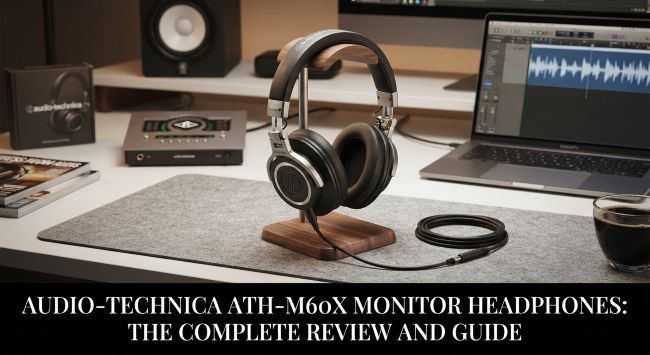
What Are the ATH-M60x?
The Audio-Technica ATH-M60x monitor headphones are closed-back, on-ear professional monitoring headphones, first shown at the NAB Show in 2018 and released later that year. They occupy a distinctive position in Audio-Technica’s M-Series, being the only model in the line to use an on-ear (supra-aural) design rather than the over-ear (circumaural) configuration used by the M20x, M30x, M40x, M50x, and M70x.
The central idea is straightforward: take the proprietary 45 mm large-aperture drivers from the enormously popular ATH-M50x and package them in a smaller, lighter, lower-profile body. The result targets studio, broadcast, and mobile applications, which is exactly where an on-ear design has advantages over the over-ear standard.
Audio-Technica positioned them squarely against the Sennheiser HD 25, the long-standing benchmark for compact professional on-ear monitoring, particularly in broadcast and DJ contexts. That is ambitious company, and it tells you a great deal about the intended use case.
One note on naming: Audio-Technica has since replaced a component and updated the model number to ATH-M60xa. The company has been explicit that this change does not affect performance or specifications, and the two are functionally the same headphone, so anything said here about the ATH-M60x applies equally to the current version.
The Full Specifications
The technical picture behind the Audio-Technica ATH-M60x monitor headphones is worth laying out clearly:
| Specification | Detail |
|---|---|
| Type | Closed-back, on-ear (supra-aural) |
| Drivers | 45 mm large-aperture |
| Magnets | Rare earth (neodymium) |
| Voice coils | Copper-clad aluminum wire |
| Frequency response | 15 Hz to 28 kHz |
| Impedance | 38 ohms |
| Sensitivity | 102 dB/mW |
| Maximum input power | 1,600 mW at 1 kHz |
| Weight | Approximately 200 g (about 7.1 oz), without cable |
| Cables | Three detachable, locking |
| Price at launch | Around $199 |
A few of these numbers matter more than others in practice. The 38 ohm impedance is deliberately low, which means the headphones can be driven properly from portable devices, laptops, and field recorders rather than requiring a dedicated headphone amplifier. Combined with a sensitivity of 102 dB/mW, which is around 5 dB more sensitive than other M-Series models, these are easy to drive from almost anything.
One technical caveat worth knowing: because the impedance is low, it is best to avoid sources with high output impedance, since that can alter the tonal response. Anything under about 5 ohms output impedance is fine, which covers the vast majority of modern devices.
The Driver Story: Same as the M50x, Different Result
The most discussed aspect of the Audio-Technica ATH-M60x monitor headphones is that they use the same 45 mm driver found in the ATH-M50x. That fact leads a lot of people to assume the two must sound identical, and they do not.
Audio-Technica has explained the reason directly. In the M50x, the driver is angled within the earcup. In the M60x, it is mounted flat. That change in orientation, combined with the fundamental difference between sitting on the ear and enclosing it, produces a meaningfully different sonic signature from identical hardware.
The physical relationship between driver and ear matters enormously in headphone design. With an over-ear headphone, your outer ear sits inside the cup and contributes to how you localize sound. With an on-ear design, the driver fires more directly at the ear canal. Reviewers comparing the two consistently report that the M50x gives a greater sense of space and envelopment, while the M60x sounds more direct and immediate.
This is a genuinely interesting example of how much headphone design involves factors beyond the driver itself.
Sound Quality
The sound of the Audio-Technica ATH-M60x monitor headphones has been broadly well received, with a fairly consistent set of observations across professional reviews.
Overall character. The presentation is described as engaging, direct, and dynamic, with a sound that is clear and reasonably balanced. It is a more neutral, less flattering picture than the M50x, which some reviewers considered an advantage for monitoring work and others found less immediately enjoyable for casual listening.
Bass. The low end is present and well defined rather than exaggerated. Compared to the M50x, reviewers describe the bass as cleaner and better separated, though with less of the rich weight that made the M50x such a popular consumer crossover. The depth extends similarly, but the character differs.
Midrange. The mids are frequently praised as tidy, detailed, and with genuine depth. Some listeners who prioritize vocals rate these highly for that reason, though others note the vocal range sits somewhat behind the bass and treble in the overall balance.
Treble. The high end is clear and extended, contributing to the sense of detail, without being harsh in most material.
Distortion. One measurable standout is harmonic distortion, where independent measurement found the M60x performing exceptionally well, described as class-leading against direct competitors at the price. Low distortion contributes to the clean, defined quality reviewers consistently note.
The criticisms. Measurement-based reviews have identified dips in the response around 700 Hz and roughly 3 kHz, which affect tonal accuracy. This is the main reason some reviewers concluded these are not their first choice for detailed mixing work, though the same reviewers rated them highly for monitoring, tracking, and broadcast use.
Taken together, the Audio-Technica ATH-M60x monitor headphones deliver a capable, clean, direct sound that suits monitoring and general listening well, with some tonal quirks that matter more for critical mixing than for most applications.
Build Quality and Design
Build is an area where the Audio-Technica ATH-M60x monitor headphones genuinely impress, and multiple reviewers noted a palpable step up over the M50x.
The construction makes significant use of metal. Adjustable metal yokes hold the earcups, curved metal strips slide for sizing, and the overall feel is more substantial and premium than the largely plastic M50x. One reviewer specifically praised the increase in build quality over both the M50x and the Sennheiser HD 25.
The headband adjusts differently from the M50x, with the sides adjusting on the outside of the headband rather than the inside. The earcups are mounted on gimbals allowing vertical rotation, with a hinged joint permitting a small amount of forward and backward movement for fit.
There is one notable omission: the earcups do not swivel flat and the headphones do not fold, unlike the M50x and M70x. For a product aimed partly at mobile and location use, several reviewers flagged this as a genuine drawback, since folding designs pack down considerably better for transport.
Comfort and Fit
Comfort is where on-ear headphones traditionally struggle, and it is the aspect reviewers were most skeptical about before testing. The consensus afterward was largely positive.
At around 200 grams, the Audio-Technica ATH-M60x monitor headphones are notably light, roughly 2.9 ounces lighter than the M50x. That weight difference is substantial in extended use.
The earpads and headband pad use premium memory foam wrapped in protein leather, creating a snug fit that reviewers repeatedly described as comfortable enough to forget you are wearing them. Several reviewers who explicitly disliked on-ear designs in general reported being won over.
There is also an argument that on-ear designs are more comfortable than over-ear ones for long sessions in warm environments, since they are less claustrophobic and less prone to becoming sweaty. Reviewers working long studio days made exactly this point.
The clamping force is described as snug but not tight. One reviewer noted that the relatively relaxed fit, while comfortable, made them less suitable for active mobile use where a firmer grip would help.
A practical note: the earpads (HP-EP2) and headband pad (HP-HB2) are both easily replaceable, which meaningfully extends the usable life of the headphones. Both are made without animal by-products and are vegan-friendly, as are all M-Series models.
Isolation
Isolation on the Audio-Technica ATH-M60x monitor headphones sits between what over-ear and open-back designs provide, which is precisely the point for some applications. The closed-back on-ear design with memory foam pads gives good but not extreme passive isolation, less than a well-sealed over-ear design would achieve.
Interestingly, reviewers noted that the Audio-Technica ATH-M60x monitor headphones suffer from less sound spill than many other on-ear headphones, which matters when recording acoustic instruments where headphone bleed can reach the microphone. That partially addresses the traditional objection to using on-ear headphones for tracking.
For broadcast work, the moderate isolation is arguably a feature rather than a compromise. Commentators pointed out that on-ear designs give a useful mix of isolation and ambient awareness, letting you hear both your feed and your immediate environment, which is valuable for sports, news, and live situations where being completely cut off is a liability.
The Onboard Level Limiter
A feature that genuinely distinguishes the Audio-Technica ATH-M60x monitor headphones from most competitors is the switchable level limiter, located on the top of the left earcup.
This allows the maximum output level to be capped, serving as hearing protection against sudden loud transients. Anyone who has taken a burst of feedback or an unexpected level spike directly to the ears understands why this matters, and it is a particularly sensible inclusion for broadcast and live work where you cannot always predict what arrives on your feed.
It is a small feature that reviewers consistently singled out as thoughtful, and it is unusual at this price point.
What Comes in the Box
The accessory package supplied with the Audio-Technica ATH-M60x monitor headphones is generous:
- Three detachable cables: a 1.2 m straight cable, a 3.0 m straight cable, and a 3.0 m coiled cable.
- A twist-lock connector securing the cable to the left earcup.
- A 3.5 mm to 6.3 mm (quarter-inch) screw-on adapter.
- A soft protective carrying pouch.
The three-cable arrangement is genuinely useful, covering mobile use with the short cable, studio use with the coiled one, and general connection with the long straight cable. The locking connector is a meaningful improvement over friction-fit designs that work loose, and detachable cables mean the most common failure point on any headphone is a cheap replacement rather than a dead product.
ATH-M60x vs ATH-M50x
The comparison everyone makes between the Audio-Technica ATH-M60x monitor headphones and their over-ear sibling deserves a direct answer:
| Factor | ATH-M60x | ATH-M50x |
|---|---|---|
| Fit | On-ear | Over-ear |
| Driver | 45 mm, mounted flat | 45 mm, angled |
| Weight | About 200 g | About 285 g |
| Folding | No | Yes, swivels and folds |
| Isolation | Good | Better |
| Soundstage | More direct | More spacious |
| Bass | Cleaner, more separated | Richer, weightier |
| Build | More metal, more premium | Largely plastic |
Choose the M50x if you want maximum isolation, a more enveloping soundstage, richer low end, and a folding design for transport. Choose the Audio-Technica ATH-M60x monitor headphones if you want lighter weight, less fatigue over long sessions, better build quality, a more neutral presentation, ambient awareness alongside your monitoring, and a lower profile.
Who These Are For
Based on their design priorities, the Audio-Technica ATH-M60x monitor headphones suit several specific users well:
- Broadcast engineers and operators, which is the application Audio-Technica explicitly designed toward, where the combination of monitoring accuracy and ambient awareness is genuinely useful.
- Location and field recordists, who benefit from the light weight, low impedance, and easy driving from portable recorders.
- Studio engineers doing long sessions, where the reduced fatigue compared to over-ear designs matters.
- Musicians tracking, where the lower spill than typical on-ear designs is helpful.
- Anyone who finds over-ear headphones claustrophobic or hot during extended use.
- Listeners wanting a compact, well-built pair with a clean, detailed presentation.
They are a weaker fit for anyone doing detailed mixing where absolute tonal accuracy is paramount, anyone needing maximum isolation in loud environments, and anyone who prioritizes a folding design for travel.
The Broadcast Connection
Worth noting is that Audio-Technica also released the BPHS2 broadcast headset range based on the design of the Audio-Technica ATH-M60x monitor headphones, adding a hypercardioid dynamic headset microphone on a rigid boom with a flexible gooseneck. That the design was considered a suitable foundation for a dedicated broadcast product reinforces where the company saw its strengths.
Practical Ownership Notes
A few practical considerations apply to living with the Audio-Technica ATH-M60x monitor headphones. Changing the earpads noticeably alters the sound response, more so than with the over-ear M-Series models, so if you replace worn pads it is worth using the correct HP-EP2 replacements rather than third-party alternatives if you care about consistency.
The low impedance means no amplifier is required, which simplifies portable use considerably, though avoiding sources with high output impedance keeps the tonal balance as intended.
The lack of folding means factoring in the space the included pouch occupies, since these do not compress into a small package the way the M50x does.
Is It Worth It?
The honest assessment is that the Audio-Technica ATH-M60x monitor headphones are a well-made, capable, thoughtfully designed pair aimed at a specific set of use cases rather than a universal recommendation.
The build quality is genuinely excellent and exceeds both the M50x and the HD 25 in perceived construction quality. The comfort is far better than on-ear skeptics expect. The level limiter is a smart and unusual inclusion. The three-cable accessory package and replaceable pads represent real value. The measured distortion performance is genuinely impressive at the price.
Against that, the tonal dips noted in measurement mean these are not the most accurate option for critical mixing, the isolation is moderate rather than exceptional, and the non-folding design undermines the mobility case somewhat.
For broadcast, location work, long studio sessions, and anyone who wants M-Series sound in a lighter package, they earn their place. For pure mixing accuracy or maximum isolation, other options serve better.
The bottom line on the Audio-Technica ATH-M60x monitor headphones is that they take the proprietary 45 mm drivers from the acclaimed ATH-M50x and mount them flat in a compact, closed-back, on-ear body weighing around 200 grams, producing a more direct and neutral presentation than their over-ear sibling. With 38 ohm impedance and 102 dB sensitivity they drive easily from anything, the metal-heavy construction outclasses much of the competition, the memory foam pads deliver genuine long-session comfort, and the onboard level limiter and three detachable locking cables are thoughtful touches. They excel at broadcast, location, and monitoring work, and are a compelling choice for anyone who wants M-Series sound without the bulk.
Key Takeaways
- The ATH-M60x are closed-back, on-ear professional monitor headphones, the only on-ear model in Audio-Technica’s M-Series.
- They use the same proprietary 45 mm large-aperture drivers as the ATH-M50x, but mounted flat rather than angled.
- That mounting change plus the on-ear design produces a more direct, more neutral sound than the M50x.
- Key specs include 15 Hz to 28 kHz frequency response, 38 ohm impedance, 102 dB sensitivity, and about 200 g weight.
- The low impedance and high sensitivity mean they drive easily from phones, laptops, and field recorders without an amplifier.
- Build quality uses significant metal and was rated by reviewers above both the M50x and the Sennheiser HD 25.
- Memory foam earpads and headband deliver comfort that won over reviewers who normally dislike on-ear designs.
- An onboard switchable level limiter on the left earcup provides hearing protection against sudden level spikes.
- Three detachable locking cables (1.2 m straight, 3.0 m straight, 3.0 m coiled), an adapter, and a pouch are included.
- The earcups do not fold or swivel flat, and measured dips around 700 Hz and 3 kHz make them better suited to monitoring than critical mixing.