Rainy Day Activities for Kids: Ideas That Actually Work
There is a particular moment familiar to every parent: the rain settles in for the day, the words “I’m bored” arrive before ten in the morning, and the prospect of hours indoors with restless children starts to feel genuinely long. The solution is not an elaborate Pinterest project requiring supplies you do not own. It is having a mental list of things that reliably work, use what is already in the house, and buy you a decent stretch of engaged, occupied time. Here are rainy day activities for kids that genuinely deliver.
Indoor Physical Activities
The first problem to solve is energy. Children who normally run around outside need somewhere for that to go, and skipping this step guarantees difficulty later.
- Indoor obstacle course, built from cushions, chairs, blankets, and tape lines on the floor. Timing each attempt adds competitive appeal.
- Balloon volleyball or keepy-uppy, where the rule is simply that the balloon must not touch the ground.
- Dance parties, with each family member choosing a song in turn.
- Animal movement games, hopping like frogs, crawling like bears, and similar, which work particularly well for younger children.
- Indoor bowling, using plastic bottles and a soft ball.
- Simon says and freeze dance, which require nothing at all and can start instantly.
These are the highest-value rainy day activities for kids precisely because they address restlessness rather than suppressing it.
Building and Construction
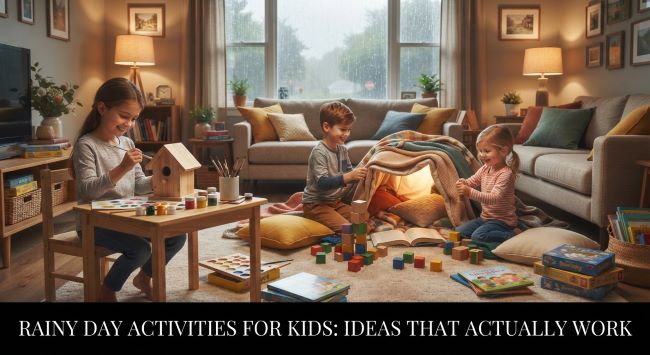
Building projects reliably absorb long stretches, making them essential among rainy day activities for kids. Blanket forts are the classic for good reason, since building one is an activity and the fort then becomes a base for reading, snacks, or games afterward. Cardboard box construction is similarly effective, with large boxes becoming rockets or castles. Blocks and construction toys work best given a challenge, like the tallest tower that survives a shake, rather than left open-ended.
Creative Projects
Arts and crafts are the traditional answer to rainy day activities for kids, working best when the setup is realistic about mess:
| Activity | What You Need |
|---|---|
| Drawing and coloring | Paper, pencils, crayons |
| Painting | Paints, paper, protected surface |
| Collage | Old magazines, glue, scissors |
| Playdough | Homemade from flour, salt, water |
| Homemade cards | Card, decorations |
| Comic strips | Paper folded into panels |
Homemade playdough deserves mention, since making it is itself an activity that then provides extended play. A mix of flour, salt, water, and oil works, with food coloring added.
A prompt produces better engagement than a blank page. Asking children to draw a monster that is afraid of something gives their imagination somewhere to start.
Kitchen Activities
Cooking combines occupation, learning, and a reward. Options include decorating cookies, assembling pizzas with chosen toppings, no-bake treats, or building sandwiches into shapes. Cooking incidentally teaches measuring and sequencing. Adults handle anything hot or sharp while children do the mixing, pouring, and decorating.
Games and Puzzles
Traditional options remain among the most reliable rainy day activities for kids. Board games, card games, and puzzles occupy substantial time and involve everyone.
Indoor hide and seek, scavenger hunts with a written list, charades, and twenty questions require no equipment at all. A treasure hunt with clues leading room to room takes ten minutes to set up and occupies children far longer.
Simple Science Experiments
Kitchen science is a reliably popular category of rainy day activities for kids, since the results feel genuinely surprising:
- Baking soda and vinegar reactions, the classic, done in a tray to contain the mess.
- Growing crystals from salt or sugar solutions, which extends across days.
- Sink or float, testing household objects in a bowl of water.
- Making slime or oobleck from cornstarch and water, which behaves strangely enough to hold attention.
- Rain gauge, actually using the weather by measuring the rainfall outside.
These deliver a sense of discovery, and most use ingredients already in the kitchen cupboard.
Quiet Time Options
Not every hour needs to be active. Reading together, audiobooks, jigsaw puzzles, and drawing all provide genuine downtime, and a reading nook built from cushions makes reading feel like an event rather than an instruction. Screen time is a legitimate part of the mix, and a deliberate chosen film with snacks works better than open-ended scrolling.
Getting Out of the House
Sometimes the best rainy day activities for kids happen elsewhere, since a change of environment resets everyone’s mood. Options include libraries, museums, play centers, pools, and bowling alleys.
Indoor mini golf is a particularly good option, working across a wide age range and giving everyone something to do together without requiring much organization. The guide to Mini Golf Near Me covers finding courses in your area, which is genuinely useful for rainy days since indoor courses turn a washed-out afternoon into an outing, and it is one of the few activities that works equally well for young children and teenagers who consider themselves too old for most things.
Making It Work
A few points help. Rotate between active and calm rather than doing everything energetic at once. Involve children in choosing, since ownership improves engagement. Keep unopened craft supplies in reserve for difficult days, accept that mess is part of it, and do not feel obliged to entertain constantly, since some boredom genuinely prompts children to invent their own games.
The bottom line on rainy day activities for kids is that a wet day only becomes difficult when you are improvising from scratch. Start with something physical to burn off energy, move into building projects or creative work that absorb long stretches, use kitchen activities and simple science for novelty, and keep games, puzzles, and quiet reading in reserve. If everyone is climbing the walls, an outing to somewhere indoors like mini golf or a library resets the whole day. Rotate between active and calm, let children help choose, and keep one surprise in reserve for the worst afternoons.
Key Takeaways
- Start with physical activities like indoor obstacle courses, balloon games, and dance parties to address restless energy.
- Blanket forts and cardboard box construction absorb long stretches and create ongoing play afterward.
- Creative projects work best with a prompt rather than a blank page, and homemade playdough doubles as activity and toy.
- Cooking and baking combine occupation, learning, and a reward, with adults handling anything hot or sharp.
- Board games, card games, puzzles, scavenger hunts, and charades remain reliably effective and often need no equipment.
- Kitchen science like baking soda reactions, growing crystals, and making oobleck delivers genuine surprise.
- Balance active time with quiet options like reading nooks, audiobooks, and puzzles.
- Deliberate screen time with a chosen film works better than open-ended scrolling.
- Indoor outings to libraries, museums, play centers, or mini golf reset the mood when everyone is restless.
- Rotate active and calm activities, involve children in choosing, and keep a surprise supply in reserve.