How to Remove Plaque From Teeth: Safe Methods That Actually Work
Run your tongue across your teeth at the end of a long day and you will feel it: a fuzzy film that was not there this morning. That film is plaque, a sticky layer of bacteria that forms constantly, and managing it is the single most important thing you can do for oral health. The good news is that fresh plaque is genuinely easy to remove with the right daily habits. The catch is that plaque you let sit hardens into tartar, which no home method can remove. Here is the guide to how to remove plaque from teeth safely, what actually works, and where the line is between what you can do at home and what needs a professional, with the note that a dentist is the authority on your specific mouth.
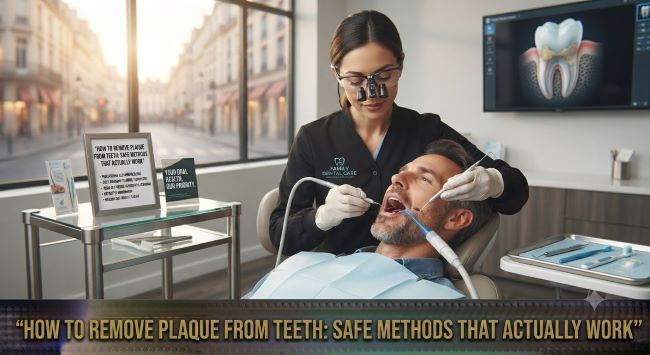
A Note Before You Read On
This article is general information, not dental advice. Only a dentist or dental hygienist can assess your oral health and recommend treatment for your specific situation. Bleeding gums, persistent bad breath, tooth sensitivity, and visible buildup can signal problems that warrant professional evaluation rather than home management alone. Use this guide to build good habits, and see a dentist regularly for the professional care that home care cannot replace.
What Plaque Actually Is
Understanding plaque explains how to remove it. Plaque is a soft, sticky biofilm of bacteria that forms on teeth continuously, feeding on sugars and starches from food. Left alone, the bacteria produce acids that attack tooth enamel (causing cavities) and irritate gums (causing gum disease). This is why removing plaque daily matters so much: it is the root cause of the two most common dental problems.
The critical distinction: plaque is soft and removable at home, but if it stays on teeth for a day or two, it hardens into tartar (also called calculus), a rock-hard deposit that bonds to the tooth and can only be removed by a dental professional with special tools. The entire goal of home plaque control is removing plaque before it becomes tartar.
How to Remove Plaque From Teeth at Home
The effective methods for how to remove plaque from teeth are the familiar ones done properly and consistently:
Brush correctly, twice a day. The foundation. But technique matters more than most people realize:
- Brush for a full two minutes, twice daily.
- Hold the brush at a 45-degree angle to the gumline, where plaque concentrates.
- Use gentle circular motions, not hard back-and-forth scrubbing, which damages enamel and gums without removing plaque better.
- Reach all surfaces of every tooth: outer, inner, and chewing.
- Do not forget the gumline and the back teeth, the most commonly missed spots.
Floss daily. Brushing misses the surfaces between teeth entirely, where much plaque and decay develops. Flossing is not optional; it reaches what the brush cannot. Water flossers are an effective alternative for those who struggle with string floss.
Use an antibacterial or fluoride mouthwash. It reaches areas brushing and flossing miss and reduces plaque-forming bacteria, supplementing but not replacing brushing and flossing.
Consider an electric toothbrush. Electric brushes, especially oscillating and sonic models, remove more plaque than manual brushing for most people, since they do the motion correctly and include timers.
The Tools That Help
Beyond technique, a few tools improve how to remove plaque from teeth:
| Tool | What It Does |
|---|---|
| Soft-bristled toothbrush | Removes plaque without damaging enamel or gums |
| Electric toothbrush | More effective plaque removal for most users |
| Dental floss | Cleans between teeth where brushing cannot reach |
| Water flosser | Alternative between-teeth cleaning, good for braces |
| Interdental brushes | Clean larger gaps and around dental work |
| Fluoride toothpaste | Strengthens enamel against acid attack |
| Tongue scraper | Removes bacteria from the tongue surface |
A soft-bristled brush is specifically recommended, since hard bristles damage enamel and gums without cleaning better.
What to Avoid
Some popular takes on how to remove plaque from teeth do more harm than good:
- Do not use hard-bristled brushes or scrub aggressively. This wears down enamel and causes gum recession, both permanent.
- Do not use DIY dental scrapers or picks to remove tartar yourself. Dental scaling tools in untrained hands damage the enamel and gums and can cause injury and infection. Tartar removal is a professional job.
- Be cautious with abrasive DIY whitening trends like baking soda used aggressively or acidic mixtures, which can erode enamel over time.
- Do not rely on “natural” remedies alone to replace brushing, flossing, and dental visits.
The general principle: gentle, consistent, proper technique beats aggressive scrubbing or DIY tools every time.
Diet’s Role in Plaque
What you eat directly affects plaque formation, so diet is part of how to remove plaque from teeth:
- Limit sugary and starchy foods, which feed the bacteria that form plaque.
- Reduce snacking frequency, since every time you eat, bacteria produce acid, so constant snacking means constant acid.
- Drink water, especially after eating, to rinse away food particles and sugars.
- Eat crunchy fruits and vegetables, which help mechanically clean teeth.
- Limit sugary drinks, which coat teeth in sugar for extended periods.
When You Need a Professional
Knowing how to remove plaque from teeth at home controls it, but home care cannot do everything, and this is where the honest limits matter. Once plaque hardens into tartar, only professional cleaning removes it, which is why dentists recommend cleanings typically every six months. Regular professional cleanings remove the tartar that inevitably builds up even with good home care, and dental checkups catch problems while they are small and inexpensive to fix.
Neglected plaque and tartar lead directly to cavities and gum disease, and cavities that develop require professional treatment. If home care has slipped and decay has set in, comparing options like Dental Fillings Near Me becomes the next step, which is exactly the expensive outcome that consistent daily plaque removal is designed to prevent in the first place.
The bottom line on how to remove plaque from teeth: brush properly twice daily, floss every day, use supporting tools, watch your diet, and see a dentist regularly. Do those consistently, and you control the root cause of most dental problems before it ever becomes something a dentist has to fix.
Key Takeaways
- Consult a dentist or hygienist for your specific situation; this is general information, and bleeding gums or buildup warrant professional evaluation.
- Plaque is a soft bacterial film that forms constantly and is easy to remove at home; left on teeth, it hardens into tartar that only a professional can remove.
- Brush two minutes twice daily at a 45-degree angle to the gumline with gentle circular motions, not hard scrubbing.
- Floss daily to clean between teeth where brushing cannot reach, using a water flosser as an alternative if needed.
- A soft-bristled or electric toothbrush and fluoride toothpaste are the core tools; add mouthwash to supplement.
- Never use DIY scrapers to remove tartar yourself, and avoid hard bristles and abrasive DIY trends that damage enamel.
- Limit sugary and starchy foods, reduce snacking frequency, and drink water to reduce plaque formation.
- See a dentist roughly every six months, since only professional cleaning removes hardened tartar and catches problems early.