How AI-Powered Healthcare Security Systems Are Transforming Smart Hospitals in 2026
Healthcare is becoming smarter every year, but it is also becoming more complex to secure. Modern hospitals are no longer just medical facilities. They are connected ecosystems filled with patients, staff, visitors, medical devices, pharmacies, data centers, and sensitive health information that require continuous protection.
The need for stronger security has never been greater. According to the American Hospital Association, the United States has over 6,000 hospitals serving millions of patients each year. At the same time, incidents involving workplace violence in healthcare continue to rise, with healthcare workers experiencing significantly higher rates of workplace violence than employees in most other industries. Hospitals are also investing heavily in digital transformation, with the global smart hospital market projected to surpass $100 billion within the next decade, making physical security just as important as cybersecurity.
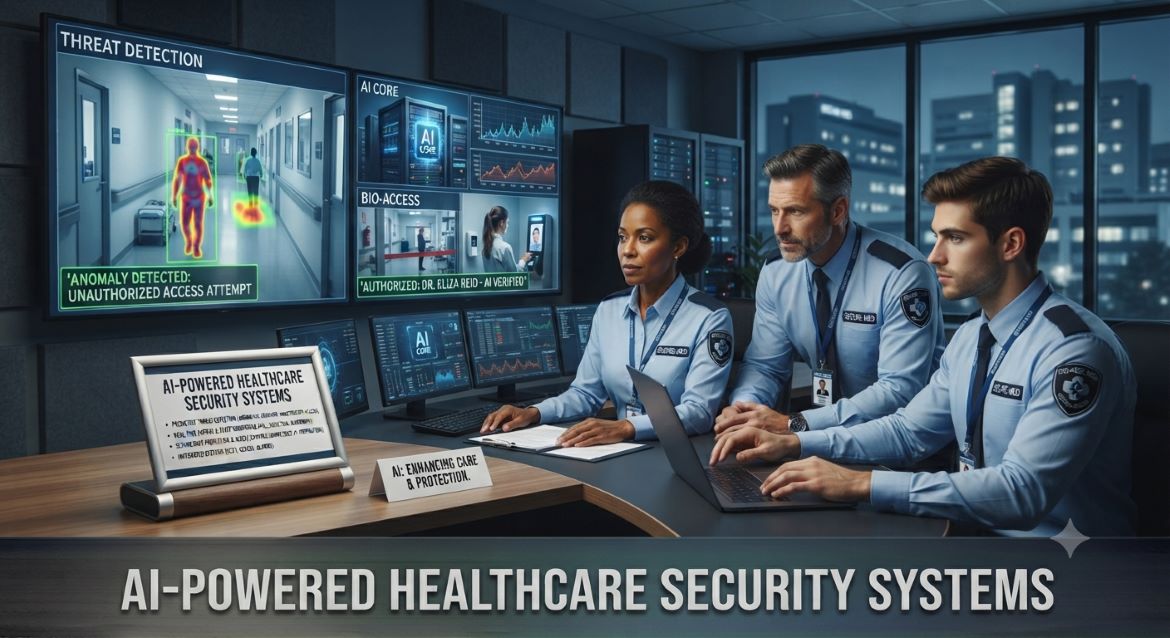
Traditional CCTV systems can record incidents, but they often depend on security personnel to notice problems after they occur. AI is changing that approach by helping hospitals detect risks in real time, automate monitoring, and respond faster during emergencies.
In this article, you’ll learn how an AI-powered healthcare security system is transforming smart hospitals in 2026, improving patient safety, supporting healthcare staff, and making hospital operations more efficient.
1. AI Is Shifting Hospital Security from Reactive to Proactive
For decades, hospital surveillance relied on security teams watching dozens of camera feeds simultaneously. While this approach records incidents, it is difficult for people to monitor hundreds of cameras without missing critical events.
AI changes this by continuously analysing video streams and automatically identifying suspicious behaviour, restricted area access, abandoned objects, unusual movement, or emergency situations.
Instead of waiting for someone to discover an incident, AI immediately notifies the appropriate staff, allowing them to respond before a situation escalates.
For busy emergency departments, pharmacies, maternity wards, and surgical wings, this proactive monitoring significantly improves situational awareness while reducing the workload on security teams.
Some common AI capabilities include:
- Real-time suspicious activity detection
- Unauthorised access alerts
- Crowd monitoring
- Weapon detection
- Intelligent video search
- Automated incident notifications
Hospitals are moving beyond simply recording footage. They are using AI to actively protect patients, visitors, and healthcare professionals.
2. Modern Healthcare Security Systems Create Faster Emergency Response
Every second matters during a hospital emergency.
Whether it involves an aggressive visitor, an unauthorised individual entering a restricted area, or a potential weapon threat, security teams need immediate visibility.
Modern healthcare security system platforms such as Coram demonstrate how AI can improve emergency response without requiring hospitals to replace their existing IP cameras. According to Coram, its HIPAA-compliant platform works with existing infrastructure while providing 24/7 monitoring, real-time AI alerts, access control integration, environmental sensor integration, and intelligent firearm detection designed specifically for healthcare environments. The platform also helps reduce false alarms by using multiple AI models and securely processes video to support patient privacy requirements.
Rather than relying solely on human observation, hospitals receive instant alerts that help security personnel assess situations and respond much faster.
This approach is especially valuable in emergency departments, pharmacies, data centres, and restricted clinical areas where delays can have serious consequences.
3. Better Patient Safety Through Continuous Intelligent Monitoring
Patient safety extends far beyond preventing crime.
Hospitals constantly monitor patients who may be at risk of falls, wandering, or unauthorised movement.
AI-powered video analytics helps staff identify these situations sooner without requiring someone to continuously watch live video.
For example, AI can recognise when:
- A patient enters a restricted area
- Someone remains in a sensitive location unusually long
- A patient leaves a monitored zone unexpectedly
- Unusual movement patterns suggest a potential emergency
Research into AI-based patient monitoring has demonstrated strong accuracy in recognising patient activity and identifying situations associated with fall risk and patient isolation, showing how intelligent video analysis can support clinical teams.
This allows healthcare workers to spend more time caring for patients instead of constantly monitoring surveillance screens.
4. AI Improves Hospital Operations Beyond Security
One of the biggest advantages of AI is that it supports operational efficiency alongside security.
Hospitals generate enormous amounts of activity every day, including staff movement, visitor traffic, deliveries, equipment transfers, and patient flow.
AI helps administrators understand these patterns without manually reviewing hours of footage.
Hospitals can use video analytics to:
- Identify congestion in waiting areas
- Analyse visitor traffic
- Monitor delivery zones
- Improve emergency department workflows
- Verify staff movement in restricted departments
These insights help reduce delays, improve resource allocation, and enhance the overall patient experience.
In 2026, many hospitals view AI surveillance as both a security investment and an operational intelligence tool.
5. Healthcare Facilities Can Strengthen Compliance and Privacy
Healthcare security is different from security in retail or commercial buildings because patient privacy must always remain a priority.
Modern AI platforms are increasingly designed to support privacy requirements while improving visibility.
Hospitals also need secure storage, controlled access to recordings, audit trails, and clear policies regarding who can access surveillance footage.
Recent healthcare guidance has also emphasised limiting surveillance inside treatment areas while focusing monitoring on entrances, corridors, restricted departments, and other appropriate locations to balance safety with patient privacy.
A properly designed AI security strategy helps hospitals improve both compliance and physical security.
6. Existing Infrastructure Can Become Smarter Without Complete Replacement
Many hospitals hesitate to modernise because they assume AI requires replacing every camera.
Fortunately, that is no longer true.
Many AI platforms are designed to integrate with existing IP camera infrastructure, allowing healthcare organisations to modernise gradually instead of starting from scratch.
This offers several advantages:
- Lower upgrade costs
- Faster deployment
- Reduced disruption to hospital operations
- Better return on existing security investments
- Easier expansion as facilities grow
For large healthcare networks operating hundreds of cameras across multiple buildings, this flexibility makes AI adoption far more practical.
7. Smart Hospitals Will Continue Investing in AI Security
The hospital of 2026 is becoming increasingly connected.
Access control systems, surveillance cameras, emergency response platforms, environmental sensors, visitor management, and AI analytics are beginning to work together as one intelligent ecosystem.
Instead of treating security as a standalone department, hospitals are integrating AI across daily operations to improve safety, reduce response times, and support better decision-making.
As hospitals continue adopting smart technologies, AI-powered security will become a foundational part of healthcare infrastructure rather than an optional upgrade.
Organisations that invest today will be better prepared to protect patients, healthcare professionals, and critical medical assets in the years ahead.
Frequently Asked Questions
What is a healthcare security system?
A healthcare security system combines surveillance cameras, access control, alarms, AI analytics, and monitoring technologies to protect patients, staff, visitors, medical equipment, and sensitive hospital areas.
How does AI improve hospital security?
AI analyses live video feeds to detect suspicious activity, unauthorised access, potential threats, and unusual behaviour in real time, allowing hospitals to respond much faster than traditional surveillance systems.
Can hospitals use AI with existing cameras?
Yes. Many modern AI security platforms are designed to integrate with existing IP cameras, reducing upgrade costs while improving monitoring capabilities.
Why is AI becoming important for smart hospitals?
As hospitals become more connected and operate around the clock, AI helps improve patient safety, automate monitoring, strengthen operational efficiency, and support faster emergency response.
Conclusion
AI is transforming hospital security from passive video recording into intelligent, real-time protection. From improving emergency response and patient safety to supporting compliance and operational efficiency, AI-powered security systems are helping hospitals meet the growing demands of modern healthcare.
As smart hospitals continue to evolve in 2026, adopting an intelligent healthcare security system will become less about adding new technology and more about creating a safer environment for everyone who enters the facility. The question is no longer whether hospitals should embrace AI-driven security, but how quickly they can implement it effectively.