POE Trade: A Complete Guide to Trading in Path of Exile
Path of Exile’s economy is built almost entirely around player-to-player trading, since the game deliberately doesn’t include a fully automated auction house system, instead relying on a combination of an official trade search website and direct player communication to complete transactions. Understanding how this system actually works, both the official trade tools and the broader trading etiquette and strategy involved, makes a significant difference in how efficiently you can gear up your character throughout a league.
What POE Trade Actually Is
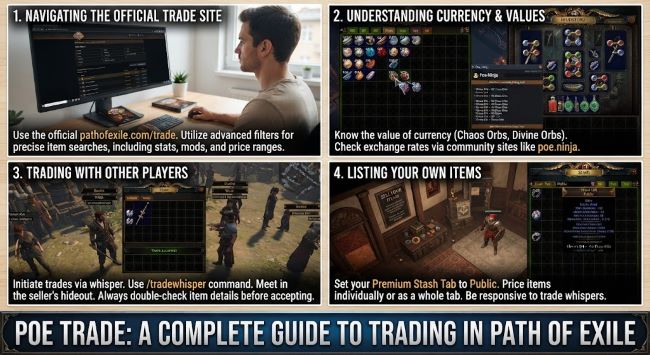
“POE trade” most commonly refers to the official Path of Exile Trade website (pathofexile.com/trade), Grinding Gear Games’ official tool for searching publicly listed items that other players have made available for trade. This isn’t a fully automated marketplace — finding an item you want through the search tool generates contact information for the seller, and completing the actual transaction requires direct in-game communication and a manual trade between both players.
This player-driven trading model, while requiring more manual effort than a fully automated auction house, is a deliberate design choice that’s remained largely consistent throughout the game’s development, with the official trade website itself being a major quality-of-life addition that significantly streamlined what was previously an even more manual, forum-post-based trading system in the game’s earlier years.
How to Use the Official POE Trade Website
Step 1: Navigate to pathofexile.com/trade and select your current league from the dropdown menu, since item listings are league-specific and searching the wrong league will show irrelevant or unavailable results.
Step 2: Use the search filters to specify exactly what you’re looking for — item type, specific modifiers (affixes) you want, modifier value ranges, item level requirements, and other relevant criteria depending on what you’re shopping for.
Step 3: Review search results, which display available listings sorted by price (typically ascending by default), along with the seller’s account name and whether they currently appear to be online.
Step 4: Click “whisper” on a listing you want to purchase, which generates a pre-filled in-game chat message to send to the seller, initiating contact about the trade.
Step 5: Once the seller responds and confirms the item is still available, they’ll typically invite you to their hideout (an instanced personal area) to complete the trade safely, using the game’s trade window to ensure both parties receive what was agreed upon simultaneously.
Understanding Currency in POE Trade
Path of Exile doesn’t use a single universal gold-style currency for trading. Instead, various in-game currency items (Chaos Orbs, Divine Orbs, Exalted Orbs, and many others, each with specific crafting functions beyond just trading value) serve as the de facto trading currency, with their relative value to each other fluctuating throughout a league based on supply, demand, and how useful each currency type is for the crafting meta at that point in the league’s lifecycle.
Chaos Orbs have traditionally served as the baseline “common” trading currency for lower and mid-value items, though this has shifted somewhat in more recent league cycles as the overall in-game economy has evolved.
Divine Orbs have become an increasingly important higher-value currency, often used for pricing more valuable items, with the Chaos-to-Divine exchange ratio being one of the most closely watched economic indicators players track throughout a league.
Exalted Orbs and various other specialty currencies serve specific crafting functions while also carrying trading value, with their relative worth shifting based on current crafting strategies popular within that specific league.
Checking current exchange rates through community resources or the trade site’s currency exchange feature, rather than assuming rates from a previous league still apply, is important since these values can shift significantly between leagues and even throughout a single league’s progression.
Pricing Your Own Items Correctly
When listing items for sale through the in-game stash tab pricing system (which feeds into the official trade website’s search results), researching comparable listings for similar items before setting your price helps avoid either underpricing valuable items or overpricing items in a way that results in no buyer interest. The trade website itself is the most direct tool for this research, since you can search for items similar to what you’re selling and see what comparable listings are currently priced at.
Trading Etiquette and Safety
Respond promptly to trade whispers when you’re the seller, since buyers often message multiple sellers for similar items and will complete a trade with whoever responds and confirms availability first.
Honor your listed price rather than attempting to negotiate upward once a buyer has already contacted you based on your listed price, since this practice (sometimes called price-gouging mid-trade) is widely considered poor trading etiquette within the community and can result in being reported or blocked by frustrated buyers.
Use the official in-game trade window for all transactions rather than agreeing to any kind of “trust-based” exchange outside the proper trade mechanism, since the trade window ensures both parties simultaneously receive their agreed-upon items, eliminating the scam risk inherent in any informal exchange arrangement.
Be patient with response times, since sellers aren’t always immediately available, and whispering multiple sellers for the same or similar items simultaneously is generally accepted practice given the asynchronous nature of the system.
Keep your stash tabs organized and accurately priced if you’re actively selling regularly, since outdated pricing (items priced based on early-league values that no longer reflect current market conditions) creates frustration for both you and potential buyers.
Third-Party Tools That Complement Official POE Trade
Various community-built tools and websites supplement the official trade site, including price-checking tools that help you quickly evaluate an item’s likely market value, and currency exchange tracking sites that show historical and current exchange rates between different currency types throughout a league. These tools are widely used and generally accepted within the community, though it’s worth sticking to well-established, reputable community tools rather than unfamiliar third-party sites, particularly any that request account credentials or claim to offer trading functionality beyond what the official systems provide.
Key Takeaways
- POE trade primarily refers to the official Path of Exile Trade website, a search tool for finding player-listed items that requires manual in-game contact and a trade window exchange to actually complete a purchase, rather than a fully automated auction house
- Currency in Path of Exile isn’t a single universal gold system: various orb types (Chaos, Divine, Exalted, and others) serve as trading currency with fluctuating relative value throughout each league
- Researching comparable listings on the trade website before pricing your own items helps avoid significantly underpricing or overpricing items relative to current market conditions
- Trading etiquette matters in this player-driven system: respond promptly as a seller, honor your listed price rather than negotiating upward mid-trade, and always use the official trade window rather than any informal exchange arrangement
- Checking current currency exchange rates regularly is important since values shift meaningfully between leagues and even throughout a single league’s progression as the crafting meta evolves
- Reputable third-party price-checking and currency tracking tools widely supplement the official trade site, though caution is warranted around any unfamiliar site requesting account credentials