
Are Rice Krispies Gluten Free? The Surprising Answer
This is one of the more commonly misunderstood gluten questions in the grocery aisle, because the intuitive assumption — rice doesn’t contain gluten, so a cereal made from rice should be gluten free — turns out to be wrong for the original product. Understanding exactly why, and what your actual options are, matters if you’re managing celiac disease or a gluten sensitivity.
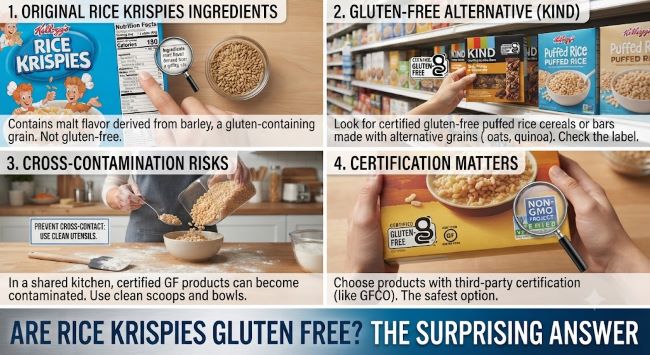
Are Original Rice Krispies Gluten Free?
No, original Kellogg’s Rice Krispies are not gluten free. While the cereal is primarily made from rice, it contains malt flavoring, which is derived from barley — a gluten-containing grain. This single ingredient is enough to disqualify the original formula from being considered gluten free, despite rice itself being naturally gluten-free.
This surprises a lot of people because the cereal looks and tastes like it should be a simple rice product, and the gluten-containing ingredient (malt flavoring) is a relatively minor component by volume, used for flavor rather than as a structural ingredient. But for anyone with celiac disease, even small amounts of gluten from ingredients like malt flavoring can trigger a reaction, so the quantity doesn’t change the answer.
Why Malt Flavoring Contains Gluten
Malt flavoring is typically derived from malted barley, a process where barley grains are soaked, germinated, and then dried, developing distinctive flavor compounds used widely in food manufacturing for their characteristic sweet, toasty flavor. Because the source grain is barley, the malt flavoring itself retains gluten proteins, even though it’s used in relatively small quantities in products like Rice Krispies.
This is a common pattern across many processed foods: an otherwise gluten-free base ingredient (rice, in this case) gets combined with a flavor or processing ingredient derived from a gluten-containing grain, making the final product unsuitable for a gluten-free diet even though the primary ingredient wouldn’t be a problem on its own.
Gluten-Free Rice Krispies Alternatives
Kellogg’s Rice Krispies Gluten Free. Kellogg’s does produce a dedicated gluten-free version of Rice Krispies, reformulated without the barley malt flavoring and explicitly labeled “Gluten Free” on the box. This version is certified to meet the FDA’s gluten-free labeling standard (under 20 parts per million) and is widely available at most major grocery stores, typically in the same cereal aisle as the original, though sometimes also stocked in a dedicated gluten-free or health food section.
Store brand “crispy rice” cereals labeled gluten free. Many store brands (including Trader Joe’s, Whole Foods 365, and various supermarket private labels) produce their own crispy rice cereal specifically formulated and labeled gluten free, generally at a lower price point than the Kellogg’s gluten-free version.
Erewhon Crispy Brown Rice Cereal. A widely available organic, gluten-free crispy rice cereal option, often found in natural foods sections, made without malt flavoring or other gluten-containing ingredients.
One Degree Organic Sprouted Brown Rice Crisps. Another widely available certified gluten-free crispy rice cereal option focused on organic and sprouted grain ingredients.
How to Verify Any Product Is Genuinely Gluten Free
Look for explicit “Gluten Free” labeling, which in the US means the product meets the FDA’s regulatory standard of containing fewer than 20 parts per million of gluten — this labeling claim is legally regulated and meaningful, not just a marketing term.
Check for a certification mark from organizations like the Gluten-Free Certification Organization (GFCO), which conducts independent testing and provides an additional layer of verification beyond the manufacturer’s own labeling claim.
Read the full ingredient list, watching specifically for wheat, barley, rye, malt, malt flavoring, malt extract, brewer’s yeast, and modified food starch (which can sometimes derive from wheat, though most modified food starch in the US is corn-based — when in doubt, products specifically labeled gluten free have already verified this for you).
Don’t assume based on the primary ingredient alone. As the Rice Krispies example demonstrates clearly, a product’s main ingredient being naturally gluten-free (rice) doesn’t guarantee the finished product is gluten free once flavoring, processing aids, or other minor ingredients are factored in.
Watch for cross-contamination disclosures. Some products are made with genuinely gluten-free ingredients but are produced in facilities that also process wheat, which can trigger reactions in highly sensitive individuals even without gluten-containing ingredients directly in the recipe — look for “may contain wheat” or “processed in a facility that also processes wheat” disclosures if you have a severe sensitivity.
Other Common Cereals With This Same Issue
Rice Krispies isn’t unique in this pattern. Several other cereals that seem like they should be naturally gluten-free due to their primary grain contain malt flavoring or malt extract that makes the original formula unsuitable for a gluten-free diet, including some corn-based cereals and certain puffed rice products from other brands. This is a useful general lesson: always check the full ingredient list and labeling rather than assuming based on the cereal’s primary grain.
Why This Confusion Matters Beyond Just One Cereal
The Rice Krispies example is worth understanding deeply because it illustrates a pattern that trips up newly diagnosed celiac patients and gluten-sensitive individuals constantly during the early adjustment period after diagnosis. The instinct to categorize foods by their primary grain — “this is a rice product, so it’s fine” or “this is a corn product, so it’s fine” — is a reasonable starting heuristic but an unreliable one for actually staying safe on a gluten-free diet.
Many people newly navigating a gluten-free diet initially focus heavily on avoiding the obvious sources (bread, pasta, baked goods made from wheat flour) while inadvertently consuming gluten through less obvious sources like flavorings, sauces, soy sauce (traditionally made with wheat), certain candies, and processed snack foods that use malt or wheat-derived ingredients in small quantities for flavor or texture purposes rather than as a primary structural ingredient.
This is part of why celiac disease education programs and registered dietitians who specialize in gluten-free diets consistently emphasize ingredient list literacy over grain-type assumptions as the foundational skill for managing the condition safely and confidently over the long term.
Cross-Contamination Considerations Beyond Ingredients
Even when a product’s ingredient list is genuinely gluten-free, manufacturing facility cross-contamination remains a relevant consideration for individuals with celiac disease specifically, as opposed to those managing a milder gluten sensitivity. Some gluten-free certified products are produced on dedicated gluten-free production lines with no cross-contamination risk, while others are produced on shared equipment that also processes wheat-containing products, with rigorous cleaning protocols between runs that reduce but may not entirely eliminate trace cross-contamination risk.
For most people with non-celiac gluten sensitivity, this level of caution is generally unnecessary. For people with celiac disease, particularly those who continue experiencing symptoms despite following a seemingly careful gluten-free diet, investigating manufacturing facility practices for specific brands and products — information often available directly from manufacturer customer service or detailed on company websites — can be an important troubleshooting step.
Key Takeaways
- Original Kellogg’s Rice Krispies are not gluten free because they contain malt flavoring derived from barley, despite rice itself being naturally gluten-free
- Malt flavoring is a common food industry ingredient that introduces gluten into products that would otherwise be gluten free based on their primary ingredients
- Kellogg’s makes a dedicated Rice Krispies Gluten Free version, reformulated without barley malt flavoring and explicitly labeled to meet FDA gluten-free standards
- Alternative gluten-free crispy rice cereals include store brand options, Erewhon Crispy Brown Rice Cereal, and One Degree Organic Sprouted Brown Rice Crisps
- Always check for explicit “Gluten Free” labeling and read the full ingredient list rather than assuming a product is safe based on its primary grain alone
- Watch specifically for malt, malt flavoring, malt extract, wheat, barley, and rye in ingredient lists, and consider GFCO certification for an extra layer of verification
- This same pattern (a naturally gluten-free primary ingredient combined with a gluten-containing flavoring) appears in several other cereals and processed foods, making careful label reading a consistently important habit