Best Roscón Colombiano Near Me: Finding Colombia’s Sweet Ring Bread
Colombian bakeries have a way of making bread that doesn’t quite exist anywhere else. The textures are softer, the sweetness more restrained, and the combinations of flavors more specific than in most other Latin American baking traditions. Roscón colombiano is a good example of this. It’s a sweet ring-shaped bread that looks simple from the outside but has a particular character that’s easy to get wrong and deeply satisfying when done right. If you’ve been looking for the best roscón colombiano near me, this guide will tell you what to look for and where to find it.
What Roscón Colombiano Is
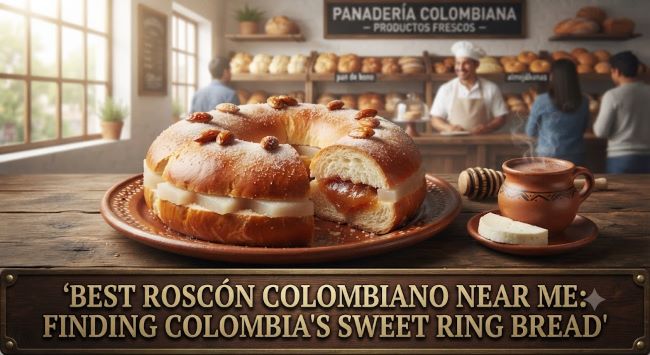
A roscón is a ring-shaped bread or pastry that exists in various forms across the Spanish-speaking world. The Colombian version is a soft, slightly sweet yeasted bread with a tender crumb and a characteristic glaze on top, often decorated with sugar or coconut flakes. Some versions are filled: guayaba (guava paste) and bocadillo are common fillings, as is arequipe (Colombian dulce de leche).
The dough for roscón colombiano is enriched with eggs and butter, which gives it a brioche-like softness without being as heavy or as rich as a French brioche. The flavor is mildly sweet with a slight vanilla or anise note depending on the bakery. The outside has a sheen from an egg wash or sugar glaze applied before baking.
In Colombia, roscón colombiano near me would point you toward a panadería (bakery) rather than a restaurant. It’s morning food, afternoon snack food, and celebration food depending on context. It’s eaten on its own, with hot chocolate, or with coffee. Around Christmas, roscón appears with more frequency as a traditional holiday bread.
How It Differs From Spanish Roscón de Reyes
The Spanish roscón de reyes is a decorated ring bread eaten on January 6th (Three Kings Day) filled with whipped cream or pastry cream and embedded with a hidden figure and a dried bean. It’s more elaborate, larger, and tied to a specific holiday.
The Colombian version is a year-round bakery item: simpler in decoration, smaller in size (individual or family portions rather than celebration-scale), and more likely to be filled with guava or arequipe than cream. The dough is softer and the crumb more tender than the Spanish version, reflecting Colombian preferences for bread with a pillowy interior.
The two share a name and a shape but occupy completely different places in their respective food cultures.
Where to Find Roscón Colombiano Near You
Colombian bakeries are the most reliable source for the best roscón colombiano near me. The dish is a bakery item, not a restaurant dish, which shifts the search toward panaderías and Latin American pastry shops.
Where to look:
Colombian panaderías. In cities with Colombian communities, Colombian bakeries operate as neighborhood institutions. They typically open early, carry traditional breads and pastries including roscón, and sell out of popular items by mid-morning. Cities with established Colombian populations include Miami, New York, New Jersey, Chicago, Houston, and parts of Florida and Georgia.
Latin American bakeries with Colombian ownership or focus. Even bakeries that market broadly as “Latin American” or “South American” sometimes carry Colombian breads if the owner or baker is Colombian. It’s worth asking.
Colombian restaurants with a bakery section. Some Colombian restaurants sell traditional breads and pastries alongside their food menu. A roscón colombiano near me might be in a display case near the register rather than on the printed menu.
Online and local delivery. In cities with active Colombian communities, home bakers often sell roscón and other Colombian pastries through Instagram, WhatsApp groups, or platforms like Goldbelly. This is sometimes your best option in smaller cities.
Search approach: Google Maps for “Colombian bakery” or “panadería colombiana” in your area. Check Instagram for Colombian bakers in your city: search city name plus “panadería colombiana” or “pan colombiano.”
What a Good Roscón Colombiano Looks Like
The texture. The defining quality of a well-made roscón colombiano is the crumb: soft, pillowy, and slightly springy. It should tear easily and have a fine, even structure. Dense or dry crumb means either the dough wasn’t properly enriched, didn’t proof long enough, or was overbaked.
The glaze. The surface should have a shine: either from an egg wash baked on or a sugar glaze applied after. Dull, matte exterior suggests the finishing step was skipped.
The filling. If the roscón is filled with guayaba, the paste should be visible in a clean layer when you cut through it. Arequipe filling should be thick enough to hold rather than running. Either way, the filling-to-bread ratio should be generous: a thin strip of filling in a large piece of bread is a disappointment.
The freshness. Roscón colombiano near me is best the day it’s made. The soft enriched dough stales faster than lean bread. If it feels compressed or the crumb is gummy, it’s not fresh. Most good Colombian bakeries sell out rather than carry over day-old product.
The size. Individual roscones are single-serving. Family-sized versions are larger rings meant for slicing. Both are legitimate but the individual version is the one you’re most likely to find at a walk-in bakery counter.
What to Eat It With
In Colombia, roscón is most commonly eaten with tinto (black coffee) or with hot chocolate. The mildly sweet bread and the bitterness of the coffee or rich chocolate make a natural pairing that Colombians have been eating for generations.
It also works with aguapanela (sugarcane water), a traditional Colombian drink that’s warm and lightly sweet, or with a cold glass of milk.
For a more complete Colombian bakery experience alongside your roscón colombiano near me, look for buñuelos (fried cheese puffs) at the same counter. The two items often appear together at Colombian bakeries and together represent the range of what Colombian baking does well.
You might also want to explore buñuelos colombianos if the bakery you find carries both, since they’re natural companions to roscón in a traditional Colombian breakfast spread.
Key Takeaways
- Roscón colombiano is a soft, ring-shaped sweet yeasted bread with an enriched dough, egg-wash or sugar glaze, and often filled with guava paste or arequipe, eaten year-round as a bakery item rather than a holiday specialty
- The best roscón colombiano near me will come from Colombian panaderías or Latin American bakeries with Colombian ownership, not from restaurants
- Quality markers include a soft, fine, pillowy crumb, shiny glaze on the exterior, generous filling if present, and same-day freshness
- It differs from the Spanish roscón de reyes in size, decoration, filling type, and cultural context: the Colombian version is an everyday bakery item, not a holiday centerpiece
- Cities with established Colombian communities (Miami, New York metro, New Jersey, Chicago, Houston) have the best concentrations of Colombian bakeries
- Instagram is often a better search tool than Google Maps for finding home bakers and small panaderías that don’t have a strong online presence
- Eat it with tinto (black coffee) or hot chocolate for the traditional Colombian pairing