Professional Mold Remediation: What It Involves and How to Choose a Provider
Discovering mold in your home triggers an immediate question: is this a DIY cleaning job, or does it require professional mold remediation? The answer depends heavily on the extent of the mold, the underlying cause, and what type of mold is present. Understanding the difference, what professional remediation actually involves, and how to choose a qualified provider protects both your health and your home’s structural integrity.
DIY Cleaning vs. Professional Mold Remediation
The EPA’s general guideline: mold covering an area smaller than approximately 10 square feet (roughly a 3-foot by 3-foot patch) can often be cleaned by a homeowner using appropriate safety precautions and standard cleaning products. Mold covering a larger area, or mold resulting from significant water damage, sewage contamination, or affecting HVAC systems, generally warrants professional remediation.
Beyond size, several factors push a situation toward professional remediation regardless of the visible area:
The mold resulted from contaminated water (sewage backup, flooding from outside sources) rather than clean water, since contaminated water introduces additional pathogens beyond just mold.
Mold is present in HVAC ductwork, since DIY cleaning can’t adequately address mold that has spread through a home’s air circulation system, and improper handling can spread spores throughout the house.
Household members have compromised immune systems, asthma, or significant mold allergies, where even smaller amounts of mold exposure during DIY cleaning pose meaningful health risk.
The mold has been present for an extended, unknown period, since long-term mold growth often indicates more extensive hidden growth behind walls or under flooring than what’s visible on the surface.
You’re unsure of the underlying moisture source, since remediation without first identifying and fixing the moisture problem only produces temporary results — professional remediation companies typically include moisture source identification as part of their process.
What Professional Mold Remediation Involves
Initial assessment and testing. A reputable remediation company begins with an inspection to determine the extent of mold growth, identify the moisture source, and in some cases conduct air quality or surface testing to identify the specific mold species present, though testing isn’t always necessary if visible mold and moisture issues are clear.
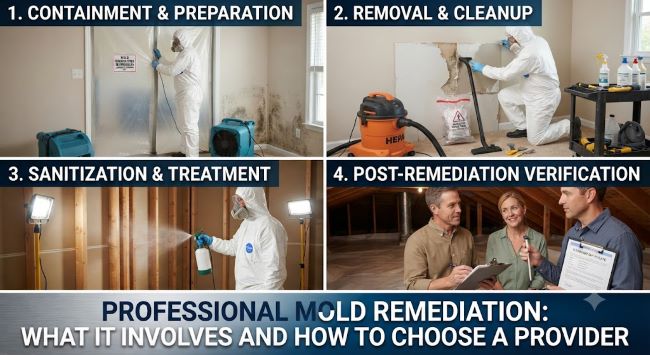
Containment. Professionals establish containment barriers (plastic sheeting, negative air pressure machines) around the affected area to prevent mold spores from spreading to unaffected parts of the home during the remediation process — this is one of the most significant advantages professional remediation has over DIY cleaning, which typically lacks proper containment.
Removal of contaminated materials. Porous materials with significant mold growth — drywall, insulation, carpet, some types of wood — often cannot be fully cleaned and need to be removed and replaced rather than cleaned in place. Professionals determine what can be salvaged through cleaning versus what requires removal.
Cleaning and treatment of salvageable surfaces. Non-porous and semi-porous surfaces (hard wood, concrete, metal, some treated wood) are cleaned using antimicrobial treatments and specialized equipment, including HEPA vacuuming to capture mold spores rather than just wiping surfaces, which can aerosolize spores.
Air filtration during the process. HEPA air scrubbers run throughout the remediation process to continuously filter mold spores out of the air in the work area.
Moisture source correction. Reputable remediation companies address or strongly recommend addressing the underlying moisture problem (leak repair, ventilation improvement, dehumidification) since remediation without fixing the moisture source typically results in mold returning.
Post-remediation verification. Many companies conduct post-remediation clearance testing to confirm mold spore counts in the treated area have returned to normal levels before considering the job complete.
Restoration. Replacing removed materials (new drywall, flooring, insulation) to restore the affected area to its pre-mold condition, sometimes performed by the remediation company directly and sometimes coordinated with a separate restoration or construction contractor.
What Professional Mold Remediation Costs
Costs vary significantly based on the extent of mold, the affected materials, and your region:
Small, contained areas (under 10 sq ft): $500-$1,500.
Moderate mold problems (10-100 sq ft, possibly affecting one room): $1,500-$5,000.
Extensive mold remediation (whole rooms, multiple areas, significant material removal and replacement): $5,000-$15,000+.
Crawl space or attic mold remediation: $1,500-$8,000 depending on extent and accessibility.
HVAC mold remediation: $2,000-$6,000 including duct cleaning and treatment.
These figures typically cover remediation only, not the cost of fixing the underlying moisture source (roof repair, plumbing fixes, foundation waterproofing) or full restoration of removed materials, which can add significantly to the total project cost.
How to Choose a Mold Remediation Company
Look for IICRC certification. The Institute of Inspection, Cleaning and Restoration Certification (IICRC) certifies companies and individuals in mold remediation (specifically the AMRT — Applied Microbial Remediation Technician — certification). This is the most widely recognized industry credential.
Get multiple quotes and detailed written estimates. A thorough estimate should specify the scope of work, what materials will be removed versus cleaned, containment procedures, and whether post-remediation testing is included.
Ask about their moisture source assessment process. A company that only addresses visible mold without identifying and addressing the moisture source is providing an incomplete service likely to require repeat treatment.
Verify insurance and licensing. Confirm the company carries liability insurance and is licensed appropriately for your state, since requirements vary — some states have specific mold remediation contractor licensing.
Be wary of companies that also perform testing and remediation without independent verification. Some industry guidance recommends using a separate, independent industrial hygienist for testing (both before and after remediation) rather than relying solely on the remediation company’s own assessment, to avoid a potential conflict of interest in the scope of recommended work.
Check reviews specifically mentioning mold remediation, not just general restoration or cleaning services, since some companies that do general water damage restoration may have less specific mold expertise.
For related guidance on water damage that often precedes mold problems, water damage restoration services near me covers how to address the moisture source issues that, if left unresolved, are the most common reason mold problems return even after professional remediation.
Key Takeaways
- Professional mold remediation is generally warranted for mold covering more than 10 square feet, mold from contaminated water sources, mold in HVAC systems, or situations involving household members with health vulnerabilities
- The remediation process includes containment, removal of unsalvageable porous materials, cleaning of salvageable surfaces with HEPA filtration, moisture source correction, and often post-remediation clearance testing
- Costs range from $500-$1,500 for small contained areas to $5,000-$15,000+ for extensive whole-room or multi-area remediation, not including underlying moisture source repair
- IICRC certification (specifically AMRT) is the most recognized industry credential to look for when choosing a remediation company
- A thorough remediation process must address the underlying moisture source, not just visible mold, or the problem is likely to recur
- Consider using an independent industrial hygienist for testing rather than relying solely on the remediation company’s own assessment to avoid potential conflicts of interest
- Get detailed written estimates specifying scope of work, containment procedures, and whether post-remediation testing is included before selecting a provider