How to Become a Professional Sculptor: A Realistic Path from Start to Career
Sculpture is one of the most demanding and most rewarding art forms to pursue professionally. It requires both artistic vision and significant technical skill — often in multiple materials and processes — and translating that into a sustainable income requires business acumen alongside craft. The path to becoming a professional sculptor is not a single straight line: it has multiple entry points, multiple viable financial models, and different timelines depending on what kind of sculptural work you want to make and how you define professional success. This guide covers the realistic landscape.
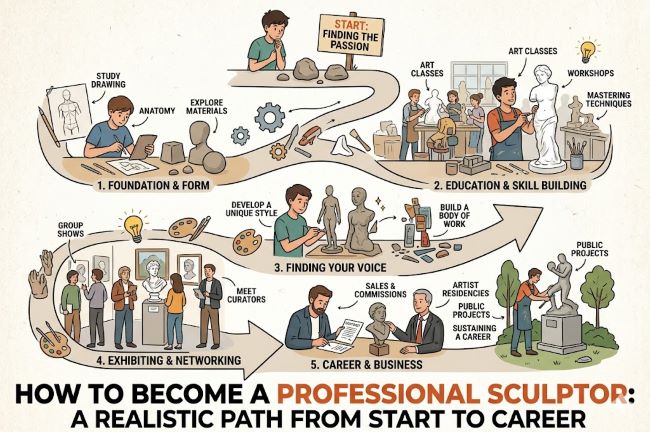
What “Professional Sculptor” Actually Means
Professional sculptor means different things depending on context. It can mean:
A fine art sculptor who creates original works for gallery sale, collector purchase, museum acquisition, and exhibition. Income comes from sales, exhibition fees, grants, residencies, and commissions.
A commercial sculptor who creates work for clients: product prototyping, architectural ornament, theatrical props and sets, theme park environments, film and TV productions, medical or scientific models.
A public art sculptor who creates large-scale commissioned work for public spaces, municipalities, corporations, and institutions.
A craft or production sculptor who makes and sells multiples of original designs through galleries, craft fairs, online platforms, or their own studio.
Most working sculptors combine elements of more than one of these: a fine art sculptor who also takes commissions, or a commercial sculptor who maintains a personal artistic practice alongside client work. Understanding which model appeals to you most shapes how you build your skills and career.
Skills You Need to Develop
Material skills. Sculpture is inherently material-dependent. The most versatile sculptors develop competency in multiple materials: clay and ceramic, stone carving, wood carving, metal fabrication (welding, forging, casting), plaster, resin and fiber composites, bronze casting, and increasingly digital fabrication (3D modeling for CNC routing or 3D printing). Starting with one material deeply and expanding from there is the practical approach.
Drawing and observation. The foundation of sculptural work is accurate observation and the ability to translate three-dimensional form into understanding. Traditional drawing — figure drawing, gesture, proportion — builds this observational capacity even for sculptors who don’t make drawing-based work.
Scale and proportion. Understanding how forms read at different scales is a specific sculptural skill. Work that reads well at 12 inches may not translate to 12 feet. Developing this intuition takes making work at different scales.
Structural engineering basics. Large sculptures need to support their own weight and often external loads. Understanding basic structural principles prevents embarrassing or dangerous failures, particularly in public art.
Finishing and surface treatment. The surface of a sculpture — patina on bronze, stone polish, wood finish, paint — is often what the viewer interacts with most directly. Finishing skills are as important as shaping skills.
Photography and documentation. Sculptors need high-quality photographs of their work for applications, grants, gallery submissions, and portfolio. Basic photography skills are essential; hiring a professional photographer for significant pieces is worth the investment.
Education Paths
Formal art school or university (BFA/MFA). A Bachelor of Fine Arts with a sculpture concentration provides foundational technical training and critical context. A Master of Fine Arts is the terminal degree in studio art and opens access to college-level teaching positions, which are a significant income source for many professional sculptors. MFA programs also provide network connections, exhibition opportunities, and concentrated studio time that are hard to replicate outside school.
Certificate and technical programs. Some art schools and community colleges offer certificate programs in specific sculptural techniques: stone carving, metalsmithing and casting, ceramics. These are more focused and shorter than degree programs and can build technical skills without the full financial commitment of a degree.
Apprenticeship and assistantship. Working in the studio of an established sculptor is one of the most effective education paths in the craft. Assistants learn fabrication techniques, studio management, and professional practice directly. Reaching out to sculptors whose work you admire and offering to assist (often initially for free or low pay) is a legitimate and time-honored entry path.
Self-directed learning. Many professional sculptors are largely self-taught in specific techniques. Books, online resources, community workshops, and local sculpture centers provide access to techniques and equipment without formal enrollment.
How Sculptors Make Money
This is the question most aspiring sculptors need to think through before assuming “sell sculptures” is the whole answer.
Original work sales through galleries. Gallery representation typically involves a 40-50% commission on sales. Galleries provide exhibition space, marketing, collector access, and credibility. Getting represented by a gallery requires a developed body of work, exhibition history, and usually a relationship with someone at the gallery.
Direct sales. Many sculptors sell directly through their website, social media, and studio visits, retaining the full price rather than splitting with a gallery. Online platforms like Artsy, Saatchi Art, and Etsy serve different market segments.
Commissions. Public art commissions, corporate collection commissions, private collector commissions, and architectural commissions can be the largest single income events in a sculptor’s career. These require a track record of completed work, references, and the capacity to execute large or complex projects.
Teaching. College and university teaching (often requiring an MFA), community art center workshops, private lessons, and online courses all provide income alongside studio practice. Teaching is the income backbone for many fine art sculptors.
Grants and residencies. Competitive grants from the NEA, state arts councils, private foundations, and artist residency programs provide time and income for studio work. Building a grant application track record takes time and requires strong artist statement writing alongside the work itself.
Commercial work. Medical illustration, architectural model-making, prop fabrication, character sculpting for entertainment, and product design all pay professional rates for sculptural skills and don’t require gallery representation.
Building the Career
The practical timeline for building a sustainable sculpting career typically runs 5-10 years from serious beginning to financial stability, and many professional sculptors supplement their practice income with teaching or commercial work throughout their career.
The most consistent career-building strategies:
Make work consistently and prolifically in your early years: the more you make, the faster you develop and the more material you have to show.
Document everything professionally: a strong portfolio of well-photographed work is your primary tool for applications, gallery submissions, and grant applications.
Build relationships within the art world: other artists, gallery owners, curators, collectors, and critics. The sculpture world, like most art worlds, is relationship-driven.
Apply for everything: grants, residencies, juried shows, public art calls. The application itself is a skill that improves with practice, and each successful application opens new doors.
Key Takeaways
- Professional sculptors work across multiple models: fine art, commercial, public art, and production/craft, often combining income streams from more than one
- Core skills to develop: material competency in one or more mediums, observation and drawing, understanding of scale, finishing techniques, and professional documentation (photography)
- Education paths include BFA/MFA programs (the MFA opens teaching positions), technical certificate programs, studio apprenticeships, and self-directed learning
- Sculptors make money through gallery sales, direct sales, commissions, teaching, grants and residencies, and commercial work: financial stability usually requires more than one of these
- Teaching is the income backbone for many fine art sculptors throughout their career, alongside studio practice
- A realistic timeline to financial sustainability is 5-10 years from serious beginning: building relationships, exhibiting regularly, and applying for grants and residencies consistently is how the career develops
- Commercial sculptural work (props, medical models, architectural ornament, entertainment industry) provides consistent professional income for sculptors who want studio stability alongside personal artistic practice