Fender American Professional Classic Stratocaster: A Complete Overview
The Fender American Professional Classic Stratocaster sits in an interesting position in Fender’s lineup: it brings together the vintage-inspired appointments and tonal character that players associate with classic Stratocasters while incorporating the playability refinements that modern players expect. Understanding what specifically makes this guitar distinct from the standard American Professional II and the American Vintage II lines requires looking at both the specifications and the philosophy behind them.
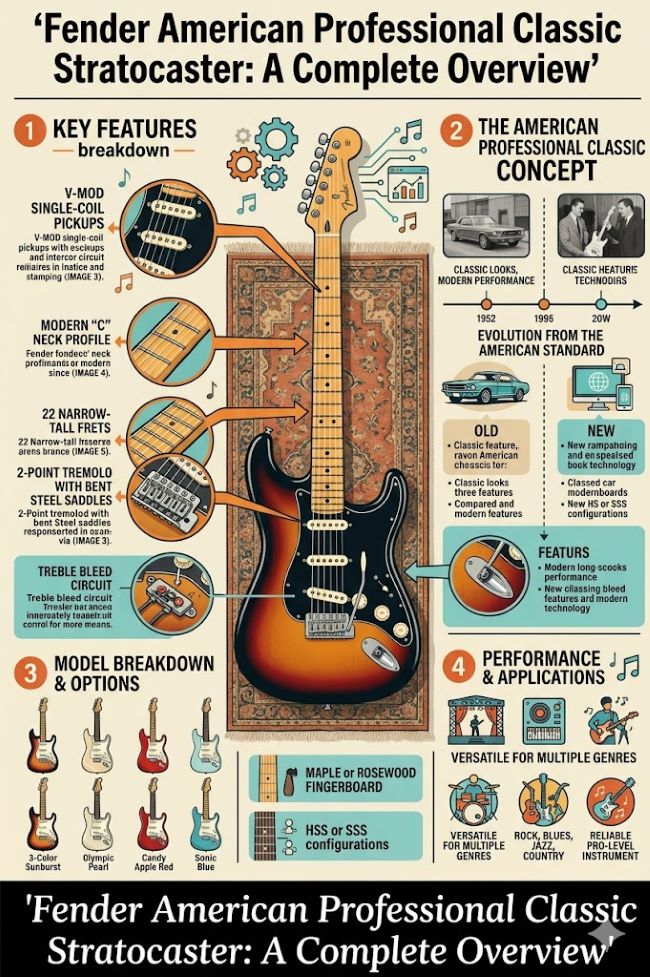
What the American Professional Classic Stratocaster Is
The American Professional Classic Stratocaster (sometimes marketed as the American Pro Classic) is a Fender USA model that blends elements of Fender’s vintage-spec instruments with the neck and playability features of the American Professional series. It’s designed to capture the look, feel, and tone of late-1950s and early-1960s Stratocasters while remaining comfortable for modern playing styles.
Key distinctions from other American Strats:
Compared to the American Professional II Stratocaster: the American Pro Classic has more vintage-leaning appointments including vintage-style tuners, a more period-correct neck profile and radius, and pickups voiced for vintage warmth rather than the V-Mod II pickups in the standard American Pro II.
Compared to the American Vintage II 1961 Stratocaster: the AVII is a near-replica of a 1961 original with a smaller 7.25-inch fingerboard radius and the playability characteristics of the original era. The American Professional Classic bridges vintage character with a slightly more player-friendly setup, making it more accessible to players who haven’t grown up playing vintage-radius necks.
Specifications
Body: alder body, contoured in the traditional Stratocaster shape. Alder is the classic Strat body wood for non-sunburst finishes, delivering balanced frequency response with clear high-end and a firm low end.
Neck: maple, with vintage “C” or “soft V” profile depending on the specific variant and production run. The neck profile is an important differentiator: the vintage-inspired profiles feel fuller and rounder in the hand than the thinner modern C profiles common on more contemporary guitars.
Fingerboard: maple or rosewood (depending on finish/variant), with a 9.5-inch radius. The 9.5-inch radius is a middle ground between the original 7.25-inch vintage radius and the flatter 12-inch radius on more modern guitars. It allows both comfortable chord playing and bend performance without the notes fretting out that can occur on the tightest vintage-radius boards.
Frets: 22 medium jumbo frets. The fret choice contributes to a slightly different playing feel than the smaller vintage frets on the AVII series: medium jumbo frets provide more material for bending and make vibrato slightly easier to control.
Pickups: Custom vintage-voiced single-coil pickups designed to recreate the character of late-1950s / early-1960s Stratocaster pickups. Staggered pole pieces address the string height and output differences between wound and plain strings, consistent with vintage pickup design. The pickups in this series emphasize the glassy, chiming top end and the distinctive quack of positions 2 and 4 that vintage Strat players identify as essential.
Controls: standard Stratocaster control layout: master volume, tone (neck pickup), tone (middle pickup), 5-way pickup selector. Older-spec 3-way switch positioning is not used.
Bridge: vintage-style synchronized tremolo with 6 individual saddles. The saddle material and setup specifications influence string vibration and sustain.
Tuners: vintage-style staggered tuners. The staggered post heights create a natural neck angle for the strings that reduces the need for a string tree on all strings, improving tuning stability on the plain G, B, and high E strings.
Finish: nitrocellulose lacquer on some variants, which breathes differently than polyurethane finishes and contributes to the instrument’s aging and resonance characteristics over time.
Tone Character
The American Professional Classic Stratocaster is voiced for the sounds most associated with the Stratocaster’s golden era: the clear, glassy bridge position that cuts through a mix, the famously complex in-between positions (bridge/middle and middle/neck combinations), and a full, warm neck pickup that’s useful for jazz, blues leads, and clean tones.
This is not a guitar aimed at heavy rock or high-gain applications. Single-coil pickups are susceptible to 60-cycle hum in high-gain environments, and the vintage voicing emphasizes the clean and edge-of-breakup sounds that defined the original Strat’s contribution to music from the 1950s through the classic rock era.
For blues, country, indie rock, classic rock, surf, and clean-to-moderate-gain applications, the American Professional Classic Stratocaster delivers genuinely excellent vintage-inspired tone.
Who It’s Best Suited For
Players who want vintage Strat character with modern playability. The 9.5-inch radius and medium jumbo frets make it more approachable than a true vintage-spec instrument while maintaining the tonal character.
Intermediate to advanced players investing in a quality American-made instrument. At its price point (typically $1,500-$2,000 depending on finish and retailer), it sits squarely in the professional tool category rather than the beginner or intermediate tier.
Players who primarily play blues, rock, country, funk, or clean jazz tones. These genres are where the vintage single-coil voice excels.
Collectors and tonal purists. Nitro-finished variants age in ways that appeal to players who value the natural relic-ing and resonance changes that occur over years of playing.
How It Compares in Price and Value
The American Professional Classic sits above the American Professional II Stratocaster in price due to the vintage-spec appointments and in some cases the nitro finish. It sits below the American Vintage II in terms of vintage accuracy but above it in terms of modern playability.
For a player deciding between these, the choice comes down to priority: if authentic vintage specification is the goal, the American Vintage II; if vintage tone with maximum modern playability is the goal, the American Professional Classic; if a well-rounded modern professional instrument is the goal, the American Professional II.
The American Professional Classic in Practice
Players who’ve spent time with the American Professional Classic Stratocaster consistently describe it as a guitar that feels immediately familiar while offering slightly more tonal color and vintage character than a standard production Strat. The neck profiles — whether the “soft V” or full “C” — fill the hand differently than the slimmer necks on current mass-market instruments, which many players find more comfortable for extended sessions.
The in-between positions (2 and 4 on the 5-way switch) are where the vintage voicing is most apparent. The characteristic “quack” — a scooped midrange with clear highs and a slightly hollow character — is enhanced by the pickup design and the way the vintage-wound pickups interact. Players who’ve spent time on original vintage Strats or reissues report that the American Professional Classic gets closer to that character than the standard American Pro II, which is voiced somewhat brighter and more contemporary.
For gigging musicians, the 9.5-inch radius and medium jumbo frets make the guitar practical for the range of playing techniques that working players use: rhythm work, lead lines, bending, chord melody, and the full palette of what the Stratocaster is known for.
Key Takeaways
- The Fender American Professional Classic Stratocaster bridges vintage-spec appointments (vintage tuners, vintage-voiced pickups, period-correct neck profiles) with modern playability features (9.5-inch radius, medium jumbo frets)
- The 9.5-inch fingerboard radius is a deliberate middle ground between vintage 7.25-inch and modern 12-inch: comfortable for chords and bending without fretting out
- Pickups are custom vintage-voiced single-coils emphasizing the glassy bridge tone, the characteristic in-between quack of positions 2 and 4, and a full neck pickup
- The instrument excels for blues, country, rock, funk, and clean applications: not optimized for high-gain metal or active pickup tones
- Nitro lacquer finish variants age and breathe differently from poly finishes, appealing to players who value natural instrument aging over time
- Positioned between the American Professional II (more modern) and the American Vintage II (more vintage-accurate): the best choice for players who want vintage tone without sacrificing modern playability
- Retail price typically $1,500-$2,000 depending on finish and configuration; a legitimate professional-grade US-made instrument at this price point