Pipe Cleaner Flowers: How to Make Them and Creative Ideas for Every Skill Level
Pipe cleaner flowers are one of the most satisfying craft projects available because they’re quick to make, require almost no tools, produce results that genuinely look good, and can be done by children and adults alike. A single flower takes five to ten minutes for a beginner, and the techniques scale up quickly: with a few hours of practice most people can make flowers that look deliberate and polished rather than accidental. This guide covers how to make pipe cleaner flowers from the simplest designs to more detailed versions, plus ideas for what to do with them.
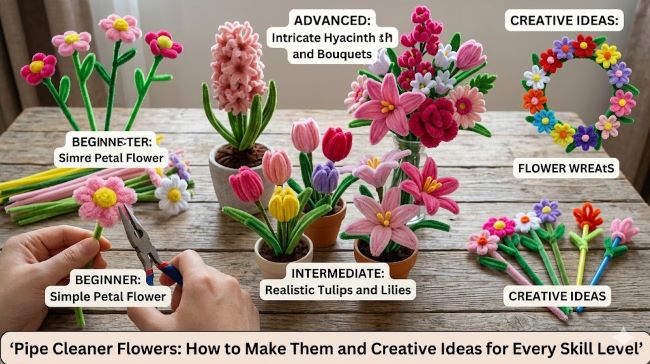
What You Need
The materials are minimal:
Pipe cleaners (chenille stems). Available at any craft store (Michaels, Joann, Hobby Lobby) and online. Standard pipe cleaners are 12 inches long and come in packs of mixed or single colors. For flowers, having multiple colors plus green for stems and leaves is ideal. Metallic, sparkle, and extra-fuzzy varieties add texture options.
Wire cutters or strong scissors. Some techniques involve cutting pipe cleaners to shorter lengths. Scissors work on thinner cleaners; wire cutters are easier on thicker ones and save your scissor blades.
Optional: floral tape (to wrap stems), a pencil or wooden skewer (for coiling), beads (for flower centers), and a styrofoam base or vase for displaying finished flowers.
How to Make a Basic Pipe Cleaner Daisy
The daisy is the most beginner-friendly pipe cleaner flower and a great starting point.
What you’ll need: 5 pipe cleaners in a petal color, 1 green pipe cleaner for the stem, 1 yellow pipe cleaner for the center.
Step 1: Make the petals. Take one petal-color pipe cleaner and fold it in half. Twist the two halves together at the fold end, leaving about an inch of a loop at the top. The loop becomes one petal. Bend the loop into a teardrop or oval shape. Repeat with each of the remaining four petal-color pipe cleaners.
Step 2: Assemble the flower head. Hold all five petals together at their twisted ends and twist them around each other to join them. Spread the petals out evenly around the center.
Step 3: Add the center. Take the yellow pipe cleaner and coil it into a small circle approximately the size of a quarter. Twist the end of the coil around the center of the assembled petals to attach it.
Step 4: Add the stem. Take the green pipe cleaner and twist one end firmly around the gathered base of the petals. Bend the remaining length downward as the stem.
Step 5: Shape and adjust. Bend and adjust the petals until they’re evenly spaced and at the angle you want. Pipe cleaner flowers are endlessly adjustable: if a petal is too flat, bend it slightly upward; too far forward, bend it back.
How to Make a Pipe Cleaner Rose
The rose takes slightly more technique but produces a more dramatic result.
What you’ll need: 3-4 pipe cleaners in a petal color, 2 green pipe cleaners, a pencil.
Step 1: Make the spiral center. Take one petal-color pipe cleaner and wrap it tightly around the pencil from one end. Slide the coil off: this is the tight spiral center of the rose. Flatten one end slightly to be the base.
Step 2: Add outer petals. Take a second pipe cleaner and wrap it loosely around the outside of the spiral center, overlapping in layers and bending the free end outward and slightly down to suggest an opening petal. Continue wrapping and shaping with additional pipe cleaners for fuller roses.
Step 3: Secure the base. Twist the loose ends together at the base of the flower to secure all the layers.
Step 4: Add sepals (optional). Cut a green pipe cleaner into three pieces and bend each into a small leaf or sepal shape. Twist these around the base of the flower, pointing downward.
Step 5: Add the stem. Twist a full green pipe cleaner around the base and shape downward into a stem. Optionally, twist a partial green pipe cleaner into a leaf shape and attach it midway down the stem.
How to Make a Pipe Cleaner Tulip
Tulips are among the simplest pipe cleaner flowers and look elegant.
Step 1: Take three pipe cleaners in the same color. Fold each one in half to make a U shape.
Step 2: Interlock the three U shapes by threading them through each other alternately to form a cup shape: the result looks like three interlocked U shapes forming an open bowl.
Step 3: Bring all six ends together at the bottom and twist them together firmly.
Step 4: Shape the top edges of the U loops outward slightly to suggest the opening petals of a tulip.
Step 5: Attach a green pipe cleaner stem by twisting it around the base.
Color Combinations That Work Well
Classic single-color flowers: monochromatic roses in red, pink, white, or yellow with green stems.
Ombre effect: use two pipe cleaners in related colors (light pink and dark pink) for one flower, twisting them together for a gradient effect.
Wild garden mix: a bouquet combining sunflower yellow, lavender, coral, and white flowers with varied stem lengths looks like a garden gathering.
Metallic accents: adding one metallic or sparkle pipe cleaner to a standard color flower catches light and adds visual interest.
Seasonal palettes: autumn arrangements in orange, rust, and gold; spring arrangements in pastels; winter arrangements in white and silver.
Things to Make With Pipe Cleaner Flowers
Bouquets and arrangements: gather 8-12 flowers of varied colors and heights and arrange in a small vase or wrap with ribbon. These make lasting gifts since they never wilt.
Wreaths: wrap a wire or foam wreath form with green pipe cleaner stems and attach flowers around the surface for a decorative wreath.
Hair accessories: use a single small flower with the stem bent into a bobby pin grip or wrapped around a headband.
Gift toppers: attach a single flower to a wrapped gift instead of a bow.
Classroom and party decorations: pipe cleaner flower making is an excellent group activity for children’s parties, school crafts, or community events. All ages can participate at different complexity levels.
Buttonholes and corsages: small tight-coiled roses on short stems wrapped with floral tape make wearable corsages for events.
For other beginner-friendly creative projects worth exploring alongside pipe cleaner flowers, best ukulele for beginners covers another accessible starting point for a new creative skill that rewards the same kind of patient hands-on practice.
Key Takeaways
- Pipe cleaner flowers require minimal materials: pipe cleaners in multiple colors, scissors or wire cutters, and optionally a pencil for coiling and floral tape for finishing
- The daisy is the most beginner-friendly design: five loops twisted together with a coiled yellow center and green stem, taking about five minutes once the technique is familiar
- Roses use a spiral coil center wrapped with additional pipe cleaners in loose layers: using a pencil to create the initial tight coil is the key technique
- Tulips are made from three interlocked U-shaped pipe cleaners twisted together at the base, one of the simplest designs with an elegant result
- Ombre effects and metallic accents are easy techniques for adding visual sophistication once basic flower shapes are mastered
- Finished pipe cleaner flowers last indefinitely, never wilt, and can be rearranged or adjusted at any time
- Group flower-making sessions work well for all age groups: younger children can make simple daisies and tulips while older participants tackle roses and more complex designs