Small Engine Repair Near Me: How to Find a Good Shop and What It Costs
Small engine equipment — lawn mowers, generators, chainsaws, pressure washers, leaf blowers, snow blowers, tillers — all rely on engines that eventually need service. When your mower won’t start, your generator runs rough, or your chainsaw won’t idle properly, finding a competent small engine repair shop near you is the practical solution. This guide covers how to find one, what to expect, and how to know if the repair is worth it.
What Small Engine Repair Shops Service
Small engine repair shops handle two-stroke and four-stroke engines across a wide range of equipment:
Lawn and garden: walk-behind mowers, riding mowers and zero-turns, string trimmers, leaf blowers, hedge trimmers, chainsaws, log splitters, tillers and cultivators.
Outdoor power: pressure washers, generators, water pumps, go-karts and mini bikes.
Winter equipment: snow blowers and snow throwers.
Marine (some shops): outboard motors, boat engines (often a specialty separate from general small engine shops).
Most small engine shops work on equipment from all major brands: Briggs & Stratton, Honda, Kawasaki, Kohler, Tecumseh, Husqvarna, STIHL, EGO, and others. Some shops specialize in specific brands or are authorized dealers with factory training, which matters for warranty work.
How to Find Small Engine Repair Near You
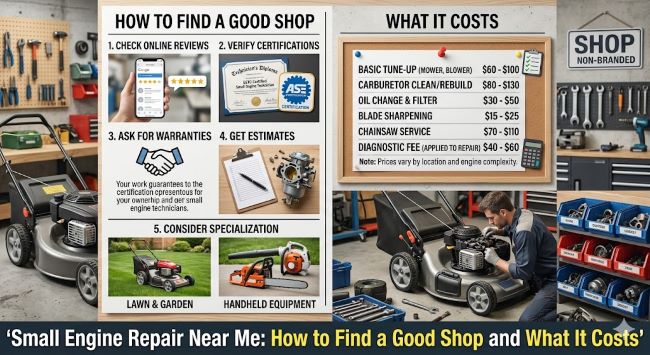
Google Maps. Search “small engine repair near me” or “lawn mower repair near me” and review the local results. Look at star ratings and, more importantly, read the reviews specifically for mentions of turnaround time, pricing transparency, and whether problems were actually fixed.
Brand dealer networks. If your equipment is under warranty or is a specific high-end brand, search for authorized dealers. STIHL, Husqvarna, Honda Power Equipment, and others maintain dealer locators on their websites. Authorized dealers have brand-specific training and access to OEM parts.
Local hardware stores and co-ops. Some independent hardware stores have a service department or refer to a trusted local shop. Farm supply stores (Tractor Supply, Rural King, Farm & Fleet) often have service departments or maintain referral lists.
Outdoor power equipment dealers. Dealers that sell riding mowers, zero-turns, or outdoor power equipment almost always have a service department for the equipment they sell and often service other brands as well.
Neighborhood referrals. Ask neighbors with well-maintained equipment who they use. Word-of-mouth referrals in small engine repair are particularly valuable because you can see the quality of work on equipment similar to yours.
What to Look for in a Small Engine Repair Shop
Reasonable turnaround time. Spring and fall are peak seasons for small engine repair (before and after mowing season). Wait times of two to four weeks are common during busy periods. A shop that promises very fast turnaround during peak season should be viewed with mild skepticism, though some shops are simply more efficient.
Written estimate before work begins. A good shop will diagnose your equipment and provide a written estimate before beginning any repair. Estimates should break out parts and labor separately. Shops that do extensive work without prior approval are a red flag.
Transparent diagnostic fee policy. Many shops charge a diagnostic fee ($20-$75) to assess what’s wrong with your equipment. This is standard and reasonable. Confirm whether the diagnostic fee is applied toward the repair cost if you approve the work.
Parts availability. Ask whether they use OEM (original equipment manufacturer) parts or aftermarket parts. OEM parts generally fit better and last longer. Some aftermarket parts are comparable quality; others aren’t. A good shop will tell you what they’re using and why.
Service warranty. Reputable shops stand behind their work with at least a 30-day warranty on parts and labor. Ask about this before approving work.
What Common Small Engine Repairs Cost
Pricing varies significantly by region and shop, but general ranges give you a baseline:
Carburetor clean or rebuild: $50-$150. One of the most common repairs, usually needed when equipment has sat with old fuel.
Carburetor replacement: $75-$200 including parts and labor.
Air filter, spark plug, and fuel filter service (tune-up): $50-$100 depending on equipment type.
Full tune-up (filter, plug, oil change, blade sharpening for mowers): $80-$150.
Blade sharpening: $10-$25 per blade.
Starter rope replacement: $25-$60.
Ignition coil replacement: $75-$175.
Carburetor replacement on riding mower: $150-$300 including parts.
Engine rebuild or replacement on riding mower: $400-$900+. At this price point, the age and value of the equipment matters: rebuilding an engine on a 15-year-old riding mower that’s worth $300 doesn’t make financial sense.
Hourly labor rates for small engine shops typically run $60-$100 per hour depending on region. Complex repairs on riding mowers or generators can run 2-4+ hours.
When Repair Makes Sense vs. Replacement
This question comes up most often with older riding mowers and higher-cost equipment. A rough guideline:
If the repair cost is less than 50% of the equipment’s current market value and the equipment is otherwise in good condition, repair makes sense. If the repair cost approaches or exceeds the equipment’s value, replacement is worth considering.
For walk-behind mowers, a $200 repair on a $500 mower that’s only a few years old makes sense. A $200 repair on a 15-year-old mower worth $75 on the used market doesn’t.
For generators and pressure washers, the same logic applies. These are higher-cost-to-replace items than basic mowers, so the threshold for worthwhile repair is higher.
Spring Preparation: Getting Ahead of the Rush
The single most consistent advice from small engine repair shops is to bring equipment in during the off-season rather than waiting until you need it. If your mower sits in the garage over winter and you bring it in February or March for a pre-season tune-up, you’ll get faster service and pay the same price as in-season. Waiting until April means waiting behind everyone else who put it off.
End-of-season service (after the last fall use) is the ideal time: the shop is less busy, you have the whole off-season before you need the equipment again, and any issues discovered have time to be addressed without urgency.
Key Takeaways
- Find small engine repair near me using Google Maps (search “small engine repair” or “lawn mower repair”), brand-specific dealer locators, outdoor power equipment dealers with service departments, and neighbor referrals
- Look for shops that provide written estimates before starting work, charge a transparent diagnostic fee, use OEM or quality aftermarket parts, and offer a service warranty on labor and parts
- Common repair costs: carburetor clean ($50-$150), full tune-up ($80-$150), blade sharpening ($10-$25), ignition coil ($75-$175), engine rebuild on riding mower ($400-$900+)
- The 50% rule: if repair costs less than 50% of the equipment’s current market value, repair generally makes sense; if it approaches or exceeds the replacement value, consider buying new or used instead
- Spring and fall are peak seasons with 2-4 week wait times; bring equipment in during winter off-season for faster service and the same pricing
- Authorized brand dealers (STIHL, Husqvarna, Honda) have factory training and OEM parts, which matters for warranty work and complex brand-specific repairs
- Always confirm the diagnostic fee policy and whether it applies toward repair cost before leaving equipment at any shop