Which Involves Food Storage in Plants? Understanding How Plants Store Energy
Plants are the primary producers of the food web, converting sunlight into energy through photosynthesis and storing that energy in forms that can be used later or passed on to other organisms. Understanding which biological process involves food storage in plants, and where and how that storage occurs, is fundamental to plant biology, agriculture, and nutrition. This guide covers the mechanisms, locations, and compounds involved in plant food storage.
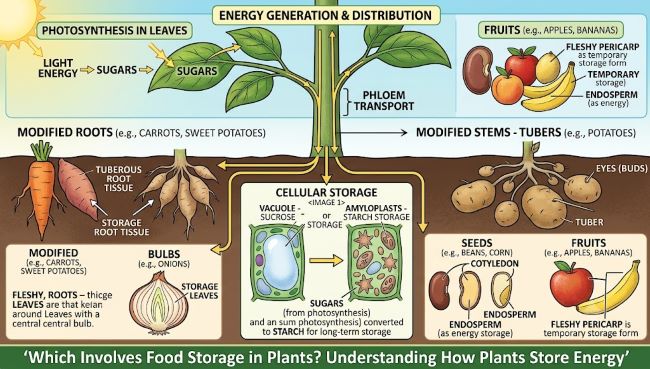
Which Process Involves Food Storage in Plants?
The process that involves food storage in plants is the conversion and accumulation of photosynthetic products — primarily glucose — into stable storage compounds, most importantly starch. This process follows photosynthesis and is part of the broader carbon fixation and carbohydrate metabolism pathway in plants.
Here’s the sequence:
Photosynthesis: plants capture light energy and use it to convert carbon dioxide and water into glucose (a simple sugar) in the chloroplasts. This is the food-making step.
Starch synthesis: excess glucose that isn’t immediately used for cellular energy (respiration) or structural building (cellulose synthesis) is converted into starch through a process involving enzymes called starch synthases. Starch is a polysaccharide: a long chain of glucose molecules bonded together. It’s far more compact and stable than free glucose, making it an effective storage form.
Storage: starch is deposited in specialized structures called plastids (specifically amyloplasts) within plant cells. Different plant structures accumulate starch in different ways and at different times depending on the plant’s life strategy.
Where Do Plants Store Food?
Food storage in plants occurs in several distinct structures, each serving different biological purposes:
Seeds. Seeds are among the most energy-dense food storage structures in the plant kingdom. They contain concentrated reserves of starch, oils (lipids), and proteins that provide the energy and nutrients a germinating seedling needs before it can photosynthesize. Cereal grains (wheat, corn, rice) store primarily starch in the endosperm tissue. Oil seeds (soybeans, sunflowers, canola) store primarily lipids in the cotyledons or endosperm. Legume seeds (lentils, peas, beans) store significant protein alongside starch.
Roots. Many plants store starch in specialized storage roots. Carrots, beets, turnips, and cassava (tapioca) all accumulate large quantities of starch in their tap roots or tuberous roots. Sweet potatoes store starch and sugars in their tuberous roots, converting starch to sugar as they mature and are exposed to certain conditions. The root’s biological function is to store food reserves that allow the plant to regrow after winter dormancy, drought, or damage.
Tubers. Tubers are modified underground stems (not roots, though often confused with them) that serve as starch storage organs. The potato is the most familiar example: white potatoes are almost entirely starch-filled stem tissue. Other tubers include yams, Jerusalem artichokes, and taro. Tubers allow a plant to store enormous quantities of energy in a compact, protected underground structure.
Bulbs. Bulbs (onions, garlic, tulips, lilies) are compressed underground stems surrounded by fleshy, food-storing leaf bases. The starch and sugar stored in bulb scales provides the energy for the plant to regrow and flower in the following season.
Fruits. Fruits store energy primarily as sugars (fructose, glucose, sucrose) rather than starch, though some fruits do contain starch (unripe bananas and plantains are starchy before ripening, converting to sugar as they mature). The sugars in fruits serve a biological purpose: attracting animals who eat the fruit and disperse the seeds.
Leaves. In some plants, particularly succulents (aloe vera, jade plant), leaves store water and energy compounds in large, fleshy parenchyma cells. Cacti, though not true leaves in most species, store water and some carbohydrates in their modified stems.
Bark and woody tissue. In trees, some starch is stored in the ray parenchyma cells of wood during the growing season and mobilized in spring to support new growth before the leaves fully develop. This is why maple sap (which flows in late winter before leaf-out) contains dissolved sugars from stored starch.
The Two Main Types of Food Storage Compounds in Plants
Starch. The primary food storage carbohydrate in plants. Starch consists of two components: amylose (a linear chain of glucose units) and amylopectin (a branched chain of glucose units). The ratio varies by plant species and affects cooking properties. Starch is insoluble in cold water, which prevents it from drawing water osmotically into cells, making it ideal for dry storage. It’s broken down to glucose by amylase enzymes when the plant needs to access stored energy.
Lipids (oils and fats). Seeds of oil crops store energy as triglycerides in specialized oil bodies. Lipids are more energy-dense than carbohydrates (9 calories per gram versus 4 for carbohydrates), making them particularly efficient for seed storage where maximum energy in minimum weight matters for seed dispersal. Soybean, sunflower, canola, and olive oils all come from plant lipid storage.
Proteins. Legume seeds in particular store significant quantities of protein (storage proteins like legumin and vicilin) alongside starch. These proteins serve as a nitrogen reserve for the germinating seedling.
Sucrose. Some plants store energy as sucrose (table sugar) rather than starch, most notably sugar beets and sugarcane, where sucrose accumulates in vacuoles within cells. Sucrose transport through the phloem also moves stored energy from leaves to other plant parts.
Why Plant Food Storage Matters for Agriculture and Nutrition
The biological mechanisms of food storage in plants have direct agricultural and nutritional implications. Crop improvement for thousands of years has involved selecting for plants with larger, starchier storage organs: bigger tubers, denser grain endosperms, higher-yielding oil seeds. Modern plant breeding and genetic engineering continue this trajectory.
For nutrition, understanding which plant parts store which compounds determines the nutritional profile of foods: why potatoes are primarily starch, why legumes offer both starch and protein, and why oily seeds like flaxseed and walnuts provide healthy fats alongside carbohydrates.
For a broader look at how food nutrition connects to animal health specifically, sensitive skin and stomach dog food covers how plant-derived ingredients like rice starch appear in specialized pet nutrition formulations designed for digestive sensitivity.
Key Takeaways
- Food storage in plants primarily involves the conversion of photosynthetically produced glucose into starch, a stable polysaccharide stored in specialized plastids called amyloplasts
- The main storage structures are seeds (starch, oils, proteins), roots (starch), tubers (starch), bulbs (starch and sugars), and fruits (sugars)
- Starch and lipids are the two primary energy storage compounds: starch dominates in most vegetative storage organs, while lipids dominate in oil seeds where energy density per unit weight matters most
- Legume seeds store significant protein alongside starch, making them the most nutritionally complete plant food storage organs
- Some plants store sucrose rather than starch: sugarcane and sugar beets accumulate sucrose in cell vacuoles rather than converting it to insoluble starch
- Unripe fruits contain starch that converts to sugar as ripening proceeds: bananas and plantains are the most familiar example of this starch-to-sugar conversion
- Agricultural crop improvement has historically selected for larger and more productive food storage organs: modern varieties of wheat, corn, rice, and potato all represent centuries of selection for enhanced starch storage capacity