Which Helps Enable an Oligopoly to Form Within a Market?
An oligopoly is one of the four main market structures in economics, sitting between the extreme of perfect competition (many sellers, no pricing power) and monopoly (one seller, full pricing power). In an oligopoly, a small number of large firms dominate a market, and their decisions about pricing, output, and strategy are deeply interdependent. Understanding what enables an oligopoly to form within a market helps explain why some industries remain concentrated for decades and why new competitors rarely break through.
What an Oligopoly Is
Before examining what enables oligopolies to form, it helps to be clear on what the structure actually means. An oligopoly exists when a handful of firms control a large share of a market. The exact number isn’t fixed: three firms controlling 80% of a market is an oligopoly just as clearly as five firms controlling 90% of another. What matters is the concentration and the interdependence it creates.
In an oligopolistic market, each firm must consider how rivals will react to its decisions. If one airline cuts fares, other airlines will respond. If one smartphone manufacturer introduces a new feature, competitors adjust their roadmaps accordingly. This strategic interdependence is what distinguishes an oligopoly from a competitive market, where individual firm decisions don’t meaningfully affect rivals.
High Barriers to Entry: The Primary Enabler
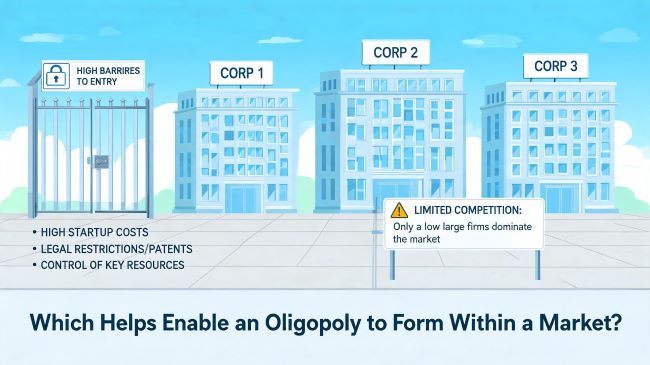
The single most important factor in what helps enable an oligopoly to form within a market is high barriers to entry. When it’s difficult, expensive, or legally restricted for new firms to enter a market, existing firms can maintain dominance without competitive pressure eroding their position.
Barriers to entry take several forms:
Economies of scale. In industries where production costs fall significantly as volume increases, large established firms can produce at a cost per unit that new entrants cannot match. A new airline cannot buy planes, hire crews, and negotiate airport gate agreements at the same cost structure as a carrier that’s been operating for decades. The capital required to achieve competitive scale is itself a barrier: the new entrant must commit enormous resources before generating any revenue, while established oligopolists are already profitable at scale.
High startup capital requirements. Some industries simply require massive upfront investment before any goods can be produced or sold. Semiconductor fabrication plants (fabs) cost $10-$20 billion to build and equip. Building a new commercial aircraft requires billions in design, certification, and manufacturing investment before a single plane is sold. These capital requirements naturally limit the number of firms that can operate, helping enable an oligopoly to form within these markets.
Patents and intellectual property. Legal protections for innovation can prevent competitors from replicating a product or process, allowing the patent holder to maintain market position. The pharmaceutical industry is a clear example: a company that develops a drug and holds its patent faces no direct competition for the drug’s active compound during the patent period, and the cost and time required to develop alternatives limits the field of competitors.
Control of key resources or infrastructure. If a small number of firms control access to a critical input (a rare mineral, a natural resource, a pipeline network, a wireless spectrum license), competitors face a fundamental supply constraint. Telecommunication markets are partly oligopolistic because wireless spectrum is a finite, government-licensed resource: only a limited number of carriers hold the licenses needed to operate national networks.
Regulatory and Legal Factors
Government regulation can both prevent and enable oligopolies, depending on how it’s designed.
Licensing requirements create a form of legally enforced barrier to entry. Industries requiring extensive regulatory approval (banking, insurance, healthcare, aviation) see fewer new entrants because the cost and time required to achieve compliance is itself a significant barrier. This doesn’t mean regulation is harmful overall: safety and consumer protection requirements serve genuine purposes. But they do contribute to market concentration as a side effect.
Government-granted monopolies or near-monopolies (utilities, for example) sometimes evolve into oligopolies when the market is partially deregulated but infrastructure remains concentrated. The electricity generation market in many US states moved from regulated monopoly toward oligopoly after deregulation: a few large generators dominate, but the market is not fully competitive because transmission infrastructure creates bottlenecks.
Network Effects
In markets where a product or service becomes more valuable as more people use it, early-leading firms gain advantages that are increasingly difficult to overcome. This is particularly relevant to technology and platform markets.
A social network with 100 million users is more valuable to any individual user than one with 1 million. A payment processing network accepted by more merchants is more useful to more consumers. This dynamic, called a network effect, helps enable an oligopoly to form within digital and platform markets because early leaders accumulate advantages that grow with scale, making it progressively harder for new entrants to attract users away from established platforms.
Social media, streaming platforms, operating systems, and payment networks all exhibit network effects that contribute to their oligopolistic concentration.
Brand Loyalty and Switching Costs
Established firms in oligopolistic markets often benefit from strong brand identity and high switching costs that make customers reluctant to move to a new entrant, even if the new entrant offers a comparable product.
Switching costs are real or perceived costs involved in changing providers. A business that has built its operations around a particular cloud provider faces significant migration costs to switch. A consumer who has years of purchase history, recommendations, and saved payment information with one e-commerce platform faces friction switching to another. These costs help existing oligopolists retain customers and deny new entrants the customer base they’d need to achieve competitive scale.
Mergers and Acquisitions
Oligopolies sometimes form not through organic growth but through consolidation. When an industry begins with more competitors and firms merge or acquire each other, the resulting concentrated market structure can be an oligopoly. Antitrust regulators exist specifically to review mergers that would reduce competition to oligopolistic or monopolistic levels, but they don’t catch every case and some consolidation proceeds with approval.
The airline industry’s consolidation in the United States is a clear example: from dozens of major carriers in earlier decades to a market now dominated by four airlines (American, Delta, United, and Southwest) controlling the vast majority of domestic capacity.
Interdependence and Price Rigidity
Once an oligopoly is established, the interdependence between firms tends to perpetuate it. Oligopolists are often reluctant to compete aggressively on price because of the kinked demand curve dynamic: if one firm cuts prices, rivals match the cut and no firm gains market share, but all firms earn less revenue. If one firm raises prices, rivals don’t follow and the price-raising firm loses customers. This creates pressure toward price rigidity, where firms compete on features, service, and marketing rather than price, which in turn reduces the pressure that might otherwise attract new entrants.
For a broader understanding of market structures and how they shape business decisions, the voluntary exchange of goods and services is the foundational concept that underpins all market activity, including oligopolistic markets where the exchange is less competitive but still voluntary. For other economic and business topics, places to eat near me represents a local market that is itself often oligopolistic at the neighborhood level, dominated by a few established restaurants with loyal customer bases.
Key Takeaways
- An oligopoly forms when a small number of firms dominate a market and make decisions with strategic awareness of how rivals will respond
- High barriers to entry are the primary enabler: economies of scale, high startup capital requirements, patents, and control of key resources all prevent new competitors from entering
- Regulatory and licensing requirements create legally enforced barriers that limit the number of firms that can operate in heavily regulated industries
- Network effects in technology and platform markets give early leaders self-reinforcing advantages that help enable an oligopoly to form and persist
- Brand loyalty and switching costs make it difficult for new entrants to attract customers away from established oligopolists even when offering comparable products
- Mergers and acquisitions can consolidate previously competitive markets into oligopolies: antitrust regulation exists to prevent the most anticompetitive consolidation
- Once established, oligopolies tend to be self-perpetuating due to price rigidity and interdependence: firms compete on features and marketing rather than price, reducing the pressure that would attract new entrants