Professional Disinfecting Services: What They Cover and When to Call
Cleaning a surface and disinfecting it are not the same thing. Cleaning removes visible dirt and debris. Disinfecting kills pathogens on surfaces, reducing the risk of illness spreading through a space. Professional disinfecting services exist because most standard cleaning routines, even thorough ones, do not reliably eliminate the full range of bacteria, viruses, and other microorganisms that can accumulate in high-traffic or high-risk environments.
Whether you manage an office, a school, a medical facility, a food service operation, or a residential property, there are situations where professional disinfecting services are the right call rather than an in-house cleaning effort. This guide covers what these services involve, when they make sense, what to look for in a provider, and how professional disinfecting services differ from everyday cleaning.
What Professional Disinfecting Services Actually Do
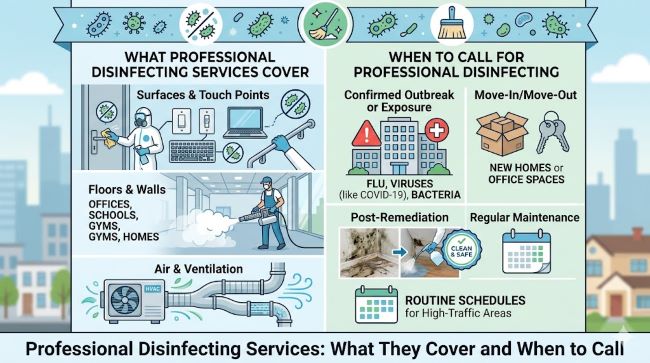
Professional disinfecting services go beyond wiping down counters and mopping floors. They use EPA-registered disinfectants, specialized application equipment, and trained technicians who understand contact times, surface compatibility, and the difference between sanitizing and true disinfection.
The most common application methods used by professional disinfecting services include electrostatic spraying, fogging, and manual application with microfiber cloths and appropriate disinfectants. Electrostatic sprayers charge disinfectant particles so they wrap around and cling to surfaces, including the undersides and backs of objects that a standard spray would miss. Fogging disperses a fine mist of disinfectant through a room, reaching areas that are hard to access manually. Both methods are faster and more thorough than manual application alone, which is why they have become standard tools in professional disinfecting services at commercial scale.
Technicians also follow dwell time protocols. Dwell time is the amount of time a disinfectant needs to stay wet on a surface to actually kill the pathogens it targets. Most people who disinfect at home wipe surfaces immediately after spraying, which is not long enough for the product to work. Professional disinfecting services train their staff to respect these contact times, which is a key reason why the results are more reliable than DIY efforts.
When to Use Professional Disinfecting Services
There is no single trigger that signals it is time to call a professional disinfecting services company, but several situations stand out as clear cases where professional help is worthwhile.
After an illness outbreak. When a contagious illness spreads through a workplace, school, or household, standard cleaning is unlikely to reduce transmission effectively. Professional disinfecting services can treat the entire space with hospital-grade disinfectants, targeting surfaces and areas that a typical cleaning routine would not address, and giving occupants confidence that returning to the space is reasonably safe.
Before reopening after a closure. Whether a business has been vacant, undergoing renovation, or closed for an extended period, professional disinfecting services provide a thorough baseline before staff and customers return. This is also common practice before opening a new location.
For ongoing commercial disinfection services. Many businesses schedule recurring professional disinfecting services rather than waiting for a problem to arise. Commercial disinfection services on a regular schedule are common in healthcare facilities, gyms, childcare centers, restaurants, and office buildings where large numbers of people move through shared spaces daily.
After water or flood damage. Water events introduce bacteria and mold risk. Following any remediation work, professional disinfecting services treat affected areas to reduce microbial contamination left behind even after the moisture is gone. Even a smaller plumbing issue like a running toilet, if left unaddressed, can create persistent moisture that encourages bacterial growth, so dealing with the source first, then calling in professional disinfecting services, is the right order of operations. A guide on how to fix a running toilet can help you resolve the plumbing side before a disinfection crew arrives.
For high-risk or vulnerable environments. Settings where immunocompromised individuals live or work, such as assisted living facilities, medical offices, or cancer treatment centers, often maintain ongoing relationships with commercial disinfection services providers to keep contamination risk low.
Commercial Disinfection Services vs. Standard Cleaning
The difference between commercial disinfection services and a standard commercial cleaning contract matters when you are deciding what kind of service to book.
Standard commercial cleaning covers visible cleaning tasks: vacuuming, mopping, wiping surfaces, emptying bins, cleaning restrooms, and restocking supplies. It keeps a space looking clean and reduces some pathogen load, but it is not designed to eliminate specific biological threats at measurable levels.
Commercial disinfection services, by contrast, are specifically designed to kill pathogens. They use products registered with the EPA for use against specific organisms, apply them at correct concentrations, and document the process. Providers who offer commercial disinfection services often produce a certificate of disinfection at the end of a job, which some businesses require for regulatory or liability reasons.
In practice, many facilities combine both. A standard cleaning contract handles the daily maintenance of a space, while commercial disinfection services are either scheduled on a recurring basis, such as weekly or monthly deep treatments, or called in response to a specific event. The two services work well together and are not mutually exclusive.
What to Look for in a Provider
Not every company that advertises professional disinfecting services delivers the same standard of work. A few things help you distinguish providers worth hiring from those that are not.
EPA-registered products. Any provider of professional disinfecting services should use disinfectants on the EPA’s registered list for the pathogens you are concerned about. Ask the company which products they use and verify those products are EPA-registered. This is a basic requirement, not a premium feature.
Training and certifications. Technicians performing commercial disinfection services should be trained in proper application, personal protective equipment use, and safe handling of chemical products. Some providers hold industry certifications from organizations like the ISSA (the Worldwide Cleaning Industry Association), which sets professional standards for cleaning and disinfection. Asking about staff training before hiring is a reasonable due diligence step.
Experience with your environment type. Commercial disinfection services for a medical office require different protocols than those for a restaurant kitchen or a school gymnasium. Ask prospective providers whether they have experience with your type of facility, since surface materials, ventilation requirements, and regulatory standards vary significantly by sector.
Transparency about methods and products. A trustworthy provider of professional disinfecting services should be willing to tell you exactly what products they use, how they apply them, and what the process looks like from start to finish. If a company is vague about any of these details, that is a signal worth paying attention to.
Insurance and liability coverage. Professional disinfecting services involve chemicals and equipment used in your space. Confirm that any provider carries appropriate liability insurance before allowing them to work in your building.
How to Prepare for a Professional Disinfection Visit
Getting a space ready for professional disinfecting services helps the treatment go more smoothly and makes the results more effective. Most providers will give you a preparation checklist specific to their process, but a few steps apply broadly.
Clear surfaces as much as possible before technicians arrive. Disinfectants need to contact surfaces directly, so items sitting on desks, counters, and shelving reduce the area that can be treated. Remove food, dishes, and personal items from the areas being treated, and cover or remove any electronics that should not be exposed to moisture.
Ask the provider how long the space needs to remain unoccupied after treatment. Many electrostatic and fogging applications require a dwell and ventilation period before the space is safe to re-enter. This can range from thirty minutes to a few hours depending on the products used, so planning your schedule around that window avoids any disruption.
Communicate any surface sensitivities to the provider beforehand. Certain finishes, materials, and coatings can react poorly to specific disinfectants. Letting a commercial disinfection services provider know about natural stone surfaces, specialty fabrics, or sensitive equipment lets them adjust their approach to protect those materials.
Key Takeaways
- Professional disinfecting services go beyond standard cleaning by using EPA-registered disinfectants, specialized application equipment, and trained technicians who follow proper contact time protocols.
- Common application methods include electrostatic spraying, fogging, and manual application, each suited to different environments and levels of contamination risk.
- Dwell time is critical to effective disinfection. Professional disinfecting services respect the contact time each product requires, which most household cleaning routines do not.
- Call professional disinfecting services after an illness outbreak, before reopening a closed space, following water damage, or as part of a regular maintenance schedule in high-traffic environments.
- Commercial disinfection services are designed to kill specific pathogens and differ from standard cleaning contracts, which focus on visible cleanliness rather than microbial reduction.
- Many facilities combine standard cleaning with scheduled commercial disinfection services rather than replacing one with the other.
- When choosing a provider, look for EPA-registered products, trained technicians, sector-specific experience, transparency about methods, and appropriate liability insurance.
- Prepare your space by clearing surfaces, removing food and sensitive items, and planning for a post-treatment ventilation period before re-entry.
- High-risk environments like healthcare facilities, gyms, childcare centers, and food service operations benefit most from ongoing commercial disinfection services on a recurring schedule.
- Ask providers for a certificate of disinfection if your business needs documentation for regulatory or liability purposes, since reputable commercial disinfection services companies routinely provide this.