Astronomy 101: A Beginner’s Guide to Understanding the Universe
Look up on a clear night, away from city lights, and the sheer number of stars can stop you in your tracks. People have stared at that same sky for thousands of years, trying to make sense of it, and astronomy is the science that grew out of that curiosity. This astronomy 101 guide is for anyone who has looked up and wondered what they are actually seeing, without needing a physics degree to follow along.
We will walk through the basics: what astronomy is, how the solar system is laid out, what stars and galaxies actually are, how the universe began, and how you can start observing the sky yourself. By the end, the night sky should feel a little less mysterious and a lot more interesting.
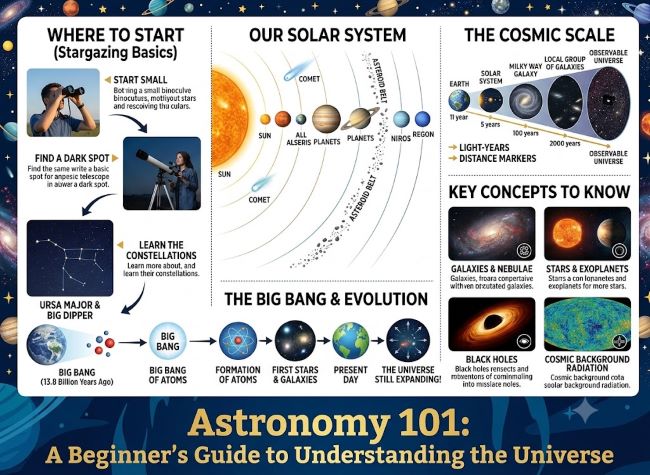
What Is Astronomy?
At its simplest, astronomy is the study of everything beyond Earth’s atmosphere. That includes the Moon, the Sun, planets, stars, galaxies, and the vast space between them. It is one of the oldest sciences, practiced in some form by nearly every ancient civilization, long before telescopes existed.
A common point of confusion worth clearing up early in any astronomy 101 discussion is the difference between astronomy and astrology. Astronomy is a science, based on observation, evidence, and physics. Astrology is the belief that the positions of celestial objects influence human lives and events, and it is not supported by scientific evidence. They share ancient roots, but only astronomy is a scientific discipline.
Modern astronomy splits into several branches. Observational astronomy focuses on collecting data through telescopes and instruments. Theoretical astronomy uses physics and mathematics to explain what observers see. Astrophysics, often used interchangeably with astronomy today, applies the laws of physics to understand how celestial objects form, behave, and evolve.
The Solar System: Our Cosmic Neighborhood
The best place to start any astronomy 101 journey is close to home, with the solar system. This is the collection of objects bound by the Sun’s gravity, and it is the part of the universe we understand best because it is the closest.
The Sun
The Sun sits at the center of everything in our solar system. It is a star, a massive ball of hot gas, mostly hydrogen and helium, that generates energy through nuclear fusion in its core. That energy is what lights and warms the planets. The Sun accounts for more than 99 percent of all the mass in the solar system, which is why its gravity holds everything else in orbit.
The Planets
Eight planets orbit the Sun, and they fall into two broad groups.
The four inner planets, Mercury, Venus, Earth, and Mars, are called terrestrial planets. They are relatively small, rocky, and dense. Earth is the only one known to support life, sitting in the zone where temperatures allow liquid water to exist on the surface.
The four outer planets, Jupiter, Saturn, Uranus, and Neptune, are called gas giants, though the outermost two are sometimes specifically called ice giants. These are enormous compared to the terrestrial planets, made mostly of gases and liquids with no solid surface to stand on. Jupiter alone is so large that all the other planets could fit inside it with room to spare.
Everything Else
The solar system contains far more than just the Sun and eight planets. Dwarf planets like Pluto, Ceres, and Eris are round objects that orbit the Sun but have not cleared their orbital neighborhoods of other debris. Moons orbit most of the planets, with some, like Jupiter’s moon Ganymede, larger than the planet Mercury.
The asteroid belt, a region between Mars and Jupiter, holds millions of rocky objects. Beyond Neptune lies the Kuiper Belt, an icy region that includes Pluto, and far beyond that, the theorized Oort Cloud, thought to be the source of many comets. Comets themselves are icy bodies that develop glowing tails when they approach the Sun and their ice begins to vaporize.
Understanding Stars
Once you move past the solar system, stars become the main characters of astronomy. Every point of light you see twinkling at night, with very few exceptions, is a star, and many are far larger and brighter than our Sun.
What Stars Actually Are
A star is a giant sphere of plasma held together by its own gravity, generating energy through nuclear fusion. In most stars, including the Sun, this fusion combines hydrogen into helium, releasing enormous amounts of energy in the process. That outward push of energy balances against the inward pull of gravity, keeping the star stable for millions or billions of years.
The Life Cycle of Stars
One of the most important ideas in astronomy 101 is that stars are not permanent. They are born, they live, and they die, over timescales far longer than human history.
Stars form inside vast clouds of gas and dust called nebulae. Gravity pulls material together until the core becomes hot and dense enough for fusion to begin, and a new star ignites. How a star lives and dies depends mostly on its mass.
Smaller and medium stars like the Sun burn steadily for billions of years, then swell into red giants as they run low on fuel, eventually shedding their outer layers and leaving behind a dense, cooling core called a white dwarf.
Massive stars live faster and die more violently. When they run out of fuel, they collapse and explode in a supernova, one of the most energetic events in the universe. What remains can become an incredibly dense neutron star or, for the most massive stars, a black hole, a region where gravity is so strong that not even light can escape.
Why Stars Have Different Colors
If you look closely, stars are not all the same color. Some appear bluish, others white, yellow, orange, or red. That color reveals the star’s temperature. Blue stars are the hottest, while red stars are the coolest. Our Sun, a yellow star, sits somewhere in the middle. This relationship between color and temperature is one of the most useful tools astronomers have for understanding stars from a distance.
Galaxies: Cities of Stars
Stars do not float alone in space. They gather into enormous collections called galaxies, held together by gravity.
Our Galaxy: The Milky Way
We live in a galaxy called the Milky Way, a spiral-shaped collection of hundreds of billions of stars. On a very dark night, you can actually see part of it as a faint, milky band stretching across the sky, which is how it got its name. That band is the combined light of countless stars in the disk of our galaxy, seen edge-on from our position inside it.
Our solar system sits in one of the Milky Way’s spiral arms, roughly partway out from the center. At the very center lies a supermassive black hole, millions of times more massive than the Sun, around which the entire galaxy slowly rotates.
Types of Galaxies
Galaxies come in several shapes. Spiral galaxies, like the Milky Way, have a central bulge with arms winding outward. Elliptical galaxies are more rounded or oval, often containing older stars. Irregular galaxies lack a clear shape, often the result of gravitational interactions or collisions with other galaxies.
The Scale of It All
The numbers in astronomy are almost impossible to truly grasp, and this is where an astronomy 101 perspective really opens up. The Milky Way contains hundreds of billions of stars. And the Milky Way is just one of an estimated two trillion galaxies in the observable universe. The scale is so large that astronomers measure distances in light-years, the distance light travels in a year, which is about 6 trillion miles. Even at that enormous unit, the nearest large galaxy to ours, Andromeda, is about 2.5 million light-years away.
How We Measure the Universe
A natural question in astronomy 101 is how anyone can possibly know the distance, size, or composition of objects trillions of miles away. Astronomers cannot travel to these objects, so they rely on clever indirect methods.
Light is the key. Almost everything we know about the universe comes from studying the light that reaches us. By spreading starlight into its component colors, a technique called spectroscopy, astronomers can determine what a star is made of, how hot it is, and even how fast it is moving toward or away from us.
For distance, astronomers use a toolkit of methods often called the cosmic distance ladder. Nearby objects can be measured using parallax, the tiny apparent shift in a star’s position as Earth orbits the Sun. For more distant objects, astronomers use certain types of stars and exploding stars whose true brightness is known, comparing that to how bright they appear in order to calculate distance.
One of the most important discoveries in astronomy came from this kind of measurement: the realization that distant galaxies are moving away from us, and that the farther away they are, the faster they recede. This was the first strong evidence that the universe is expanding.
The Big Bang and the Expanding Universe
If the universe is expanding, then running that expansion backward in time leads to a profound conclusion: everything was once packed together in an extremely hot, dense state. This is the foundation of the Big Bang theory, the leading scientific explanation for how the universe began.
According to this theory, the universe began roughly 13.8 billion years ago, not as an explosion in space, but as the rapid expansion of space itself from that initial dense state. In the earliest moments, the universe was too hot for even atoms to form. As it expanded and cooled, particles came together to form the first simple atoms, then over hundreds of millions of years, gravity pulled matter together to form the first stars and galaxies.
Strong evidence supports this picture. The cosmic microwave background, a faint glow of radiation filling the entire sky, is widely understood as leftover heat from the early universe. The observed expansion of the universe and the relative amounts of the lightest elements also match what the theory predicts.
A more recent and still mysterious discovery is that the expansion of the universe is not slowing down as you might expect from gravity, but actually speeding up. The cause is attributed to something called dark energy, which remains one of the biggest open questions in modern astronomy. Alongside it sits dark matter, an invisible form of matter that does not emit light but whose gravity affects how galaxies move. Together, dark matter and dark energy appear to make up most of the universe, while everything we can actually see makes up only a small fraction.
Getting Started With Stargazing
The good news about astronomy 101 is that you do not need expensive equipment to begin. Some of the most rewarding observing can be done with nothing but your eyes and a willingness to look up.
Start With the Naked Eye
Before buying any gear, spend time simply observing. Find a spot away from bright lights, let your eyes adjust to the dark for about 20 minutes, and start noticing patterns. Learn to identify a few constellations, which are recognizable patterns of stars that have served as a sky map for thousands of years. The Big Dipper, Orion, and Cassiopeia are good starting points in the northern sky.
You can also spot planets with the naked eye. Venus often appears as a brilliant point of light near sunrise or sunset, and Jupiter, Mars, and Saturn are all visible at various times of year, usually shining more steadily than twinkling stars.
Binoculars Before a Telescope
Many beginners rush to buy a telescope and end up frustrated by a tool they do not yet know how to use. A good pair of binoculars is often a better first step. They are easier to handle, reveal craters on the Moon, the moons of Jupiter, and countless stars invisible to the naked eye, and they cost far less than a telescope.
Using a Telescope
When you are ready for a telescope, the most useful advice is to match the telescope to your interests and learn its basics before expecting dramatic results. Telescopes gather and magnify light, revealing detail on the Moon and planets and faint objects like distant galaxies and nebulae. Patience matters, since finding and focusing on objects takes practice.
Helpful Tools and Habits
A few simple things make stargazing easier. Free astronomy apps can identify stars, planets, and constellations just by pointing your phone at the sky. Checking the Moon’s phase helps, since a bright full Moon can wash out fainter objects. And dark skies make an enormous difference, which is why dedicated observers often travel away from cities to darker locations.
Why Astronomy Matters
Beyond the wonder of it, astronomy has shaped human knowledge in practical and profound ways. Early astronomy gave us calendars, navigation, and timekeeping. The study of how objects move in space helped develop the physics that underpins much of modern science. And the ongoing search to understand the universe continues to drive advances in technology, imaging, and our basic understanding of reality. Some of those advances reach into how we communicate through space itself, such as laser satellite communication, which uses focused light to send data across vast distances much the way astronomers read the light arriving from distant stars.
There is also something deeper that an astronomy 101 perspective offers. Studying the universe puts human life in context. The atoms that make up your body were forged inside stars that died long before the Sun existed. In a real, physical sense, we are made of star material, connected to the cosmos we look up at. That idea alone is reason enough for many people to keep looking up.
Key Takeaways
- Astronomy is the scientific study of everything beyond Earth’s atmosphere, and it is distinct from astrology, which is not a science.
- The solar system is centered on the Sun, with eight planets divided into small rocky terrestrial worlds and large gas and ice giants, plus moons, dwarf planets, asteroids, and comets.
- Stars are giant spheres of plasma powered by nuclear fusion, and they are born, live, and die over millions or billions of years, ending as white dwarfs, neutron stars, or black holes depending on their mass.
- A star’s color reveals its temperature, with blue stars being the hottest and red stars the coolest.
- Galaxies are massive gravity-bound collections of stars, and our Milky Way is one of an estimated two trillion galaxies in the observable universe.
- Astronomers measure the universe mostly by studying light, using spectroscopy for composition and a ladder of techniques for distance.
- The Big Bang theory describes the universe expanding from a hot, dense state about 13.8 billion years ago, supported by evidence like the cosmic microwave background.
- Dark matter and dark energy appear to make up most of the universe and remain among the biggest unsolved mysteries in modern astronomy.
- Beginners can start stargazing with just their eyes, then binoculars, before moving to a telescope, using dark skies and astronomy apps to make the most of it.