How Industrial Form Is Reshaping Residential Design: The Architectural Language of Modern Metal Buildings
Drive through almost any American small town built in the last decade and a new architectural language starts to surface. Long rectangular structures with metal roof systems, deep porches grafted onto industrial form, residential windows clustered against industrial cladding, and an overall composition that reads as half workshop, half home. These are not aesthetic accidents. They reflect a real design movement that has been gathering momentum since around 2018, and that design press has been slower to engage with than the buildings deserve.
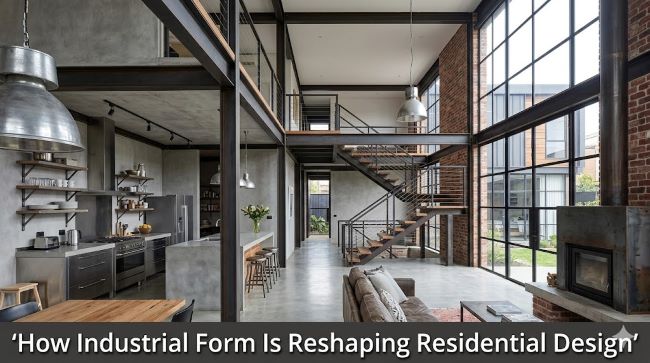
The category covers several related but distinct typologies. Barndominiums use metal building shells finished entirely as residences. Pole barn homes do similar with wood-column construction and metal cladding. Shouses combine workshop and residence under a single envelope. Carriage houses and accessory dwelling units sometimes borrow the same vocabulary. All of them draw on industrial structural systems originally designed for agricultural and commercial buildings, and all of them treat that industrial language as a design feature rather than a problem to disguise.
This piece looks at the design language emerging across these typologies, the moves that work, the moves that struggle, and what designers can take from this movement that applies more broadly.
The structural inheritance
The structures these buildings come from were never designed for residential aesthetic. Steel clear-span buildings were developed in the mid-twentieth century to span wide unobstructed interiors for industrial use. Agricultural metal buildings descended from the same engineering tradition. The standard product offering from steel building manufacturers assumes a rectangular footprint, a single ridge line, eave heights from 12 to 24 feet, and exterior cladding in corrugated metal panels or insulated metal panels (IMPs).
That structural inheritance shapes everything that follows. Residential designs working with metal building shells have to make peace with the long rectangular form, the continuous ridge, the cladding language, and the structural module dictated by the steel frame. The buildings that work as architecture are the ones that work with this inheritance, not against it. The buildings that disappoint usually try to disguise the form with applied residential detailing and end up looking like a workshop wearing a costume.
The successful designs accept the rectangular form and turn it into a feature. Long horizontal compositions read as deliberate when the proportions are right and as awkward when they are not. The 2:1 to 4:1 footprint ratios common in metal building construction (40 by 80, 50 by 100, 60 by 120) compose better than the closer-to-square ratios that residential architects often default to. The buildings that ignore this end up over-detailed and visually busy.
Three design moves that consistently work
A few specific design strategies recur across the successful examples in this category.
Differentiated end treatment. The two short ends of the rectangular form get different treatment, signaling the dual function of the structure or differentiating the residential face from the workshop face. The residential end gets clustered residential windows, a covered porch projection, finished cladding (often shiplap, stone wainscot, or board-and-batten) and residential-scale doors. The workshop end gets overhead doors, larger industrial windows, and continued metal cladding. The transition between the two faces happens along the long elevation, often with the transition wall marked externally by a change in material or color.
This works because it tells the truth about what the building is. A shouse is two functions under one envelope. A barndominium with an attached garage is a residence with a working bay. Designing the exterior to read as these things, rather than disguising them, results in compositions that look intentional rather than compromised.
Roof line continuity. The single ridge line that comes with metal building construction does not lend itself to the broken roof forms common in suburban residential architecture. The successful designs in this category keep the ridge unbroken across the full length and use other moves (porch projections, dormers, eyebrow windows) to add visual interest without breaking the structural silhouette. Buildings that try to add cross-gables, hip roofs, or other roof breaks usually look forced because the structural system fights against them.
Material restraint. The most legible designs in the category use two or three exterior materials maximum. A standard composition might be: metal roof panels in standing seam, metal wall cladding in horizontal corrugated panels for the workshop section, finished cladding (wood, shiplap, fiber cement) for the residential section, and a stone wainscot base course. Adding more materials than this usually muddles the composition. The structural system is already imposing a strong visual language, and adding too many secondary materials creates visual noise.
The shouse and the typological turn
The shouse (shop plus house) is the typology in this family that pushes the design vocabulary furthest, because it has to integrate two genuinely different functions in a single structure rather than treat the workshop as a supporting wing.
The design challenges that result are non-trivial. The two sides of the firewall need different environmental conditioning, different lighting strategies, different acoustic treatment, different aesthetic finish. The transition zone (typically a mud room of 6 by 10 to 8 by 10 feet) carries more daily traffic than equivalent spaces in conventional homes. Window placement on the kitchen wall fights against the structural logic that consolidates plumbing on the shop-facing side. Vehicular access patterns shape the orientation of porches and entry sequences.
These are interesting design problems. A contextual analysis of the shouse design typology documents how owners and designers have been solving them across different regions and use cases, with patterns that translate to other mixed-use architectural problems. The typology rewards designers who engage with it seriously rather than treating it as a sub-category of standard residential work.
What is interesting about the shouse design conversation, from a broader design perspective, is that it is one of the few residential typologies that explicitly designs for function gradients within a single envelope. Most residential architecture in North America assumes a single function (dwelling) and treats workshop, hobby, or small commercial activity as something to be added in detached outbuildings. The shouse rejects that separation and treats both functions as part of the primary architectural problem. The design moves that result (firewall as architectural feature, transition zones, asymmetric envelope treatment) have applications beyond rural construction.
What design education has not caught up with
Most residential architectural training in North America still assumes traditional stick-built or masonry construction. Working with steel building shells requires a different skill set: understanding the structural module, working with the panel sizes, designing within the eave height options, and knowing how the envelope details (girts, purlins, fastener patterns) affect both exterior aesthetics and interior wall plane.
Designers entering this space without that knowledge often produce designs that look promising on paper but fight the construction system on site. The buildings that get built are the ones where the architect understood the structural language at the schematic stage and designed with it. The buildings that get abandoned mid-construction are usually the ones where the architect designed first and then asked the metal building supplier to make it work.
This gap is closing. A small but growing set of architects in the US, particularly in Texas, the Mountain West, and rural Florida, have built specializations around residential metal building design. Their work is shaping how the broader profession will engage with this category. Design education has not yet caught up, but the practice is ahead of the curriculum.
The aesthetic implications
The buildings in this category represent a small but real shift in residential design vocabulary. They are showing that industrial structural language can carry residential meaning when designers work with the form rather than against it. They are reintroducing the long horizontal building as a viable residential type after decades of compact suburban forms dominating new construction. They are showing that workshop, hobby, and small commercial functions can integrate cleanly into residential architecture rather than getting exiled to outbuildings.
What the movement does not do is offer aesthetic universality. These designs work on rural and peri-urban sites with adequate setback and visual breathing room. They do not work on tight urban infill lots. They do not work as midrange suburban houses. The structural logic of metal building construction asks for specific site conditions, and the design vocabulary works best when those conditions are present.
For designers working in the right contexts, the category is worth engaging with seriously. The aesthetic problem is interesting. The construction system is well understood. The market is large enough to support specialization. The buildings reward design intelligence in a way that standard residential templates do not, because the structural inheritance forces the designer to make real decisions rather than fall back on convention.
Closing
The architectural language of modern metal buildings is developing in real time, mostly outside the conversations that design press covers. The buildings worth studying are not the ones featured in glossy magazines but the ones being built in rural counties across the United States by owners and small designers who understand the structural inheritance and work with it. The design moves that consistently work cluster around honest expression of function, restrained material palette, and respect for the structural language the building came from.
For designers interested in this category, the most productive starting point is direct study of completed buildings in the regions where the typology is mature. The patterns that work, and the patterns that disappoint, become clear quickly. The opportunity to shape what comes next in this space is real, and the design profession is collectively still early in engaging with it.