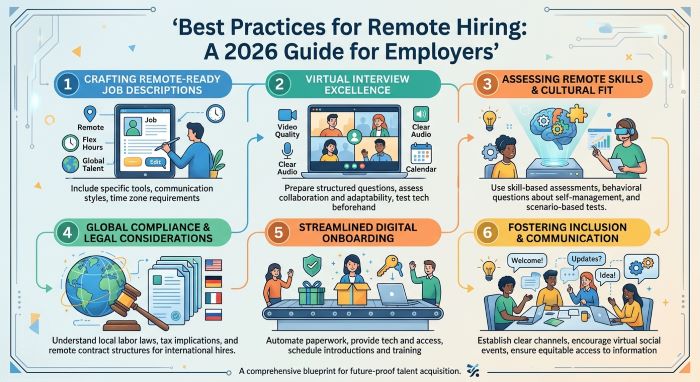
Best Practices for Remote Hiring
Remote hiring has changed a lot in the past few years. Fully remote roles are now much rarer, which means each remote opening attracts a huge number of applicants. At the same time, AI generated applications and hiring fraud have made screening harder than ever.
This guide covers the best practices for remote hiring in 2026, from writing the job post to onboarding your new team member, with current market data and practical checklists.
The Remote Hiring Market in 2026
Remote roles are in high demand but short supply. According to Robert Half’s analysis of US job postings in the second quarter of 2026:
| Work Arrangement | Share of New Job Postings (Q2 2026) |
|---|---|
| Fully on site | 87% |
| Hybrid | 10% |
| Fully remote | 3% |
Meanwhile, workers still want flexibility. Robert Half found that 39% of professionals planning a job search in the second half of 2026 say more remote flexibility is a top reason, and 64% of all workers say work life balance and remote options would motivate them to switch jobs.
That gap means two things for employers:
- Remote roles attract huge applicant pools, so screening must be efficient.
- Remote work is a powerful recruiting advantage, so it’s worth doing well.
Best Practices for Remote Hiring: Before You Post
1. Decide What “Remote” Really Means
Be specific. Candidates want to know:
- Fully remote, remote first, or hybrid?
- Which states or countries can you hire in?
- Which time zones must overlap?
- Any travel or in person meetups?
2. Define the Role Clearly
Write down the outcomes the person must deliver in 30, 60, and 90 days. This keeps the process focused on results, not just resumes.
3. Set the Pay Range
Many states and cities now require pay ranges in job postings, including Colorado, California, Washington, New York, and others. Because remote postings can be seen and applied to from many places, most employers list a range in every remote post. Decide if you’ll pay one national rate or adjust by location.
Writing a Strong Remote Job Post
A great remote job post includes:
- Clear title without jargon
- Location rules: “Remote, US only (excluding X state)” or “Remote, must overlap 10 a.m. to 2 p.m. ET”
- Pay range and benefits
- Equipment and stipends: Laptop, home office, internet
- Tools you use: Slack, Zoom, Notion, GitHub, and so on
- How the hiring process works: Number of steps and timeline
- Company culture: How the team communicates and collaborates
Screening Candidates Efficiently
Remote posts can draw hundreds or thousands of applicants. These best practices for remote hiring help you manage the flood:
- Use knockout questions. Ask about work authorization, location, and time zone up front.
- Use an applicant tracking system to sort and track candidates.
- Add a short, relevant exercise. A 20 to 30 minute task is better than a long unpaid project.
- Review writing samples. Remote work depends on clear written communication.
- Be careful with AI screening tools. They can save time, but check them for bias and follow local laws on automated hiring decisions.
Preventing Remote Hiring Fraud
Remote hiring fraud has grown fast. Some candidates use fake identities, AI generated resumes, deepfake video, or proxies to pass interviews. Protect your company with these steps:
- Verify identity with a secure ID check before the final round.
- Require cameras on for video interviews.
- Ask follow up questions that need real time thinking, not scripted answers.
- Check references by calling them directly, not just by email.
- Confirm the shipping address for company equipment matches the candidate’s verified address.
- Run background checks that follow federal and state rules.
- Watch for red flags like mismatched names, refusal to appear on video, or a voice that doesn’t sync with the video.
Remote Interviewing Best Practices
| Stage | Format | Purpose |
|---|---|---|
| Recruiter screen | 20 to 30 min video call | Basics, motivation, logistics |
| Skills assessment | Short task or live exercise | Test real job skills |
| Hiring manager interview | 45 to 60 min video call | Experience, problem solving |
| Team interview | Panel or series of short calls | Collaboration and culture add |
| Final check | Reference and identity checks | Confirm fit and verify identity |
Interview tips:
- Use structured questions so every candidate is judged fairly.
- Ask about past remote experience and how they manage their time.
- Test communication skills, both written and spoken.
- Give candidates time to ask questions about remote culture.
- Respect time zones when scheduling.
Hiring Across States and Countries
Hiring remotely means following the rules where the employee lives, not just where your company is based.
In the US:
- Register as an employer in the employee’s state
- Withhold the right state and local taxes
- Follow that state’s paid leave, minimum wage, and final pay rules
- Complete Form I-9 within three business days of the start date, using remote verification options if your company qualifies
Internationally:
- Use an Employer of Record (EOR) to hire legally without opening a local company
- Or hire as contractors, but be careful about misclassification
- Watch for permanent establishment tax risks
When in doubt, talk to an employment lawyer or a payroll provider that specializes in remote teams.
Making the Offer
- Move fast. Top remote candidates often have several offers.
- Put everything in writing, including pay, benefits, equipment, and expectations for working hours.
- Explain how performance will be measured.
Onboarding Remote Employees
Good onboarding is one of the most overlooked best practices for remote hiring. A strong first week builds trust and speeds up productivity.
Before day one:
- Ship equipment early
- Set up accounts and access
- Send a welcome message and schedule
First week:
- Assign a buddy or mentor
- Hold daily check ins
- Introduce key teammates over video
- Share written guides and documentation
First 90 days:
- Set clear goals for 30, 60, and 90 days
- Hold weekly one on ones
- Gather feedback on the onboarding experience
Remote Hiring Checklist
| Step | Done? |
|---|---|
| Define remote policy and location rules | ☐ |
| Write job post with pay range | ☐ |
| Add knockout questions | ☐ |
| Prepare short skills assessment | ☐ |
| Use structured interview questions | ☐ |
| Verify identity before offer | ☐ |
| Check state or country compliance | ☐ |
| Ship equipment before day one | ☐ |
| Assign onboarding buddy | ☐ |
| Set 30/60/90 day goals | ☐ |
Common Mistakes to Avoid
- Copying an office job post without changing it for remote work
- Hiring in states or countries you aren’t set up for
- Skipping identity checks
- Using long, unpaid take home projects
- Ignoring time zone needs
- Onboarding with only documents and no human contact
Tools That Support Remote Hiring
| Tool Type | What It Does |
|---|---|
| Applicant tracking system (ATS) | Organizes candidates and hiring steps |
| Video interview platform | Hosts live and recorded interviews |
| Skills assessment tool | Tests job related skills online |
| Identity verification service | Confirms candidates are who they say they are |
| Employer of Record (EOR) | Handles payroll and compliance abroad |
| E-signature tool | Speeds up offers and paperwork |
Measuring Remote Hiring Success
Track these metrics to improve your process:
- Time to hire: Days from posting to accepted offer
- Offer acceptance rate: Share of offers accepted
- Quality of hire: Performance ratings after 90 days
- 90 day retention: How many new hires stay past three months
- Candidate experience: Survey feedback from applicants
Review these numbers each quarter. Small changes, like shorter assessments or faster scheduling, can make a big difference. Applying best practices for remote hiring consistently, and measuring results, helps your team hire better every round. Teams that review their best practices for remote hiring often also build a stronger employer brand.
Candidate Experience Matters
Remote candidates judge your company by how you treat them. Reply quickly, share clear timelines, and close the loop with every finalist, even those you don’t hire.
Document Your Process
Write down each hiring step, scoring rubric, and decision. Clear records keep hiring fair and help new managers follow the same process.
Frequently Asked Questions
What are the most important best practices for remote hiring? Clear job posts with pay ranges, structured interviews, identity verification, legal compliance, and strong onboarding.
How long should a remote hiring process take? Many companies aim for two to four weeks from application to offer.
Should remote employees be paid less? It depends on your pay strategy. Some companies use one national rate, while others adjust by location.
Can I hire remote workers in other countries? Yes, usually through an Employer of Record or as contractors, following local laws.
Final Thoughts
Following the best practices for remote hiring helps you stand out to top talent and avoid costly mistakes. With fully remote roles making up only a small share of postings in 2026, a clear, fair, and secure process gives your company a real edge. Plan carefully, screen smartly, verify identities, and onboard with care.
Key Takeaways
- Best practices for remote hiring start with a clear remote policy and a job post that lists location rules and pay.
- Only about 3% of new US job postings were fully remote in Q2 2026, so remote roles draw large applicant pools.
- Use knockout questions, short skills tests, and structured interviews to screen efficiently.
- Verify identity and check references to prevent remote hiring fraud.
- Follow tax and labor rules in the state or country where each employee lives.
- Strong onboarding with equipment, a buddy, and clear goals builds early success.