When Did Women Get the Right to Vote? A Clear Look at the History
It is easy to take voting for granted today, but the right was hard won, and for half the population it came surprisingly late. The fight for women’s suffrage spanned decades and looked different in every country. So when did women get the right to vote, and why did it take so long? The short answer for the United States is 1920, but the fuller story stretches across the globe and reveals just how uneven the road to equality was. Here is a clear breakdown.
The short answer for the United States
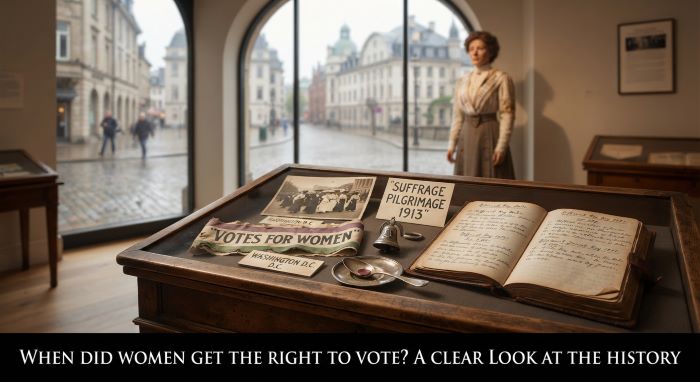
In the United States, women got the right to vote in 1920 with the ratification of the 19th Amendment. Congress passed it in 1919, and it was ratified on August 18, 1920, then formally certified on August 26. The amendment barred states from denying the vote based on sex. So when someone asks when did women get the right to vote in America, the headline date is 1920, the result of a suffrage movement that had campaigned for more than 70 years.
The long road to 1920
The push did not appear overnight. The organized movement in the US traces back to the Seneca Falls Convention in 1848, where activists first demanded voting rights. Decades of marches, petitions, and protests followed. Some western states and territories granted women the vote much earlier, with Wyoming leading the way in 1869. But a nationwide guarantee took until 1920.
Understanding when did women get the right to vote also means recognizing what the 19th Amendment did not fix. On paper it covered all women, but in practice many women of color, especially Black women in the South, still faced barriers like poll taxes and literacy tests. For millions of them, real access did not arrive until the Voting Rights Act of 1965. So the 1920 date is the legal milestone, though full participation came later for many.
When did women get the right to vote around the world
The United States was far from first. Several countries acted earlier, and a few lagged much further behind. Looking globally gives a fuller answer to when did women get the right to vote:
| Country | Year women could vote nationally |
|---|---|
| New Zealand | 1893 |
| Australia | 1902 |
| Finland | 1906 |
| United Kingdom | 1918, then equal terms in 1928 |
| Canada | 1918 |
| United States | 1920 |
| France | 1944 |
| Switzerland | 1971 |
| Saudi Arabia | 2015 |
New Zealand holds the honor of being the first self-governing country to grant women the national vote, back in 1893. Finland went a step further in 1906, becoming the first to let women both vote and run for parliament. These early movers show that the answer to when did women get the right to vote depends heavily on where you look.
The countries that waited longest
The gap between the earliest and latest is striking. While New Zealand acted in the 1800s, Switzerland did not grant women the vote at the federal level until 1971, and one Swiss region held out even longer at the local level. Saudi Arabia only allowed women to vote in 2015. These late dates are a reminder that the question of when did women get the right to vote does not have a single global answer, and that progress came in waves rather than all at once.
Why the timing varied so much
Several factors shaped the pace in each country:
- Social attitudes about the role of women in public life
- The strength and organization of local suffrage movements
- Political systems and how open they were to reform
- Major events like world wars, which shifted public opinion as women took on new roles
In the United Kingdom, for example, women’s contributions during the First World War helped build support, leading to partial voting rights in 1918 for women over 30, then full equality with men in 1928. That two-step pattern shows how the answer to when did women get the right to vote can involve more than one date even within a single country.
Why it still matters
Knowing when did women get the right to vote is not just trivia. It is a reminder that rights many people now consider basic were once denied and had to be fought for. The suffrage movements that won these battles used organizing, persistence, and public pressure, and their methods influenced later civil rights efforts around the world.
The story also encourages a fuller view of history. The 1920 date in the US is a landmark, but the continued struggle for equal access afterward shows that winning a law on paper is only part of the work. Real, universal participation often took decades more.
The bottom line
So when did women get the right to vote? In the United States, the answer is 1920, thanks to the 19th Amendment, though full access for all women came later. Globally, the dates range from 1893 in New Zealand to 2015 in Saudi Arabia. The timeline is uneven, but the through line is clear: women’s suffrage was earned through long, determined effort, and it reshaped democracy everywhere it took hold.
Key Takeaways
- In the United States, women got the right to vote in 1920 with the ratification of the 19th Amendment, ratified August 18 and certified August 26.
- The US movement began with the 1848 Seneca Falls Convention, and some states like Wyoming (1869) granted the vote decades before the national amendment.
- The 19th Amendment covered all women on paper, but many women of color faced barriers until the Voting Rights Act of 1965.
- New Zealand was the first self-governing country to grant women the national vote in 1893, and Finland was first to let women both vote and run for office in 1906.
- Other milestones include the UK (1918, then full equality in 1928), Canada (1918), France (1944), and Australia (1902).
- Some countries waited much longer, with Switzerland granting federal voting rights in 1971 and Saudi Arabia in 2015.
- The varied timing reflects differences in social attitudes, movement strength, political systems, and events like the world wars.