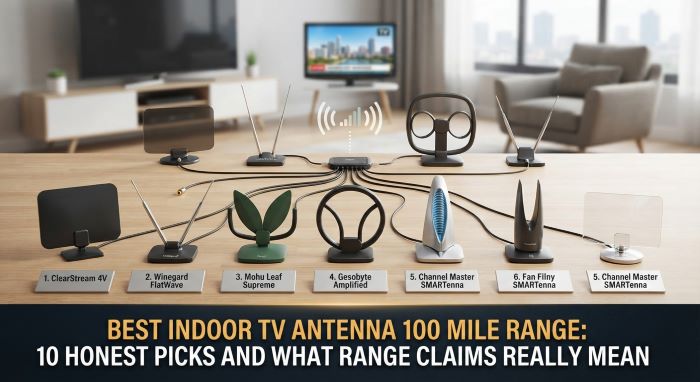
Best Indoor TV Antenna 100 Mile Range: 10 Honest Picks and What Range Claims Really Mean
Free over-the-air TV is one of the best deals in home entertainment. You pay once for an antenna, plug it in, and get local news, sports, and network shows in high definition with no monthly bill. If you live far from the broadcast towers, you have probably typed “best indoor tv antenna 100 mile range” into a search box and found hundreds of cheap flat panels that promise 100, 250, or even 1,000 miles.
Here is the plain truth. No indoor antenna reliably pulls in stations from 100 miles away. Those numbers are marketing. What you can do is pick a well-built antenna with strong tested reception, place it well, and get the most channels your location allows. This guide lists 10 specific picks, compares them in a table, and explains how to squeeze every mile out of your setup.
The Truth About 100-Mile Range Claims
TV signals travel mostly in straight lines. The earth curves, so a tower’s signal drops below the horizon at a certain distance. For most full-power stations, that practical limit sits around 60 to 70 miles, and less if hills or buildings stand in the way. An indoor antenna sits low, behind walls, which cuts range further.
No independent standard governs the range printed on a box. A seller can write any number. Reviewers who test these products report the same pattern again and again: models that claim hundreds of miles often perform no better, and sometimes worse, than modest antennas from known brands. Consumer Reports, for example, found weak results from a low-cost model that claimed a 550-mile range.
So what should you do with the phrase “100-mile range”? Treat it as a sign that you need the strongest reception you can get, and judge antennas by tested performance and design.
What to Look For in a Long-Range Indoor Antenna
- Amplification: An amplifier boosts weak signals from far towers. It helps most when you are 35 miles or more away or use a long cable. Near towers, it can overload the tuner and hurt reception.
- VHF and UHF support: Most stations use UHF, but many markets still have major networks on VHF. Flat antennas are often weak on VHF. Check your local stations first.
- Size: Bigger elements catch more signal. A tiny panel cannot match a larger design.
- Cable length: A long coaxial cable lets you reach a window or a high wall.
- Indoor and outdoor rating: Some models work in an attic or on a balcony, which adds real range.
- Brand and support: Known antenna makers publish honest specs and back their products.
Keep these six points in mind as you compare models. They matter far more than the number on the box, and they are how we judged each candidate for the best indoor tv antenna 100 mile range list below.
Comparison Table: 10 Indoor Antennas for Distant Stations
| Antenna | Type | Amplified | Claimed Range | Approx. Price | Best For |
|---|---|---|---|---|---|
| Antop Mini Big Boy AT-406BV | Indoor and outdoor | Yes | 70 miles | $85 to $100 | Best reception overall |
| Antop HD Smart Bar AT-500SBS | Indoor bar | Yes | 80 miles | $60 to $70 | Longest rated indoor design |
| ClearStream 2Max | Indoor and outdoor | No | 60 miles | $80 to $100 | Attic or window mounting |
| Mohu Curve Amplified | Tabletop | Yes | 60 miles | $80 | Stylish shelf placement |
| ClearStream Max-V | Indoor and outdoor | No | 60 miles | $70 | Markets with VHF stations |
| Winegard FlatWave Amped FL5500A | Flat panel | Yes | 55 miles | $60 | Window mounting |
| Mohu Leaf 50 | Flat panel | Yes | 60 miles | $50 | Simple wall mounting |
| Philips Hover Amplified | Tabletop | Yes | 50 miles | Varies | Budget amplified pick |
| ClearStream Eclipse Amplified | Flat, sticks to wall | Yes | 50 miles | About $75 | Easy install on any surface |
| Channel Master Flatenna | Flat panel | No | 35 miles | $30 to $35 | Low-cost starter |
Claimed ranges come from the makers. Real results depend on your location, terrain, and placement. Prices change often, so check before you buy.
1. Antop Mini Big Boy AT-406BV
This compact amplified antenna earned top reception marks in Consumer Reports testing. It works indoors or outdoors, so you can start on a shelf and move it to a balcony or attic if you need more reach. It includes a built-in filter that blocks interference from cell signals. If you want the closest thing to the best indoor tv antenna 100 mile range shoppers hope for, this is the place to start.
2. Antop HD Smart Bar AT-500SBS
The Smart Bar is a wide bar-shaped antenna that mounts flat on a wall or stands on a table. Its size gives it more capture area than a thin panel. It has an adjustable amplifier, so you can turn the gain up for far stations or down for near ones. Antop rates it at 80 miles, the highest honest rating you will find among name-brand indoor designs.
3. ClearStream 2Max
Antennas Direct builds the 2Max with two loop elements for UHF and a bar for VHF. It comes with a base for indoor use and a mast clamp for outdoor use. It has no amplifier in the box, but you can add one. In an attic or upper window, it often beats flat panels by a wide margin.
4. Mohu Curve Amplified
The Curve looks like a small piece of decor. It stands on a shelf near the TV, which makes it a good match for living rooms where a wall panel would look out of place. Its amplifier helps with stations in the 40 to 60 mile band.
5. ClearStream Max-V
The Max-V suits homes where a major network broadcasts on VHF. Its design handles both bands well and works indoors or out. If your flat antenna gets every channel but one network, this model may fix the gap.
6. Winegard FlatWave Amped FL5500A
Winegard has made antennas for decades. The FlatWave Amped is a thin panel with a low-noise amplifier powered by a USB port. It comes with a long cable, so a window mount is easy. It is a solid mid-priced choice.
7. Mohu Leaf 50
The Leaf is the design that made flat antennas popular. The Leaf 50 adds an amplifier. In Consumer Reports testing, it did better with the amplifier turned off, which shows why you should always test both ways.
8. Philips Hover Amplified
This tabletop model stands upright and has a small footprint. Reviewers rate it around 50 miles. It is a reasonable budget choice for homes at a middle distance from the towers.
9. ClearStream Eclipse Amplified
The Eclipse is a round, flat antenna that sticks to walls and windows without tape or pins. You can peel it off and move it as you test spots. The amplified version rates around 50 miles. It is one of the easiest antennas to position well.
10. Channel Master Flatenna
The Flatenna is a simple, low-cost panel from a respected brand. It has no amplifier and a modest 35-mile rating. If you live closer to the towers than you thought, it may be all you need. It also makes a cheap way to test whether an antenna will work in your home at all.
What About Antennas That Claim 250 Miles or More?
Online stores are full of unknown brands that print huge range numbers. Reviewers who test them call those claims fiction. Most of these products are thin panels with a basic amplifier, much like a $20 antenna from a known maker. Some work fine for nearby stations. None deliver the range on the box.
If a listing claims more than about 80 miles for an indoor antenna, read it as a warning sign. The search for the best indoor tv antenna 100 mile range should lead you to honest specs, not bigger numbers.
How to Find Out What You Can Really Receive
Before you buy, check your location.
- Go to the FCC DTV Reception Maps page and enter your address.
- Note each station’s signal strength, band, and direction.
- Try a second tool such as RabbitEars for distance and terrain details.
- Count how many stations fall in the strong, moderate, and weak groups.
If your key stations sit 60 miles or more away with weak signals, an indoor antenna may not be enough. You will learn that for free, before you spend anything.
Setup Tips That Add Real Range
Placement matters more than the model you buy. Use these steps.
- Go high. Mount the antenna as high as you can. An upstairs room beats a basement.
- Use a window. Glass blocks less signal than brick, stucco, or metal siding. Pick a window that faces the towers.
- Aim it. Point the flat face or the front of the antenna toward the towers.
- Rescan each time. After every move, run a channel scan on the TV. Keep notes on what you get.
- Test the amplifier on and off. Use the setting that gives more stable channels.
- Keep away from electronics. Routers, LED bulbs, and other devices can add noise.
- Use good cable. RG6 coaxial cable loses less signal than thin cable. Keep runs short where you can.
- Avoid metal. Metal screens, foil insulation, and metal roofs block signals.
Indoor vs. Attic vs. Outdoor
| Location | Typical Reach | Pros | Cons |
|---|---|---|---|
| Indoor, near TV | Up to about 35 miles | Easy, no tools | Walls block signal |
| Indoor, upper window | Up to about 50 miles | Still simple | Needs longer cable |
| Attic | Up to about 60 miles | Hidden, weather safe | Roof material cuts signal |
| Outdoor, roof or mast | 60 to 70 miles or more | Best reception | Needs install and grounding |
This table shows why the best indoor tv antenna 100 mile range buyers want is often one that can also move to an attic or a mast. These figures are rough guides. Terrain can raise or lower them a lot. If you truly need distant stations, a roof antenna is the honest answer. Several picks above work in an attic or outside, which gives you a path to upgrade without buying twice.
Do You Need an Amplifier?
An amplifier does not create signal. It makes a weak signal stronger so it survives the trip down the cable and through a splitter. It also boosts noise. Use one when you are far from the towers, when you run more than about 50 feet of cable, or when you split the signal to several TVs. Skip it when you live within about 20 miles of the towers.
ATSC 3.0 and NextGen TV
Many cities now broadcast ATSC 3.0, also called NextGen TV. It can carry 4K video and better sound. You do not need a special antenna for it. Any good antenna works. You do need a TV or an external tuner that supports ATSC 3.0. Ignore boxes that label an antenna “4K” or “8K” as if that added range. An antenna only catches signals. The TV does the rest.
How Many Channels Can You Expect?
It depends on your market. A home near a large city may get 60 to 100 channels and subchannels. A rural home may get 10 or fewer. Most areas offer ABC, CBS, NBC, Fox, PBS, and The CW, plus subchannels with classic shows, movies, weather, and Spanish-language programs.
Common Mistakes to Avoid
- Buying by the range number on the box.
- Leaving the antenna behind the TV or inside a cabinet.
- Forgetting to rescan after you move it.
- Running the amplifier when you live near the towers.
- Ignoring VHF stations in your market.
- Giving up after one spot. Test at least four or five.
Frequently Asked Questions
Is there a real best indoor tv antenna 100 mile range? No indoor model reaches 100 miles in normal conditions. The Antop AT-406BV and AT-500SBS come closest to long-range performance among tested name brands.
Why do some people report 100-mile reception? Rare weather conditions can bend signals far past the horizon for a few hours. Homes on high ground with a clear path can also do better than average. Neither is something you can count on.
Will a more expensive antenna get more channels? Only to a point. Design and placement matter more than price.
Can I use one antenna for several TVs? Yes, with a splitter. Each split weakens the signal, so an amplifier may help.
Does weather affect reception? Heavy rain, wind in the trees, and summer leaves can weaken distant stations.
Can I return an antenna that does not work? Buy from a store with an easy return policy. Reception varies so much by home that testing is the only sure way to know.
When an Indoor Antenna Is Not Enough
If you tested several spots and still cannot hold your key stations, you have three options. Move the antenna to the attic. Install an outdoor antenna on the roof or a mast. Or pair the antenna with a low-cost streaming service for the channels you miss. Many network apps also stream local news for free.
Final Thoughts
The search for the best indoor tv antenna 100 mile range starts with a hard fact: indoor antennas do not reach 100 miles. Once you accept that, the path gets clear. Check your address on a reception map. Pick a tested antenna from a known brand. Mount it high in a window that faces the towers. Scan, move, and scan again.
For most distant homes, the Antop Mini Big Boy AT-406BV is the strongest starting point, and the ClearStream 2Max is the best pick if you can use an attic. With honest expectations and careful setup, your version of the best indoor tv antenna 100 mile range will be the one that holds the most stable channels in your own living room.
Key Takeaways
- No indoor antenna reliably receives stations 100 miles away. The practical limit for most homes is about 60 to 70 miles, and less indoors.
- Range numbers on the box follow no standard. Judge the best indoor tv antenna 100 mile range by tested reception, not by the claim.
- The Antop Mini Big Boy AT-406BV and Antop HD Smart Bar AT-500SBS are the strongest name-brand picks for distant stations.
- Check the FCC DTV Reception Maps for your address before you buy.
- Placement matters most: go high, use a window facing the towers, and rescan after each move.
- Use an amplifier only when you are far from the towers or use long cables and splitters.
- If indoor reception falls short, move to an attic or outdoor antenna.