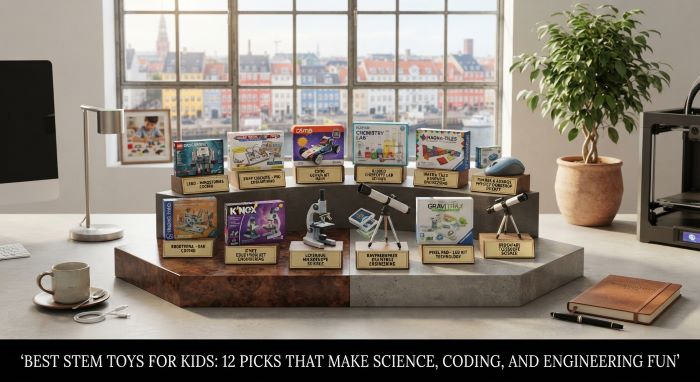
Best STEM Toys for Kids: 12 Picks That Make Science, Coding, and Engineering Fun
STEM stands for science, technology, engineering, and math. These subjects shape the world kids will grow up in, from the phones in their pockets to the bridges they cross and the medicine that keeps them healthy. The good news is that kids do not need textbooks to start exploring them. The right toys turn curiosity into hands-on experiments, building challenges, and early coding adventures.
The trick is matching the toy to the child’s age and interests. A circuit kit that thrills a 10-year-old will frustrate a 4-year-old, and a simple stacking toy will bore a middle schooler. This guide lists 12 specific toys across age groups, compares them in a table, and explains how to choose the best STEM toys for kids so learning feels like play.
What Makes a Good STEM Toy
Hands-on discovery: The best toys let kids build, test, fail, and try again. Trial and error is the heart of science and engineering.
Open-ended play: Toys that can be used many ways encourage creativity and longer play life.
Age-appropriate challenge: A toy should stretch skills without causing frustration.
Real concepts: Good STEM toys teach real ideas like circuits, gears, magnetism, gravity, coding logic, or patterns.
Replay value: Kits that can be rebuilt or expanded keep kids engaged long after the first use.
Comparison Table: Best STEM Toys for Kids
| Toy | Recommended Age | STEM Focus | Screen Needed | Approx. Price | Best For |
|---|---|---|---|---|---|
| Tegu Magnetic Wooden Block Set | 1 to 3+ | Patterns, problem solving | No | around $40 | Toddlers’ first building toy |
| Battat Take-Apart Roadster | 3+ | Engineering, fine motor | No | around $15 | Little builders with tools |
| Magna-Tiles Stardust Set | 4+ | 3D building, magnetism | No | around $21 | Open-ended building |
| Learning Resources Space Rover Deluxe Coding Set | 5+ | Screen-free coding, robotics | No | around $42 | First coding lessons |
| Osmo Pizza Co. | 5 to 12 | Math, money, business | Yes (tablet) | around $46 | Math practice through play |
| LEGO City Mars Spacecraft | 6+ | Engineering, space science | No | around $32 | LEGO fans and space lovers |
| Elenco Snap Circuits | 8+ | Electricity, engineering | No | $30 to $70 | Learning real circuits |
| NSI Smithsonian Microscope Kit | 8+ | Biology, observation | No | around $22 | Young scientists |
| K’NEX Marble Coaster Run | 8+ | Physics, mechanics | No | around $45 | Kids who love building big |
| Educational Insights Pyxel | 8+ | Coding, robotics | Yes (app) | around $31 | Coding a robot pet |
| Smartivity Robotic Mechanical Hand | 8 to 14 | Hydraulics, mechanics | No | around $30 | Hands-on engineering |
| Thames & Kosmos Kai AI Robot | 10+ | Robotics, artificial intelligence | Yes (app) | around $82 | Tweens curious about AI |
Prices change often with sales and new editions, so check current listings before you buy.
STEM Toys for Toddlers (Ages 1 to 3)
At this age, STEM learning looks like stacking, sorting, and experimenting with cause and effect. Kids learn early math concepts like size, shape, and balance through simple building.
1. Tegu Magnetic Wooden Block Set
Tegu blocks combine smooth wooden blocks with hidden magnets inside. They snap together at odd angles, which lets toddlers build structures that would topple with regular blocks. Kids explore balance, patterns, and magnetism without even realizing it.
The blocks are durable, beautiful, and grow with your child. Older kids use them to build more complex structures, so a set can last for years. For more ideas for the youngest builders, see this guide to the best toys for 1 year old, which covers early motor and cause-and-effect toys that prepare kids for STEM play.
2. Battat Take-Apart Roadster
The Battat Take-Apart Roadster comes with a kid-safe toy drill and screws. Toddlers and preschoolers take the car apart and put it back together, building fine motor skills and early engineering thinking. It shows kids that machines are made of parts that work together.
STEM Toys for Preschool and Early Elementary (Ages 4 to 7)
Kids in this range are ready for more complex building, early coding logic, and simple experiments. They ask “why” constantly, which makes it a perfect time to introduce STEM concepts.
3. Magna-Tiles Stardust Set
Magna-Tiles are a classic for good reason. These translucent magnetic tiles snap together to form flat shapes, 3D structures, towers, and buildings. Kids explore geometry, symmetry, and magnetism as they build. The Stardust set adds sparkly tiles that kids love.
Magna-Tiles grow with kids from preschool through elementary school, and many families add more sets over time.
4. Learning Resources Space Rover Deluxe Coding Set
This screen-free coding set introduces programming through a cute rover robot. Kids use coding cards to plan a sequence of moves, then program the rover to follow a path. They learn sequencing, logic, and debugging when the rover does not go where they expected.
It is one of the best STEM toys for kids who are not yet reading well, since it relies on simple symbols rather than text.
5. Osmo Pizza Co.
Osmo combines physical game pieces with a tablet. In Pizza Co., kids run a pizza shop, making pizzas to order and handling money. They practice addition, subtraction, money skills, and early business concepts like profit.
It requires a compatible tablet, so it suits families comfortable with some screen time.
6. LEGO City Mars Spacecraft
LEGO building sets teach following instructions, spatial reasoning, and engineering. The City Mars Spacecraft set adds a space science theme, sparking conversations about planets, rockets, and astronauts.
Once built, kids can redesign and rebuild, which encourages creative engineering.
STEM Toys for Older Kids (Ages 8 and Up)
Older kids can handle real circuits, coding, robotics, and science equipment. They also enjoy challenges and projects that take time to complete.
7. Elenco Snap Circuits
Snap Circuits is one of the most loved STEM toys ever made. Kids snap color-coded electronic parts onto a grid to build real working circuits, including lights, alarms, fans, and radios. Kits range from beginner sets to advanced kits with hundreds of projects.
It teaches real electronics in a safe, hands-on way. Many engineers credit Snap Circuits with sparking their interest in electronics as kids. It consistently ranks among the best STEM toys for kids ages 8 and up.
8. NSI Smithsonian Microscope Kit
A microscope opens up a hidden world. This beginner kit lets kids examine slides, leaves, hair, insects, and other everyday objects up close. It builds observation skills and introduces biology concepts.
It is affordable and a great first microscope for curious young scientists.
9. K’NEX Marble Coaster Run
K’NEX coaster sets let kids build tall roller coaster tracks for marbles. They learn about gravity, momentum, speed, and friction as they tweak their designs to make marbles travel farther and faster.
It is a hit with kids who love building big projects.
10. Educational Insights Pyxel
Pyxel is a coding robot pet. Kids use block-based coding in an app to teach Pyxel tricks, dances, and movements, and then move on to more advanced coding as they progress. It makes coding feel like caring for a pet.
11. Smartivity Robotic Mechanical Hand
This kit lets kids build a mechanical hand that grips objects using strings and levers. It teaches mechanics, levers, and how real human hands and robotic arms work. Building takes a few hours, which makes it a satisfying weekend project.
12. Thames & Kosmos Kai Artificial Intelligence Robot
The Kai AI Robot introduces tweens to artificial intelligence. Kids build the robot, then use an app to train it to recognize objects and respond to commands. It covers robotics, coding, and basic machine learning concepts.
It suits kids 10 and up who are curious about how AI works.
STEM Skills by Age
| Age | Key STEM Skills | Toy Types |
|---|---|---|
| 1 to 3 | Cause and effect, shapes, balance | Magnetic blocks, stacking toys, simple take-apart toys |
| 4 to 7 | Patterns, sequencing, early math, simple engineering | Magnetic tiles, screen-free coding robots, LEGO, math games |
| 8 to 10 | Circuits, mechanics, observation, coding logic | Snap Circuits, microscopes, marble runs, coding robots |
| 11 and up | Advanced coding, robotics, AI, chemistry | Robot kits, AI kits, chemistry sets, programmable electronics |
Screen-Free vs. App-Based STEM Toys
Screen-free toys like Tegu blocks, Magna-Tiles, Snap Circuits, and the Space Rover coding set focus on hands-on exploration. They are great for younger kids and families who want to limit screen time.
App-based toys like Osmo, Pyxel, and the Kai AI Robot use tablets or phones to add interactive lessons and advanced features. They are powerful for teaching coding and AI, but they require supervision and screen time limits.
A balanced approach often works best. Many families choose screen-free toys for younger kids and add app-based coding toys as children get older.
STEM Gifts for Tweens
Tweens often want gifts that feel grown up and connect with their interests. STEM kits like robotics sets, coding projects, chemistry kits, and DIY electronics can feel exciting rather than educational. For more ideas, see this list of the best gifts for 11-12 year olds girl, which includes creative and tech-focused gifts that pair well with STEM kits.
Active Play Also Builds STEM Skills
Not every STEM lesson happens at a table. Outdoor and active play teach physics, too. Kids learn about speed, momentum, balance, and cause and effect when they ride bikes, scooters, and ride-on toys. A ride-on vehicle like the Best Choice Products kids ride on truck car can spark conversations about batteries, motors, and how vehicles move. Ask questions like “Why does it go slower uphill?” to turn playtime into a science lesson.
How to Encourage STEM Learning at Home
- Ask open-ended questions. “What do you think will happen?” and “How could we make it better?” build scientific thinking.
- Let kids fail. Mistakes are part of engineering. Resist the urge to fix things for them.
- Join in. Building together shows that learning is fun for everyone.
- Connect to real life. Point out circuits, gears, and patterns in everyday objects.
- Celebrate curiosity. Praise questions as much as answers.
- Keep supplies handy. Cardboard, tape, string, and recycled materials make great building materials.
Subscription STEM Kits
Monthly subscription boxes deliver a new project to your door, which keeps kids engaged with fresh challenges. KiwiCo is the best-known option, with age-based lines for toddlers through teens. Projects range from simple art and science kits for young children to working machines, electronics, and engineering builds for older kids. Other subscription services focus on chemistry, coding, or nature science.
Subscriptions work well for families who want a steady stream of new activities without researching individual toys. They also make thoughtful gifts from grandparents or relatives. For many families, a subscription box rounds out a collection of the best STEM toys for kids by adding variety every month.
Budget Guide
- Under $25: NSI Smithsonian Microscope Kit, Battat Take-Apart Roadster, Magna-Tiles Stardust Set, and Snap Circuits starter kits.
- $25 to $50: Tegu Magnetic Blocks, Learning Resources Space Rover, Osmo Pizza Co., LEGO City Mars Spacecraft, K’NEX Marble Coaster, Pyxel, and Smartivity Robotic Hand.
- $50 and up: Thames & Kosmos Kai AI Robot and larger Snap Circuits or Magna-Tiles sets.
You do not need to spend a lot to find the best STEM toys for kids. Many affordable kits deliver hours of learning, and simple household materials can fill the gaps.
DIY STEM Projects With Household Items
Some of the most memorable STEM lessons cost almost nothing. Try these simple projects at home:
- Baking soda volcano: Mix baking soda and vinegar to learn about chemical reactions.
- Cardboard marble run: Tape paper towel tubes to a wall and test how angles affect speed.
- Paper airplane contest: Experiment with wing shapes to see which design flies farthest.
- Egg drop challenge: Build a container that protects an egg from a fall.
- Homemade slime: Explore states of matter with glue and contact solution.
- Bridge building: Use popsicle sticks or spaghetti to build a bridge that holds weight.
These projects pair well with store-bought kits and show kids that STEM is everywhere. Combining DIY projects with the best STEM toys for kids creates a well-rounded learning routine at home.
Storing and Organizing STEM Kits
STEM kits often come with many small parts, and lost pieces can make a kit unusable. Keep each kit in a labeled clear bin or zip bag. Store instruction booklets with the parts, or take photos of them so you can find them again later. A low shelf with bins lets kids choose a project independently and put it away when they are done. Rotating kits every few weeks keeps them feeling fresh and prevents clutter.
Safety Tips
- Check age recommendations carefully.
- Keep small parts away from children under three.
- Supervise use of magnets, since swallowed magnets are dangerous.
- Supervise science kits with chemicals or heat.
- Store batteries safely and out of reach of young children.
STEM for Girls and Boys
STEM toys are for every child. Research shows that early exposure to building, coding, and science helps all kids feel confident in these subjects later in school. Avoid labeling toys by gender, and let your child’s interests guide your choices. Many brands now design kits with diverse themes, from fashion design circuits to space exploration.
Choosing the Right Toy
Start with your child’s age and interests. For toddlers, Tegu blocks and the Battat Take-Apart Roadster build early skills. For preschoolers and early elementary kids, Magna-Tiles and the Space Rover coding set are excellent. For older kids, Snap Circuits, the NSI microscope, and K’NEX coasters provide real challenges. For tweens, robotics and AI kits like the Kai Robot open new possibilities.
The best STEM toys for kids spark curiosity, invite experimentation, and grow with your child. Pick toys that match where your child is today and leave room to stretch, and you will help build skills that last a lifetime.
Key Takeaways
- STEM toys teach science, technology, engineering, and math through hands-on play.
- Tegu Magnetic Wooden Blocks and the Battat Take-Apart Roadster are great for toddlers.
- Magna-Tiles and the Learning Resources Space Rover coding set suit preschool and early elementary kids.
- Elenco Snap Circuits teaches real electronics and remains a favorite for ages 8 and up.
- The Thames & Kosmos Kai AI Robot introduces tweens to robotics and artificial intelligence.
- Balance screen-free toys with app-based coding toys as kids get older.
- Ask open-ended questions and let kids fail and try again to build real STEM thinking.