Ray-Ban Meta Smart Glasses (Gen 2): The Complete Guide
Meta’s second-generation Ray-Ban glasses fixed the two complaints everyone had about the first pair. Battery life doubled, and video went from 30-second 1080p clips to three minutes at 3K. Everything else stayed deliberately familiar, because the original’s main achievement was looking like ordinary Wayfarers rather than like technology. Here is what the Gen 2 actually changes and whether it matters.
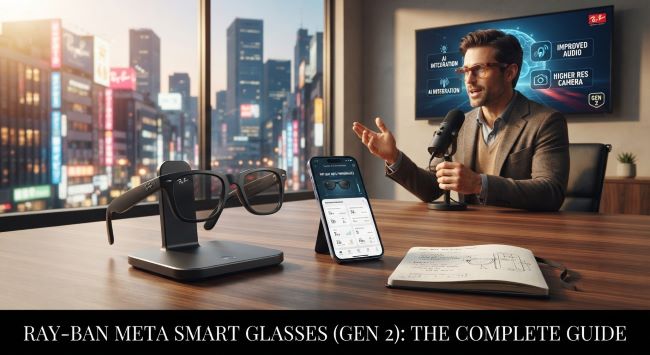
What They Are
The Ray-Ban Meta smart glasses (gen 2) are camera-and-audio glasses with a built-in AI assistant. They were announced at Meta Connect on 17 September 2025 and went on sale immediately, starting at $379 USD, £379, or AU$599.
Crucially, they have no display. These are not augmented reality glasses. There is no screen, no heads-up display, and nothing projected into your field of vision. They take photos and video, play audio, and let you talk to Meta AI.
That distinction matters because Meta announced a separate product at the same event, the Ray-Ban Display, which does have a screen and costs considerably more.
The Two Headline Upgrades
Almost everything notable about the Ray-Ban Meta smart glasses (gen 2) sits in two areas, and both address specific complaints about the original.
Battery life doubled. The first generation managed roughly four hours. Meta rates the Gen 2 at up to eight hours of typical use. Independent testing has suggested real-world gains somewhat below the doubling claim but still substantial, with the largest improvements when capturing photos and video.
Charging also improved. The glasses reach 50% in about 20 minutes in the case, and the charging case itself now holds up to 48 hours of additional charge, up from 32 hours on the original.
Video capture improved significantly. The Gen 2 records 3K Ultra HD video for up to three minutes, against 30-second 1080p clips on the first generation. Capture modes include 3K at 30fps, 1440p at 30fps, and 1200p at 60fps.
Video remains vertical, which is a deliberate choice aimed at social platforms but a limitation if you want landscape footage.
Full Specifications
| Specification | Detail |
|---|---|
| Starting price | $379 USD / £379 / AU$599 |
| Battery life | Up to 8 hours typical use |
| Fast charge | 50% in approximately 20 minutes |
| Charging case | Up to 48 hours additional |
| Video | 3K at 30fps, 1440p at 30fps, 1200p at 60fps |
| Max clip length | 3 minutes |
| Video orientation | Vertical |
| Audio | Open-ear speakers |
| Microphones | Multiple, for calls and voice commands |
| Frame styles | Wayfarer, Skyler, Headliner |
| Configurations | Around 27 across styles, colors, and lenses |
| Prescription | Supported, with dedicated Optics Styles available |
Higher-end configurations, including transition lenses, run above the base price, with reviewers reporting figures around $459 for some combinations.
Software Features
The Ray-Ban Meta smart glasses (gen 2) run Meta AI, and several features arrived alongside or shortly after launch.
Meta AI voice assistant, activated hands-free, answering questions and responding to what the camera sees.
Conversation Focus, which amplifies the voice of the person you are speaking with while reducing background noise. This is genuinely useful in noisy environments and was among the more practical additions.
Live translation, supporting conversation between multiple languages, and notably functioning in airplane mode provided the relevant language pack has been downloaded in advance.
Hyperlapse and slow motion capture modes, rolled out across Meta’s AI glasses range.
Open-ear audio for music, podcasts, and calls, audible to the wearer without blocking ambient sound, though also audible to people nearby at higher volumes.
Meta’s Glasses Range
Understanding where the Gen 2 sits helps, since Meta announced three products around the same period:
Ray-Ban Meta (Gen 2) at $379, with camera, audio, and AI but no display.
Meta Ray-Ban Display at $799, adding an actual in-lens screen controlled by a wrist-worn Neural Band using surface electromyography. Heavier, with shorter battery life, and a genuinely different category of product.
Oakley Meta Vanguard at $499, sport-focused with IP67 dust and water resistance, a wide-angle lens, louder speakers, Garmin integration, and longer battery life.
Anyone comparing these should be clear that only the Display has a screen. The Gen 2 and Vanguard differ mainly in styling and durability rather than capability.
Privacy Considerations
This deserves genuine attention rather than a footnote, because it is the most common objection to the category.
The glasses include a capture indicator light that illuminates when recording, which is the primary mechanism informing people nearby. Meta has stated the design intends to prevent covert recording.
However, reviewers consistently note that the glasses look almost identical to ordinary Ray-Bans, and the indicator is small. People in the vicinity may not notice it or understand what it means.
Practical considerations for owners:
- Local recording laws vary considerably by jurisdiction, particularly regarding audio recording and consent requirements.
- Private spaces including bathrooms, changing rooms, and medical facilities generally have specific rules and expectations.
- Some venues prohibit recording devices entirely.
- Telling people you are wearing camera glasses is basic courtesy and avoids most problems.
Anyone with specific legal questions about recording should consult local regulations rather than assuming the device’s presence implies permission.
Who They Suit
Based on capability, the Ray-Ban Meta smart glasses (gen 2) fit certain users considerably better than others.
Good fit: people who want hands-free photo and video capture during activities, anyone who wants open-ear audio without earbuds, travellers who benefit from live translation, and people who want AI assistance without pulling out a phone.
Weaker fit: anyone expecting augmented reality or a display, anyone needing landscape video, people wanting professional-quality footage, and anyone uncomfortable with the social dimension of wearing a camera on their face.
Worth considering: prescription wearers, since Meta supports prescriptions and released dedicated Optics Styles covering nearly all prescriptions, meaning these can serve as everyday glasses.
Practical Ownership Notes
A few things worth knowing.
They are still sunglasses or glasses first. Frame fit, lens choice, and comfort matter as much as the technology, and the Wayfarer, Skyler, and Headliner shapes suit different face shapes differently. Trying frames in person is worthwhile if possible, since a pair that does not sit well will not get worn regardless of features.
Lens options include standard tinted, clear, polarized, and transition lenses, with pricing varying accordingly. Transition lenses are popular for anyone wanting a single pair for indoor and outdoor use, though they add to the cost.
The case is essential, since it carries the charge. Losing it substantially undermines the product.
Software updates have added features post-launch, so capabilities have expanded since the original release.
Durability is worth considering. At least one long-term reviewer reported a hinge issue after months of use, and these are more expensive to replace than ordinary sunglasses. Ray-Ban offers a protection plan at additional cost.
Availability expanded after launch to additional countries including Switzerland, the Netherlands, Mexico, India, and Brazil.
Is It Worth Upgrading?
For first-generation owners considering the Ray-Ban Meta smart glasses (gen 2), the honest assessment depends on usage.
If battery life frustrated you, or if 30-second clips were a genuine limitation, the upgrade addresses both directly and substantially.
If you mainly use them for audio and occasional photos, the improvements are less compelling, since photo capability and the core experience are broadly similar.
For new buyers, the Gen 2 is the current version and there is little reason to seek out the original except on price, and discounted first-generation stock can represent reasonable value for anyone who mainly wants audio and casual photos.
It is also worth being realistic about what these are. They are a camera, speakers, and a microphone in a familiar frame, with an assistant attached. They do not replace a phone, they do not display information, and the video quality, while much improved, remains phone-adjacent rather than camera-quality. Bought with those expectations they are genuinely useful. Bought expecting augmented reality they will disappoint.
The bottom line is that the Ray-Ban Meta smart glasses (gen 2) launched on 17 September 2025 at $379, doubling battery life to a rated eight hours, adding 3K video capture at up to three minutes against 30-second 1080p on the original, and improving the charging case to 48 hours. They have no display, which distinguishes them from the $799 Meta Ray-Ban Display, and come in Wayfarer, Skyler, and Headliner styles across roughly 27 configurations with prescription support. Features include Meta AI, Conversation Focus, and live translation that works offline with downloaded language packs. Video remains vertical, and the privacy dimension of wearing a discreet camera deserves genuine consideration.
Key Takeaways
- The Ray-Ban Meta Gen 2 launched 17 September 2025 at Meta Connect, starting at $379 USD.
- They have no display, distinguishing them from the $799 Meta Ray-Ban Display with its in-lens screen.
- Battery life is rated up to eight hours, roughly double the first generation’s four.
- The glasses charge to 50% in about 20 minutes, and the case holds up to 48 hours.
- Video capture improved to 3K Ultra HD for up to three minutes, from 30-second 1080p clips.
- Capture modes include 3K at 30fps, 1440p at 30fps, and 1200p at 60fps, all vertical.
- Frame options include Wayfarer, Skyler, and Headliner across roughly 27 configurations.
- Prescriptions are supported, with dedicated Optics Styles covering nearly all prescriptions.
- Conversation Focus amplifies a speaker’s voice over background noise in busy environments.
- Live translation works in airplane mode when language packs are downloaded in advance.
- A capture indicator light signals recording, though it is small and easily missed by others.
- Recording laws vary by jurisdiction, and telling people you are wearing camera glasses avoids most issues.