Best Lebkuchen Near Me: Germany’s Spiced Christmas Cake
German Christmas markets smell of two things: mulled wine and lebkuchen. The second is a spiced cake somewhere between gingerbread and a soft biscuit, made in Nuremberg since medieval times, often baked on thin wafers and glazed or covered in chocolate. The finest grade contains almost no flour at all, which is not a shortcut but the legal definition of quality. If you are searching for the best lebkuchen near me, here is the guide.
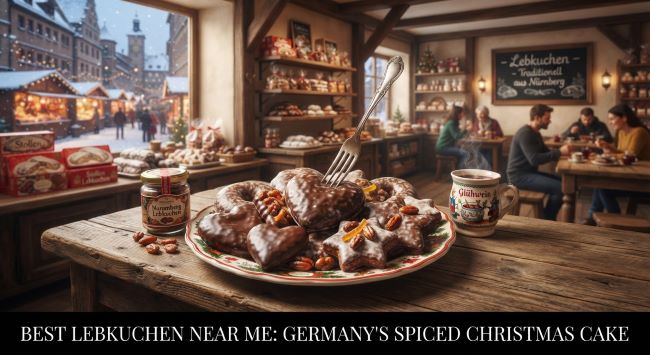
What Is Lebkuchen?
Lebkuchen is a traditional German spiced cake associated with Christmas, with roots going back to medieval monastery baking. The best lebkuchen near me typically contains:
- Honey, the traditional sweetener and a defining ingredient.
- Ground nuts, particularly almonds and hazelnuts.
- Spices, including cinnamon, cloves, nutmeg, allspice, ginger, cardamom, and anise.
- Candied citrus peel, contributing brightness.
- Very little or no flour, in the highest grades.
- An oblaten wafer base, a thin edible wafer many varieties are baked on.
- A glaze or chocolate coating, on many versions.
The texture is soft and chewy rather than crisp, and the flavor is intensely spiced and honeyed.
Elisenlebkuchen and the Quality Grades
This is the most useful thing to know in the best lebkuchen near me search, because German regulation formally defines quality levels based on nut content and flour content.
Elisenlebkuchen is the highest grade, requiring a high proportion of nuts and a very low proportion of flour, typically capped at a small percentage or none at all. It is the premium designation, and if you see it on a package it means something specific rather than being marketing language.
Lower grades permit progressively more flour and fewer nuts, producing a denser, less rich result.
For anyone buying lebkuchen seriously, looking for Elisenlebkuchen is the shortcut to quality. The difference between it and a basic supermarket version is substantial.
Nürnberger Lebkuchen
The other designation worth knowing is geographic. Nürnberger Lebkuchen holds Protected Geographical Indication status in the European Union, meaning it can only be made in Nuremberg.
Nuremberg’s association with the cake dates back centuries, tied to the city’s position on medieval spice trading routes, which gave its bakers access to the imported spices the recipe depends on. The city’s Christmas market remains the most famous place to buy it.
A product labeled Nürnberger Lebkuchen has been made in Nuremberg. One simply labeled lebkuchen has not necessarily been.
Where to Find It
The best lebkuchen near me search runs through:
German bakeries and konditoreien, the best option where available.
German delicatessens and food shops, which import it seasonally.
Christmas markets, particularly German-style ones, which are the traditional venue.
European delis and specialty food shops, especially from November onward.
Well-stocked supermarkets during the Christmas season, which carry imported tins.
Seasonality is significant. Lebkuchen is a Christmas product, and availability drops sharply outside the period from roughly October through December, though the packaged versions keep well.
How to Judge Quality
Evaluating the best lebkuchen near me comes down to nuts, spice, and texture:
| Element | Done right | Warning sign |
|---|---|---|
| Texture | Soft, moist, chewy | Dry, hard, or crumbly |
| Nuts | Rich, prominent | Faint or absent |
| Spicing | Complex, layered, warm | Flat or one-note |
| Honey | Detectable depth | Merely sugary |
| Grade | Elisenlebkuchen marked | Unmarked, flour-heavy |
Texture is the first test. Good lebkuchen is soft and yielding. Dryness is the most common problem, either from a poor recipe or from age, since these dry out over time once opened.
Spice complexity distinguishes serious versions. Proper lebkuchen has a layered spice profile with multiple warm spices, not simply cinnamon. That complexity is what makes it distinct from ordinary gingerbread.
Nut content shows in richness and moisture. High-nut versions are noticeably richer and moister.
The Oblaten Wafer
Something that puzzles first-timers is the thin wafer on the bottom of many lebkuchen. This is oblaten, an edible wafer traditionally made in monasteries, the same type used for communion wafers.
It is entirely edible and is meant to be eaten with the cake. Historically it served a practical purpose, preventing the sticky honey-based dough from adhering to baking surfaces. It remains standard on many varieties, particularly the round Nuremberg style.
Anyone attempting to peel it off is making unnecessary work.
How It Is Eaten
The best lebkuchen near me is straightforward to enjoy:
- As a Christmas treat, which is its natural context.
- With coffee, the most common pairing.
- With Glühwein, the German mulled wine, at markets.
- With black tea, which suits the spicing well.
- Stored in a tin, since it dries out if left open.
A traditional storage tip is to keep a slice of apple in the tin with the lebkuchen, which helps maintain moisture.
Varieties
Several forms appear in the best lebkuchen near me search. Round Nuremberg-style discs on oblaten are the classic. Chocolate-covered and sugar-glazed versions are both standard. Elisenlebkuchen as discussed is the premium grade. And braune Lebkuchen are a firmer, spicier variety often cut into shapes.
Decorated lebkuchen hearts, sold on ribbons at fairs and Oktoberfest, are a different item, generally firmer and made more for display than eating.
The bottom line on the best lebkuchen near me search is that this German spiced Christmas cake, built on honey, ground nuts, and a complex mix of warm spices, is defined at its best by high nut content and minimal flour. Look for the Elisenlebkuchen designation, which is a formal quality grade rather than marketing, and Nürnberger Lebkuchen, which is protected and made only in Nuremberg. Find it at German bakeries, delis, and Christmas markets from autumn onward, judge it on soft moist texture and layered spicing, eat the oblaten wafer rather than peeling it off, and store it in a tin to keep it from drying.
Key Takeaways
- Lebkuchen is a traditional German spiced cake associated with Christmas, with medieval monastery origins.
- It contains honey, ground almonds and hazelnuts, candied peel, and a complex mix of warm spices.
- Elisenlebkuchen is a formally defined premium grade requiring high nut content and very little or no flour.
- Nürnberger Lebkuchen holds EU Protected Geographical Indication status and can only be made in Nuremberg.
- Nuremberg’s association stems from its position on medieval spice trading routes.
- The thin wafer on the base is oblaten, an edible wafer that is meant to be eaten with the cake.
- Find it at German bakeries, delicatessens, Christmas markets, and European specialty shops from October onward.
- Judge quality by soft moist texture, prominent nut richness, and layered rather than one-note spicing.
- Dryness is the most common failing, either from a poor recipe or from age after opening.
- Store it in a tin, traditionally with a slice of apple, to maintain moisture.