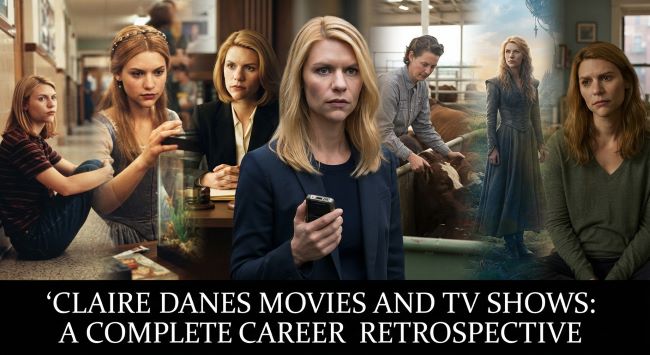
Claire Danes Movies and TV Shows: A Complete Career Retrospective
Very few actors manage to define a decade twice. Claire Danes became the voice of teenage interiority in the mid-1990s, then, fifteen years later, delivered one of the defining television performances of the 2010s. In between and since, she has assembled a filmography built on quality rather than volume, choosing challenging roles and working with respected directors rather than chasing constant visibility. The result is a body of work with several genuinely definitive performances in it. Here is a complete retrospective of Claire Danes movies and TV shows.
Her Early Years and First Roles
Claire Danes was born on April 12, 1979, in New York City, to artistic parents: her mother a painter and textile designer, her father a photographer. She was drawn to performing from an early age, reportedly declaring at nine that she had to act with no plan B, and she began taking classes at the Lee Strasberg Theatre and Film Institute at ten before attending the Professional Performing Arts School.
The story of Claire Danes movies and TV shows begins with a striking early credit. At twelve she was offered a role on the soap opera All My Children but turned it down, concerned it would hamper her development. Instead, she made her television debut in 1992 at thirteen, playing a teenage murderer named Tracy Brandt in the season three premiere of Law & Order, an episode titled “Skin Deep.” It remains a remarkable early performance, and one her husband Hugh Dancy has been shown reacting to with amused disbelief in later interviews.
My So-Called Life: The Breakthrough
The role that made her famous, and which still anchors any discussion of Claire Danes movies and TV shows, is Angela Chase in My So-Called Life. The teen drama premiered in 1994 with Danes at fifteen, and it captured adolescent uncertainty with a specificity television had rarely attempted.
The series was cancelled after a single season of nineteen episodes, but it developed a fiercely devoted cult following that has only grown. Its pilot episode is regularly cited among the finest television episodes ever made. For Danes, the role brought a Golden Globe for Best Actress in a Television Series and her first Emmy nomination, extraordinary recognition for an actress that young.
My So-Called Life established the quality that has characterized her work ever since: an ability to convey complicated internal states without external showiness, letting thought and feeling register on her face rather than in dialogue.
Little Women and the Mid-1990s Films
Her film career began almost simultaneously. Among the earliest Claire Danes movies and TV shows is Little Women (1994), the acclaimed adaptation of Louisa May Alcott’s novel, in which she played Beth March alongside Winona Ryder, Trini Alvarado, Kirsten Dunst, and Christian Bale. It was a strong first feature credit in a well-received film.
She followed it with How to Make an American Quilt (1995), playing the young version of Anne Bancroft’s character, and Home for the Holidays (1995), Jodie Foster’s Thanksgiving ensemble comedy featuring Holly Hunter, Robert Downey Jr., Anne Bancroft, and Charles Durning. These roles established her as a serious young actress moving comfortably among veteran performers.
Romeo + Juliet: Global Stardom
The film that made her an international name, and probably the most widely seen of all Claire Danes movies and TV shows, is Baz Luhrmann’s Romeo + Juliet (1996). Playing Juliet opposite Leonardo DiCaprio, in Luhrmann’s audacious modern-dress adaptation set in Verona Beach with the original Shakespearean dialogue intact, she delivered a performance that grounded the film’s stylistic extravagance in genuine feeling.
The film was a substantial hit and became a defining movie for a generation, introducing many young viewers to Shakespeare. Danes’s Juliet is frequently praised for making the verse sound like natural speech and for the emotional directness she brings to it. Coming immediately after My So-Called Life, it confirmed her as one of the most promising actors of her generation.
The Late 1990s and Early 2000s
The period following Romeo + Juliet saw a varied run of Claire Danes movies and TV shows. She appeared in The Rainmaker (1997), Francis Ford Coppola’s adaptation of the John Grisham novel, opposite Matt Damon. She took a role in Les Misérables (1998) and appeared in The Mod Squad (1999) and Brokedown Palace (1999).
In 1998 she enrolled at Yale University, studying psychology, before leaving after two years to return to acting full time. She also moved into theater during this period, appearing off-Broadway in The Vagina Monologues in 2000.
The early 2000s brought her into significant ensemble work. The Hours (2002), the acclaimed adaptation of Michael Cunningham’s novel, placed her among a cast including Nicole Kidman, Julianne Moore, and Meryl Streep. She then took a substantial role in a major blockbuster with Terminator 3: Rise of the Machines (2003), and appeared in the holiday ensemble comedy The Family Stone (2005), Shopgirl (2005), and The Flock (2007).
Stardust and Me and Orson Welles
Two later-2000s films stand out among Claire Danes movies and TV shows for showing her range. In Stardust (2007), Matthew Vaughn’s fantasy adventure based on Neil Gaiman’s novel, she played Yvaine, a fallen star in human form. The film has become a genuine cult favorite over the years, and her performance is central to its charm.
She also appeared in Me and Orson Welles (2008), and made her Broadway debut in 2007 playing Eliza Doolittle in a revival of Pygmalion, demonstrating her continued commitment to stage work alongside screen roles.
Temple Grandin: Awards Recognition
One of the most acclaimed entries in all of Claire Danes movies and TV shows is the 2010 HBO television film Temple Grandin, in which she played the title role. Grandin is an autistic scientist whose revolutionary rethinking of livestock handling transformed the meat industry, and Danes’s portrayal was praised for its precision, empathy, and refusal to sentimentalize.
The performance swept the major awards, earning her the Primetime Emmy for Outstanding Lead Actress in a Miniseries or Movie, a Golden Globe, and a Screen Actors Guild Award. It remains one of the most admired performances of her career and demonstrated her capacity for deeply researched, transformative work.
Homeland: The Defining Television Role
If My So-Called Life made her famous, Homeland made her one of the most acclaimed television actors of her era, and it is the most substantial entry in any survey of Claire Danes movies and TV shows. From 2011 to 2020, across eight seasons and 96 episodes of the Showtime thriller, she played Carrie Mathison, a brilliant CIA officer living with bipolar disorder.
Carrie is one of television’s great characters: fiercely intelligent, professionally ruthless, personally chaotic, and frequently her own worst enemy. The role demanded enormous range, taking her through mania, depression, deception, obsession, and grief across nearly a decade of storytelling.
The recognition was substantial. Danes won two Primetime Emmys for Outstanding Lead Actress in a Drama Series, two Golden Globes for Best Actress in a Television Series Drama, and a Television Critics Association Award for Individual Achievement in Drama. Her portrayal of a character managing a serious mental health condition while working at the highest levels of intelligence work was also widely discussed for its complexity and the fact that it refused to reduce her to her diagnosis.
The show’s early seasons in particular, opposite Damian Lewis as a returned prisoner of war whose loyalties are uncertain, are regarded as some of the strongest television drama of the 2010s.
Films During and After Homeland
Danes continued taking film roles throughout the Homeland years, and these entries in Claire Danes movies and TV shows show her range outside the series. She appeared in As Cool as I Am (2013), the offbeat Brigsby Bear (2017), and A Kid Like Jake (2018), among others. She has also done voice work and continued theater projects.
Across her career she has consistently favored substantial roles in smaller films over large paydays in projects that would not challenge her, which is part of why her filmography, while not enormous, contains so many performances worth seeking out.
Recent Work: The Beast in Me
Among the most recent Claire Danes movies and TV shows is The Beast in Me, the limited series in which she stars. The project continues her pattern of choosing complex, demanding television roles, and it has drawn considerable attention as her most prominent work since Homeland concluded.
Her return to leading a series after the enormous commitment of Homeland was widely anticipated, and it reflects her continued position as one of the actors television turns to for psychologically demanding material.
Her Theater Work
Any account of Claire Danes movies and TV shows is incomplete without her stage work, which she has returned to consistently throughout her career. She appeared off-Broadway in The Vagina Monologues in 2000, during the period when she had stepped back from screen work to attend Yale.
Her Broadway debut came in 2007, playing Eliza Doolittle in a revival of George Bernard Shaw’s Pygmalion. Taking on one of the most demanding and frequently performed roles in English-language theater, at a point when she was already an established screen actress, reflected a seriousness about craft that has characterized her choices generally.
She has continued to return to theater in the years since, and the discipline of stage work is often cited as part of why her screen performances have such technical control. For an actress who became famous on television at fifteen, the decision to keep testing herself in front of live audiences is notable.
What Makes Her Performances Distinctive
Watching across Claire Danes movies and TV shows, certain qualities recur. The most frequently noted is her ability to convey complex internal states with minimal external signaling. Her face does an extraordinary amount of work, registering thought, doubt, and shifting emotion in ways that dialogue would flatten.
Her willingness to appear unflattering is another. Carrie Mathison in particular is frequently frantic, unwell, manipulative, and physically unguarded, and Danes never softens any of it for the audience’s comfort. The famous intensity of her crying scenes became a widely discussed feature of Homeland precisely because she refused to make distress look attractive.
There is also a consistent intelligence to her characters. Angela Chase is observant in a way real teenagers are; Temple Grandin thinks in ways the film has to visualize; Carrie Mathison is the smartest person in most rooms and the least stable. Danes plays intelligence convincingly, which is rarer than it sounds.
Her Career Trajectory in Context
The arc of Claire Danes movies and TV shows is unusual in a specific way: she has had two distinct career peaks separated by more than a decade. The mid-1990s made her a teenage phenomenon with My So-Called Life and Romeo + Juliet. The 2010s made her one of the most decorated actors in television with Homeland.
The period between those peaks is often characterized as a quieter stretch, with steady film work that included well-regarded projects but no single defining role. In retrospect, that period looks less like a lull than a deliberate transition, allowing her to move from teenage stardom into adult roles without the desperate visibility that derails many child and teenage performers.
The Yale decision is emblematic. Stepping away from acting at the height of post-Romeo + Juliet demand, to study psychology, was commercially counterintuitive and personally sensible. She has spoken about the intensity of early fame, and the choice to interrupt it looks increasingly wise given how many careers of that era did not survive the transition.
It is also worth noting how selective the filmography is. Compared with contemporaries who accumulated dozens of credits, the list of Claire Danes movies and TV shows is relatively compact, and that is clearly deliberate. She has repeatedly chosen fewer, more demanding projects over constant work, accepting long gaps rather than taking roles that would not stretch her. The result is a body of work where a strikingly high proportion of the entries are genuinely worth seeking out, which is a rarer achievement than sheer volume.
Her Awards and Recognition
Across the span of Claire Danes movies and TV shows, the recognition has been considerable. She has won three Primetime Emmy Awards and four Golden Globes, along with a Screen Actors Guild Award. Her Emmy wins came for Temple Grandin and twice for Homeland, and her Golden Globes span My So-Called Life, Temple Grandin, and Homeland.
That she won a Golden Globe as a teenager for her first major role and continued winning major awards more than fifteen years later speaks to a rare consistency. She also received a star on the Hollywood Walk of Fame, recognizing a career that has spanned three decades.
Her Approach and Legacy
What characterizes Claire Danes movies and TV shows overall is a preference for quality over quantity. Rather than maximizing output, she has consistently selected projects that challenge her, working with respected directors and taking on characters with genuine psychological complexity.
Her transition from teenage star to adult dramatic actor, a passage that derails many careers, was managed unusually smoothly, helped by careful role selection and her early decision to step back for university rather than capitalize immediately on Romeo + Juliet’s success. The decade-long commitment to Homeland demonstrated sustained intensity across an extended narrative, developing a single character over eight seasons without letting the performance calcify.
On a personal note, she married actor Hugh Dancy, whom she met on the film Evening, in 2009, and they have three children together. The two have occasionally discussed each other’s work publicly, including a memorable moment when Dancy was shown a clip of her Law & Order debut as a teenage killer, decades after the fact.
The bottom line on Claire Danes movies and TV shows is that she has built one of the most consistently impressive careers of her generation across three decades. From her Law & Order debut at thirteen and her Golden Globe-winning breakthrough as Angela Chase in My So-Called Life, through her international stardom as Juliet in Romeo + Juliet and varied film work including Little Women, The Hours, Terminator 3, and Stardust, to her award-sweeping performance in Temple Grandin and her defining eight-season run as Carrie Mathison in Homeland, and on to recent work in The Beast in Me, she has repeatedly chosen difficult, psychologically rich roles and delivered performances that endure.
Key Takeaways
- Claire Danes, born April 12, 1979, in New York City, began acting classes at ten and made her TV debut on Law & Order in 1992 at thirteen.
- Her breakthrough was Angela Chase in My So-Called Life (1994), winning a Golden Globe and her first Emmy nomination at fifteen.
- My So-Called Life lasted only one season but became a cult classic, with its pilot cited among television’s greatest episodes.
- Her film debut was as Beth March in Little Women (1994), followed by How to Make an American Quilt and Home for the Holidays.
- She achieved international stardom as Juliet opposite Leonardo DiCaprio in Baz Luhrmann’s Romeo + Juliet (1996).
- Other notable films include The Rainmaker, The Hours, Terminator 3: Rise of the Machines, The Family Stone, and Stardust.
- Her portrayal of Temple Grandin in the 2010 HBO film won her an Emmy, a Golden Globe, and a SAG Award.
- She played CIA officer Carrie Mathison across eight seasons and 96 episodes of Homeland (2011-2020), winning two Emmys and two Golden Globes.
- She has won three Primetime Emmys and four Golden Globes across her career, and attended Yale before returning to acting.
- Recent work includes the limited series The Beast in Me, continuing her pattern of psychologically complex television roles.