Pacman 30th Anniversary: The Story Behind Google’s Playable Doodle
Back in 2010, millions of people sat down to do a quick Google search and ended up playing a video game instead. That was the magic of the pacman 30th anniversary Google Doodle, a fully playable version of the classic arcade game embedded right on the Google homepage to celebrate three decades of Pac-Man. It was a landmark moment: Google’s first interactive, playable Doodle, and it delighted the internet, reportedly consuming untold hours of collective productivity. Here is the story behind this iconic tribute, why it mattered, and how the beloved game lives on.
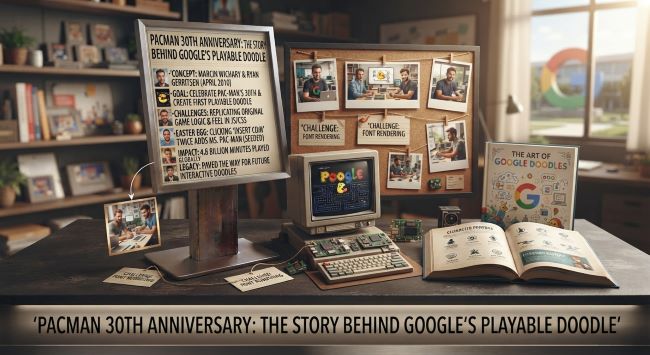
What Was the Pacman 30th Anniversary Doodle?
The pacman 30th anniversary Doodle was a special, interactive Google Doodle released in 2010 to mark 30 years since the original Pac-Man arcade game debuted in 1980. Instead of the usual static or lightly animated Doodle, Google created a fully playable version of Pac-Man right on its homepage, complete with the classic maze, the yellow Pac-Man character, the ghosts, and the familiar gameplay and sounds.
What made this Doodle so special was that it was actually playable. Visitors could use their arrow keys to guide Pac-Man through a maze designed to incorporate the Google logo, eating dots and avoiding ghosts, just like the original arcade classic. It even faithfully recreated the game’s look, sound, and behavior, making it a genuine tribute rather than a mere image.
Why It Was a Landmark Moment
The Doodle holds a special place in internet history for a simple reason: it was Google’s first playable, interactive Doodle. Before this, Google Doodles were images or animations celebrating events, people, and holidays. The Pac-Man tribute changed that, introducing the idea that a Doodle could be an interactive experience you could actually play.
This opened the door to a whole new category of Google Doodles. Following the success of this tribute, Google went on to create many more playable and interactive Doodles over the years, turning its homepage into an occasional source of games and interactive fun. That legacy traces directly back to the Pac-Man Doodle, making it a genuinely influential moment.
The Productivity It “Cost”
One famous aspect of the Doodle is the sheer amount of time people spent playing it. Because it appeared on Google’s homepage, one of the most visited pages on the internet, an enormous number of people encountered it and started playing. Estimates circulated suggesting that the collective time spent playing the Doodle worldwide added up to a staggering amount of otherwise productive hours.
While such figures are hard to verify precisely, the point stands: the Doodle was so engaging and so widely seen that it genuinely captured global attention, with countless people pausing their day to play a few rounds. That level of engagement speaks to both Pac-Man’s enduring appeal and the clever execution of the tribute.
A Bit of Pac-Man History
To appreciate this tribute, it helps to know the history it honored. Pac-Man originally launched in 1980 and became one of the most iconic and successful arcade games of all time. Its simple but addictive gameplay, guiding a character through a maze eating dots while avoiding ghosts, made it a cultural phenomenon. Pac-Man became a symbol of the golden age of arcade games and remains one of the most recognizable characters in gaming history.
By celebrating the game’s 30th anniversary in 2010, Google honored this landmark of gaming culture in a fitting, interactive way. The pacman 30th anniversary Doodle connected a new generation with a classic while giving longtime fans a nostalgic treat.
How the Doodle Worked
The playable Doodle recreated the core Pac-Man experience:
- The maze was designed to incorporate the Google logo shape.
- Arrow keys controlled Pac-Man’s movement through the maze.
- The goal was to eat all the dots while avoiding the ghosts.
- Power pellets let Pac-Man temporarily turn the tables and eat the ghosts.
- The classic sounds and visuals were faithfully recreated.
- A two-player option was even included, adding Ms. Pac-Man for a second player.
This attention to detail made the Doodle feel like the real thing, which is a big part of why it resonated so strongly.
The Lasting Legacy
Because it was so popular, Google made the pacman 30th anniversary Doodle permanently available even after the celebration, so people could return to play it any time. This permanence, unusual for a Doodle, reflects just how beloved it became. The Doodle is often remembered as one of the most iconic and successful in Google’s history.
More broadly, the pacman 30th anniversary Doodle paved the way for interactive online experiences and demonstrated the appeal of accessible, browser-based games, a category that has flourished ever since. Simple, instantly playable games that run right in your browser, requiring no downloads, owe something to the path this Doodle helped blaze. For anyone who enjoys quick, accessible browser games in that spirit, the roundup in HTML5 Games to Kill Time explores the world of easy, browser-based games, which pairs naturally with the legacy of the Pac-Man Doodle since both are about the simple joy of jumping into a fun game instantly, right in your browser, whenever you have a few minutes to spare.
The bottom line on the pacman 30th anniversary Doodle is that this 2010 tribute to 30 years of Pac-Man was Google’s first playable, interactive Doodle, faithfully recreating the classic arcade game right on the homepage. It delighted millions, launched an entire tradition of interactive Doodles, and remains one of the most iconic in Google’s history. Celebrating one of gaming’s greatest classics in a genuinely playable form, it captured the nostalgia and fun of Pac-Man for a whole new generation, and it lives on as a beloved piece of internet history.
Key Takeaways
- The pacman 30th anniversary Doodle was a fully playable Google Doodle released in 2010 marking 30 years of Pac-Man.
- It was Google’s first interactive, playable Doodle, faithfully recreating the classic arcade game on the homepage.
- Players used arrow keys to guide Pac-Man through a maze incorporating the Google logo, eating dots and avoiding ghosts.
- It launched an entire tradition of interactive and playable Google Doodles that followed.
- The Doodle was so widely seen that estimates suggested it consumed a staggering amount of collective productivity worldwide.
- It honored Pac-Man, which debuted in 1980 and became one of the most iconic arcade games ever.
- Google made the Doodle permanently available afterward due to its popularity, a rare move.
- It remains one of the most iconic Doodles in Google’s history and helped popularize accessible browser-based games.