Best Chess Openings for Beginners: A Practical Starter Guide
Starting out in chess can feel overwhelming, especially when it comes to openings. There are hundreds of named openings with intimidating names and endless variations, and it is easy to think you need to memorize them all to play well. The truth is far more encouraging: beginners benefit most from learning a few solid, principle-based openings and, above all, understanding the ideas behind them. Master a handful of reliable openings and the principles that guide them, and you will start games confidently and set yourself up to improve. Here is a practical guide to the best chess openings for beginners.
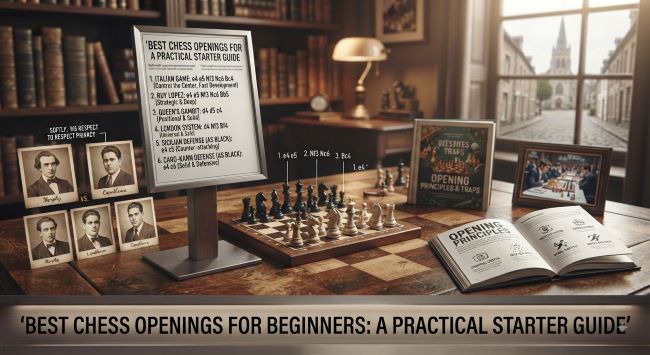
Principles Matter More Than Memorization
Before listing specific openings, the single most important lesson is that understanding opening principles matters far more than memorizing move sequences. In fact, if you follow sound principles, you will play reasonable openings even without memorizing them.
The core opening principles are:
- Control the center, since central squares give your pieces the most influence.
- Develop your pieces, bringing knights and bishops out early toward active squares.
- Castle early, to keep your king safe and connect your rooks.
- Do not move the same piece twice unnecessarily in the opening, which wastes time.
- Do not bring your queen out too early, since it can be chased around and lose tempo.
These principles underlie all good openings. When learning any opening, always understand how the moves serve these principles, rather than just memorizing them.
Best Openings for White
When you play White, you move first and can steer the game. Among the best options for beginners playing White:
The Italian Game. Starting with moves that develop pieces toward the center and target key squares, the Italian Game is a classic, principled, beginner-friendly opening that naturally follows good opening principles. It is a superb first opening to learn.
The London System. A solid, flexible setup that White can use against almost anything, the London System is popular with beginners because it involves a consistent, easy-to-learn setup rather than many variations to memorize. Its reliability makes it one of the best chess openings for beginners.
The Ruy Lopez. A time-honored, principled opening that develops naturally and pressures the center, the Ruy Lopez is slightly more advanced but excellent to grow into as you improve.
These openings for White emphasize sound development and central control, making them ideal starting points.
Best Openings for Black
Playing Black, you respond to White’s first move, and having reliable responses matters just as much. Good beginner-friendly options include:
The Italian Game as Black (responding symmetrically), meeting White’s central pawn move by mirroring it and developing naturally, which follows the same sound principles.
The Caro-Kann Defense. A solid, reliable defense that gives Black a sturdy position without sharp complications, making it a great choice for beginners who want stability.
The Scandinavian Defense. A straightforward, easy-to-learn defense that immediately challenges White’s center, popular with beginners for its simplicity and clear plans.
The French Defense. A solid, structured defense with clear strategic ideas, good for beginners who like a stable, understandable position.
These defenses give Black reliable, principle-based ways to meet White’s opening, which is exactly what the best chess openings for beginners should provide.
Why These Openings Suit Beginners
The best chess openings for beginners share certain qualities that make them ideal for newer players:
| Quality | Why It Helps |
|---|---|
| Principle-based | Reinforces good habits |
| Not overly complex | Fewer variations to learn |
| Solid and reliable | Avoids early disasters |
| Clear plans | Easy to understand the goals |
| Room to grow | Useful as you improve |
Openings like the Italian Game and London System are favored for beginners precisely because they follow sound principles, are not bogged down in heavy memorization, and give clear, understandable plans. This lets beginners focus on good chess rather than rote memorization.
Common Opening Mistakes to Avoid
Part of learning the best chess openings for beginners is avoiding common errors:
- Bringing the queen out too early, where it gets chased and you lose time.
- Moving too many pawns instead of developing pieces.
- Ignoring development, leaving pieces on their starting squares.
- Not castling, leaving the king exposed.
- Making pointless moves that do not develop or control the center.
- Memorizing without understanding, which falls apart when opponents deviate.
Avoiding these mistakes, and following opening principles, matters more than any specific opening you choose.
Don’t Over-Focus on Openings
An important perspective on the best chess openings for beginners is that, while openings matter, beginners often overemphasize them. At the beginner level, most games are decided by tactics, blunders, and basic mistakes in the middlegame, not by opening theory. So while learning a couple of solid openings is valuable, do not obsess over memorizing deep lines. Time spent on tactics, board awareness, and not hanging pieces will improve your results far more.
Chess as a Learning Tool
Learning chess offers benefits well beyond the game itself, developing thinking skills, patience, planning, and discipline that carry into other areas of life. The strategic thinking involved in mastering the best chess openings for beginners and playing thoughtfully builds valuable mental habits. The guidance in How Chess Training Helps Students Develop Financial Skills explores how chess develops skills that transfer to real-life areas like financial thinking, which is a fascinating connection since the same strategic planning, patience, and decision-making that make you a better chess player also build broader life skills, making learning chess rewarding far beyond the board.
The bottom line on the best chess openings for beginners is that you should learn a few solid, principle-based openings, like the Italian Game and London System for White, and the Caro-Kann, Scandinavian, or French for Black, while focusing above all on understanding opening principles: control the center, develop your pieces, and castle early. Avoid common mistakes like bringing the queen out too early, and remember that at the beginner level, tactics and avoiding blunders matter more than deep opening theory. Master these fundamentals, and you will start your games with confidence and a solid foundation for improvement.
Key Takeaways
- For beginners, understanding opening principles matters far more than memorizing specific move sequences.
- The core principles are control the center, develop your pieces, castle early, and avoid moving pieces or the queen out prematurely.
- Good openings for White include the Italian Game, the London System, and the Ruy Lopez to grow into.
- Good openings for Black include mirroring the Italian, the Caro-Kann, the Scandinavian, and the French Defense.
- These openings suit beginners because they are principle-based, not overly complex, solid, and have clear plans.
- Avoid common mistakes: bringing the queen out early, moving too many pawns, ignoring development, and not castling.
- At the beginner level, tactics and avoiding blunders decide most games, so do not over-obsess over opening theory.
- Learning chess also builds thinking, patience, and planning skills that transfer to other areas of life.