Which Best Explains How Contractionary Policies Can Hamper Economic Growth?
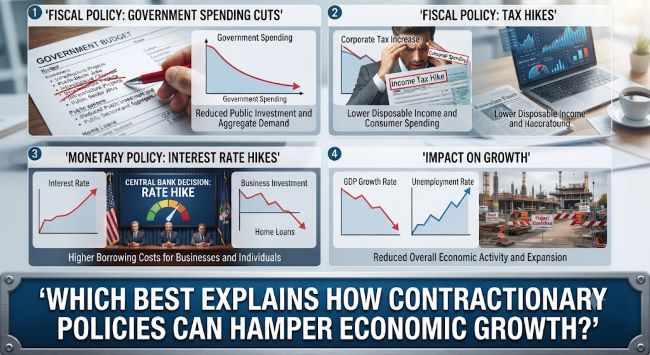
Contractionary policies are tools governments and central banks use to slow an overheating economy: they raise interest rates, reduce government spending, or increase taxes with the goal of cooling inflation. But the same mechanisms that slow inflation can also slow economic growth, sometimes more than intended. Understanding which best explains how contractionary policies can hamper economic growth requires looking at how these tools work through the economy and where the effects on output and employment become most significant.
What Contractionary Policies Are
Contractionary policy comes in two forms:
Contractionary monetary policy is implemented by central banks (like the US Federal Reserve). The primary tool is raising the federal funds rate, which pushes up borrowing costs across the economy: mortgage rates, auto loan rates, business credit rates, and bond yields all rise when the central bank tightens. The central bank can also reduce its balance sheet by selling bonds (quantitative tightening), which withdraws money from the financial system.
Contractionary fiscal policy is implemented by governments through reducing spending, increasing taxes, or both. Cutting government expenditure directly reduces the government’s contribution to GDP. Raising taxes reduces disposable income for households and after-tax profits for businesses.
Both approaches reduce the money flowing through the economy. That’s the point: when inflation is high, reducing demand is how you bring prices back down. But the same reduction in demand that slows inflation also reduces economic output and can push unemployment higher.
The Primary Way Contractionary Policies Hamper Growth: Reduced Demand
The most direct explanation for how contractionary policies can hamper economic growth is through the reduction of aggregate demand: the total spending in the economy by consumers, businesses, and government.
When interest rates rise, borrowing becomes more expensive. Consumers take out fewer mortgages, buy fewer cars on credit, and put more discretionary purchases on hold. Businesses borrow less for capital investment: fewer new factories, less equipment, fewer hires. Government spending cuts directly reduce what the public sector contributes to total economic output.
All of these reductions in spending feed through the economy via the multiplier effect in reverse. When one business receives less revenue, it may reduce orders from its suppliers, cut staff hours, or delay expansion plans. Those suppliers in turn spend less, and so on. A reduction in initial spending produces a larger total reduction in economic activity than the initial cut suggests.
This is the core mechanism behind how contractionary policies hamper growth: they are designed to reduce spending, and reduced spending means reduced output, which is by definition slower economic growth.
Higher Interest Rates and Business Investment
One of the most significant channels through which contractionary monetary policy hampers economic growth is the effect on business investment. When borrowing costs rise, the hurdle rate for investment projects rises with it.
A business considering expanding its production capacity might finance that expansion with a loan. At 3% interest, many projects are profitable enough to justify the borrowing cost. At 7% interest, fewer projects clear the hurdle. The investment doesn’t happen, capacity doesn’t expand, workers don’t get hired, and the multiplier effects of that investment don’t flow through the economy.
This is particularly significant for long-duration, capital-intensive projects: manufacturing facilities, real estate development, infrastructure investment, and research and development spending. These are the investments that drive productivity growth and long-term economic expansion. When contractionary policy raises rates enough to price these projects out, it doesn’t just slow current growth: it can reduce the economy’s future productive capacity.
Consumer Spending and the Wealth Effect
Contractionary monetary policy also affects economic growth through its impact on asset prices. Rising interest rates reduce the present value of future cash flows, which tends to push down the prices of stocks, bonds, and real estate.
When asset prices fall, households that own these assets feel less wealthy and tend to reduce spending. This wealth effect works in reverse: the same way rising home prices made homeowners feel richer and encouraged spending during the 2000s housing boom, falling asset prices make households feel poorer and cause them to pull back.
This channel from contractionary policy to reduced consumer spending represents another path through which economic growth can be hampered beyond just the direct effect of higher borrowing costs.
Government Spending Cuts and the Multiplier
Contractionary fiscal policy through government spending cuts directly reduces GDP through two mechanisms. First, government spending is itself a component of GDP: reducing it reduces total output directly. Second, the reduction in government spending flows through the economy via the fiscal multiplier: the total economic impact of a spending change is larger than the initial change.
When government cuts spending on infrastructure, public services, or transfers to households, the recipients of that spending (contractors, employees, benefit recipients) have less income to spend in the private economy. Those private economy businesses in turn have less revenue, and the effect cascades through the supply chain.
The size of the fiscal multiplier is debated by economists, but there’s broad agreement that it’s positive: reducing government spending by $1 reduces total economic output by more than $1, particularly during periods of weak private demand.
Unemployment as a Consequence and Feedback
A critical way contractionary policies hamper economic growth is through rising unemployment. When businesses reduce investment and consumers reduce spending, labor demand falls. Companies hire fewer workers, reduce hours, or conduct layoffs.
Rising unemployment creates a negative feedback loop: unemployed workers spend less, further reducing demand, which further reduces business revenue, which leads to more layoffs. This is how contractionary policy, applied too aggressively or maintained too long, can tip an economy from controlled slowdown into recession.
The unemployment channel is also why contractionary policies can have lasting effects on growth even after the policies are reversed. Workers who are unemployed for extended periods lose skills and connections to the labor market (hysteresis), reducing the economy’s productive capacity even after recovery begins.
The Timing Problem
Which best explains how contractionary policies can hamper economic growth also involves the problem of timing. Monetary and fiscal policy work with significant lags: the effects of an interest rate increase take twelve to eighteen months to fully flow through the economy. This means policymakers who raise rates to fight inflation may be making decisions based on economic conditions that will look quite different by the time the policy takes full effect.
If rates are raised too aggressively or held high for too long after inflation has peaked, the contractionary effect continues to suppress growth even after the inflation problem has been resolved. The Federal Reserve’s rate hiking cycle following the 2022 inflation surge in the US generated significant debate about exactly this timing problem.
For related economic concepts that help contextualize how contractionary policies interact with broader market behavior, which statement best describes how an investor makes money off debt covers the investment side of interest rate changes that contractionary policy produces.
Key Takeaways
- Contractionary policies reduce aggregate demand through higher interest rates (monetary) or reduced government spending and higher taxes (fiscal): since reduced demand means reduced output, economic growth slows as a direct consequence
- Higher interest rates raise the hurdle rate for business investment, pricing out capital projects that would have proceeded at lower rates: this reduces both current hiring and future productive capacity
- The wealth effect from falling asset prices (stocks, real estate) causes households to reduce consumer spending beyond just the direct effect of higher borrowing costs
- Government spending cuts reduce GDP directly and through the fiscal multiplier: the total economic impact is larger than the initial spending reduction
- Rising unemployment from contractionary policy creates a negative feedback loop: fewer jobs mean less consumer spending, which means less business revenue, which means more job cuts
- The timing lag of twelve to eighteen months between policy change and full economic effect means contractionary policy can continue suppressing growth after the inflation problem it targeted has already resolved
- The challenge for policymakers is calibrating the policy tightly enough to reduce inflation without triggering a recession: this balance is difficult to achieve in practice