
Professional Dryer Vent Cleaning: Why It Matters and What to Expect
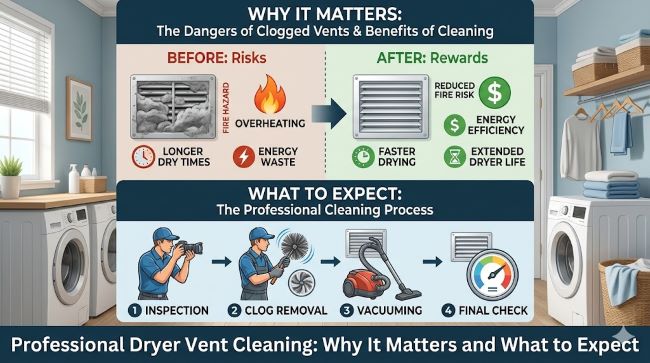
Dryer vent cleaning is one of the most consistently overlooked home maintenance tasks, which makes it one of the more consequential ones. The US Fire Administration reports that dryers cause approximately 2,900 home fires annually, and the leading cause is failure to clean the dryer vent. Beyond fire risk, clogged vents reduce dryer efficiency (longer drying times, higher energy bills), shorten dryer lifespan, and in gas dryers create carbon monoxide risks from inadequate exhaust. Professional dryer vent cleaning addresses all of these issues with the tools and technique to do the job thoroughly.
What Professional Dryer Vent Cleaning Involves
A professional dryer vent cleaning service goes significantly further than cleaning the lint trap. The lint trap catches only a fraction of the lint produced by each drying cycle: the rest travels into the exhaust duct, where it accumulates on duct walls and bends over time.
A professional service typically includes:
Disconnecting the dryer from the vent. The technician pulls the dryer away from the wall and disconnects the flexible transition hose connecting the dryer to the wall duct.
Inspection of the vent system. Many professional services include a visual inspection with a camera or scope to check for vent damage, improper materials (plastic flexible duct is a fire hazard and shouldn’t be used), blockages, and bird or rodent nests.
Mechanical cleaning from the interior. A long rotating brush system is inserted into the duct from the dryer end and run through the full length of the vent, dislodging accumulated lint from the duct walls. Simultaneously or afterward, a high-powered vacuum captures the dislodged material.
Exterior vent cap cleaning. The exterior vent cap (the flap-covered opening where the duct exhausts outside the home) is cleaned and inspected. Clogged exterior caps are a common problem: blocked flaps trap heat and moisture, creating exactly the conditions that cause fires and mold.
Reconnection and test run. The dryer is reconnected, and a test cycle confirms adequate airflow before the technician leaves.
How Often to Have Dryer Vents Professionally Cleaned
The general recommendation is annually for most households. However, several factors warrant more frequent cleaning:
- You do laundry more than 5-7 loads per week
- You have a large family with frequent heavy-load washing (towels, jeans, bedding)
- You have pets and wash pet bedding frequently (animal fur loads vents faster)
- Your dryer vent is long (over 25 feet) or has multiple bends (each 90-degree bend reduces effective vent length)
- Your dryer takes more than one cycle to dry a normal load
For households using the dryer daily or near-daily, twice-yearly cleaning may be appropriate.
Signs Your Dryer Vent Needs Cleaning Now
Longer drying times. If clothes that dried in one 40-minute cycle now take 60-80 minutes, reduced airflow from lint buildup is the most likely cause.
Clothes are hotter than normal at the end of the cycle. Restricted exhaust means heat accumulates in the drum rather than venting outside. This is a fire warning sign.
Burning or musty smell during or after a cycle. Burning smell can indicate lint near a heating element. Musty smell suggests moisture isn’t venting properly.
The exterior vent flap isn’t opening during operation. Stand outside during a drying cycle: the exterior flap should open and you should feel warm, moist air exhausting. If the flap isn’t moving or you feel little to no airflow, the vent is obstructed.
The dryer feels hot to the touch on the exterior. Normal dryers are warm on the outside, not hot. Excess heat building up is a red flag.
It’s been more than a year since the last cleaning (or never). The lint accumulation timeline is reliable: if it’s been over a year, there’s lint in the duct worth removing regardless of whether symptoms are obvious yet.
How to Find Professional Dryer Vent Cleaning Services
HVAC companies. HVAC contractors frequently offer dryer vent cleaning alongside their duct cleaning and air quality services.
Dryer vent cleaning specialists. Dedicated dryer vent cleaning companies exist in most markets, often found through Google Maps search for “dryer vent cleaning near me.” These specialists typically use professional-grade equipment designed specifically for vent cleaning.
Appliance repair companies. Some appliance service companies offer dryer vent cleaning as a maintenance service alongside appliance repair.
Air duct cleaning companies. Companies offering air duct cleaning often include dryer vent cleaning as an add-on service.
Watch for scams. The dryer vent and air duct cleaning industries have documented scam patterns: very low advertised prices that serve as bait, then pressure for expensive add-ons once the technician is on-site. A fair price for professional dryer vent cleaning is $80-$175. Any price significantly below $70 warrants skepticism about what’s actually being done.
Look for companies with specific dryer vent cleaning reviews (not just general HVAC reviews), CSIA (Chimney Safety Institute of America) or NADCA (National Air Duct Cleaners Association) certification, and transparent pricing before arrival.
What Professional Dryer Vent Cleaning Costs
Standard dryer vent cleaning (single-story home, normal vent length): $80-$150.
Longer vents or complex routing: $120-$200.
Inspection with camera: some companies include this; others charge $50-$100 extra.
Vent repair or replacement: if the inspection reveals damaged duct sections or improper materials, repair costs vary significantly by length and material needed.
DIY vs. Professional
Consumer-grade dryer vent cleaning kits (flexible brush systems that attach to a drill) are available for $20-$40 and can remove some lint from shorter, simpler vent runs. They’re a reasonable supplement between professional cleanings for high-use households.
Professional cleaning is more thorough for several reasons: professional brush systems are more powerful and reach further, the vacuum systems capture dislodged lint rather than pushing it further into the duct or out into the laundry room, and the professional inspection catches issues (damaged duct sections, improper materials, bird nests) that DIY cleaning misses entirely.
Annual professional cleaning supplemented by DIY brushing mid-year is an appropriate maintenance schedule for high-use households.
Key Takeaways
- Clogged dryer vents are the leading cause of dryer fires in US homes: professional dryer vent cleaning is a meaningful fire prevention measure, not just a maintenance nicety
- Professional cleaning includes full-length brush cleaning, high-powered vacuum capture of removed lint, exterior cap cleaning and inspection, and a test run to confirm adequate airflow
- Clean annually for most households, more frequently for large families, pet owners, high-use households, or homes with long or complex vent runs
- Signs that cleaning is overdue: longer drying times, clothes hotter than usual after drying, burning or musty smell, exterior flap not opening during operation
- Fair pricing is $80-$175: prices significantly below this suggest incomplete service or a bait-and-switch approach
- Look for NADCA-certified companies or those with specific dryer vent cleaning reviews rather than general HVAC companies that list vent cleaning as an afterthought
- DIY brush kits can supplement professional cleaning between visits but shouldn’t replace annual professional service for homes with complex or longer vent runs