Teachers Pay Teachers: What It Is and How to Get Started
Every teacher knows the late-night scramble of building a lesson from scratch when something better surely already exists somewhere. Teachers Pay Teachers exists for exactly that moment. It is an online marketplace where educators buy and sell classroom resources, from worksheets and lesson plans to full units and digital activities, created by other teachers who have already done the work.
For some educators, it is a place to find ready-made materials and save hours of prep. For others, it is a way to turn years of classroom expertise into actual income. This guide covers both sides: what Teachers Pay Teachers is, how it works for buyers and sellers, what it costs, and how to get started if you want to open your own store.
What Is Teachers Pay Teachers?
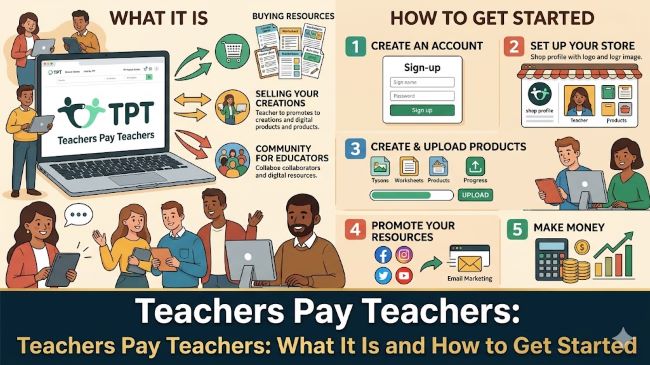
Teachers Pay Teachers, commonly shortened to TPT, is the largest online marketplace for educational resources made by educators, for educators. Rather than relying on a single publisher, the platform connects teachers worldwide, letting anyone with classroom expertise open a store and sell the materials they have created.
The catalog is enormous, spanning millions of resources across every grade level, subject, and teaching style. You can find materials for elementary phonics, middle school math, high school chemistry, special education, homeschooling, and nearly any niche in between. Because the resources are made by working educators, they tend to reflect what actually happens in real classrooms rather than what looks good in a textbook catalog.
The appeal cuts two ways. Buyers get access to a vast library of practical, classroom-tested materials, often at low prices. Sellers get a built-in audience of teachers actively searching for resources, plus a platform that handles the technical and financial side of running an online store.
How Teachers Pay Teachers Works for Buyers
For most teachers, the first encounter with Teachers Pay Teachers is as a buyer, looking for something specific to fill a gap in their lesson plans.
Browsing and buying is straightforward. You search for what you need, whether that is a fractions review game, a novel study unit, or a set of classroom decor, and the platform returns matching resources from sellers across the marketplace. Each listing typically includes a description, preview images, the grade levels and subjects it covers, ratings and reviews from other buyers, and the price.
A few things make the buying experience work well:
- Previews matter. Most quality listings include preview images or sample pages so you can see exactly what you are getting before you buy, which reduces the guesswork.
- Reviews guide decisions. Ratings and feedback from other teachers who have used a resource help you judge whether it will work for your classroom.
- Free resources exist too. Many sellers offer free downloads alongside their paid products, which is a low-risk way to try out a seller’s style before purchasing.
- Formats vary. Resources come as printable PDFs, editable files, digital activities for tools like Google Classroom, and more, so checking the format fits your needs is worth doing.
Creating a buyer account on Teachers Pay Teachers is free. You only pay for the individual resources you choose to purchase, and once bought, a resource is yours to download and use according to the seller’s usage terms, which typically cover use in your own classroom.
How Teachers Pay Teachers Works for Sellers
The other half of the platform is the seller side, and this is where Teachers Pay Teachers becomes a potential income stream rather than just a shopping destination. For educators looking to earn from home, it sits alongside other remote income opportunities that let you work on your own schedule.
When you become a TPT seller, you open your own store on the platform and upload the resources you have created. You set your own prices, run your own sales and promotions, and build out your store over time. The materials you can sell are wide-ranging: printables, task cards, interactive notebooks, digital games, teacher planners, full curriculum units, and much more.
What makes this manageable, even for teachers with no business background, is that the platform handles the parts most educators do not want to deal with. TPT takes care of payment processing, customer service, order fulfillment, and even sales tax remittance. That means a seller can focus on what they are actually good at, creating quality educational content, without getting bogged down in the administrative and technical machinery of running an online shop.
The income potential on TPT varies enormously. The reality, based on seller data, is that most sellers earn modest side money, often somewhere in the range of a small monthly supplement, while a smaller group builds it into meaningful part-time income, and a tiny minority reaches full-time earnings. The distribution is heavily top-weighted, meaning a small percentage of sellers account for a large share of total earnings. Some well-known sellers report earning several thousand dollars a month, but those results are the exception rather than the norm, and they typically come after years of consistent work. For teachers wanting steadier supplemental pay rather than the uncertainty of store sales, more predictable options like flexible data entry work are worth weighing alongside it.
Understanding TPT Seller Fees and Memberships
If you want to sell on TPT, the first decision is which membership tier to choose, since this directly affects how much of each sale you keep. The platform offers two main options.
Basic Seller. This requires a one-time, non-refundable fee to set up. Basic sellers earn a 55 percent payout on each sale and pay a transaction fee on every resource sold, regardless of price. The lower payout rate means a larger share of each sale goes to the platform.
Premium Seller. This is an annual subscription rather than a one-time fee. Premium sellers earn an 80 percent payout on each sale, a significant jump over the Basic rate, and pay a smaller transaction fee that applies only on small orders below a certain threshold, with no transaction fee on larger orders.
The difference adds up quickly. On a single low-priced resource, the gap between a Basic and Premium payout might seem small, but across many sales, and especially on higher-priced bundles, the higher Premium payout rate can mean keeping substantially more of your earnings. For a seller who plans to treat the store seriously and expects steady sales, many experienced sellers recommend starting with Premium from the beginning and treating the annual fee as an investment rather than a cost.
That said, the math depends on your sales volume. Premium generally pays off once you reach a certain number of sales per year, so a seller just testing the waters with minimal sales might start Basic, while one committing to building a real store benefits from Premium sooner.
What You Can Sell on Teachers Pay Teachers
The range of sellable resources on TPT is broad, which is part of why educators across every specialty can find a niche. Common categories include:
- Lesson plans, detailed teaching plans that organize classroom instruction
- Worksheets and activities, hands-on materials aligned with educational standards
- Digital resources, from PDFs to Google Classroom tools and interactive digital games
- Task cards and interactive notebooks, popular formats for engaging students
- Assessments, quizzes, tests, and review materials
- Classroom decor and organization tools, materials for setting up and managing a classroom
- Teacher planners and templates, organizational tools for educators themselves
- Full units and bundles, larger collections that combine related resources at a package price
The key for sellers is that quality wins over quantity. With millions of resources already on the platform, simply adding more does not guarantee sales. What works is creating materials that are genuinely useful, well-designed, and aligned with what teachers are actively searching for.
Tips for Starting a Successful TPT Store
If you decide to sell on TPT, a few principles consistently separate stores that grow from stores that stall.
Make what teachers are searching for, not just what you feel like making. One of the most common mistakes new sellers make is creating resources based on their own interests rather than actual buyer demand. Researching what teachers in your niche are looking for, and building around those needs, dramatically improves the odds of making sales.
Pay attention to your titles and descriptions. On TPT, search language matters. A strong resource can underperform if its title and listing do not match how teachers actually search. Specific, clear titles like “1st grade phonics review worksheets” tend to outperform vague ones like “reading packet,” because they match what buyers type into the search bar.
Invest in good previews. Since buyers rely heavily on preview images to decide whether to purchase, clear, attractive previews that show exactly what is included directly affect your sales.
Focus on a niche. Trying to sell everything to everyone tends to work worse than becoming the go-to seller for a specific grade, subject, or teaching approach. Being more relevant to a specific buyer beats being broadly mediocre.
Think long-term. Income on TPT compounds over time. A single strong resource can sell for years, and a library of well-made materials can quietly generate ongoing income. Most successful sellers do not see real momentum immediately, and the ones who succeed treat it like a business they build steadily rather than a hobby they touch when exhausted.
Quality over speed. Ten well-made, thoughtfully designed resources often out-earn dozens of rushed ones. Putting care into design, accuracy, and usability pays off through better reviews and repeat buyers.
A Bit of Background
Teachers Pay Teachers grew out of a simple realization: teachers were already creating excellent materials for their own classrooms, and other teachers would happily pay for access to them rather than reinventing the wheel. What started as a way to share resources turned into a full marketplace that has paid out significant earnings to educators over the years.
Part of what sustains the platform is its community dimension. Beyond being a transactional marketplace, TPT functions as a network of educators sharing approaches, giving feedback through reviews, and learning from one another’s materials. Many sellers describe the feedback from buyers as genuinely helpful in refining their work, and the sense of contributing to classrooms beyond their own as a meaningful part of the experience.
The platform has also evolved over time, expanding its digital resource tools, adjusting its seller features, and growing its catalog as teaching methods and technology change. Sellers who succeed tend to be the ones who evolve alongside it rather than treating their store as something they set up once and forget.
Is Teachers Pay Teachers Worth It?
Whether TPT is worth it depends entirely on which side of the marketplace you are on and what you expect from it.
For buyers, the value is clear. Access to millions of practical, classroom-tested resources, often at low prices, can save enormous amounts of prep time, which is one of the most precious resources any teacher has. Even occasional purchases can be well worth it when they replace hours of building materials from scratch.
For sellers, the answer is more nuanced. The platform genuinely offers a real opportunity to turn classroom expertise into income, and it removes most of the technical barriers to running an online store. But it is not a guaranteed or instant payday. The market is competitive, success usually takes consistent effort over months or years, and most sellers earn modest amounts rather than life-changing income. For those willing to treat it seriously, research demand, and improve continually, it can grow into a meaningful side income or, for a dedicated few, more. Educators who decide selling is not for them and want a more traditional route can explore in-person hiring events through resources on local career events instead.
The honest framing is that TPT rewards quality and persistence. As a buyer, it is a straightforward way to get good materials fast. As a seller, it is a legitimate platform with real earning potential, but one that works best for those who approach it as a genuine business rather than a quick win.
Getting Started
If you want to begin, the process is simple on both sides. To buy, create a free account, search for what you need, check the previews and reviews, and purchase. To sell, sign up for a seller account, choose between the Basic and Premium membership based on how seriously you plan to pursue it, and start uploading your resources.
Either way, the platform is designed to be approachable for educators without technical or business backgrounds. The buying side requires almost no learning curve, and the selling side, while it takes real effort to succeed, removes most of the operational complexity so you can focus on the teaching materials themselves.
Key Takeaways
- Teachers Pay Teachers, or TPT, is the largest online marketplace where educators buy and sell classroom resources made by other teachers.
- Buying is free to start, with millions of resources across every grade and subject, and buyers only pay for the individual materials they choose, guided by previews and reviews.
- Selling lets educators open a store, set their own prices, and earn income, while the platform handles payment processing, customer service, and sales tax.
- Sellers choose between a Basic membership with a one-time fee and a 55 percent payout, or a Premium membership with an annual fee and an 80 percent payout plus lower transaction fees.
- Most sellers earn modest side income, a smaller group earns meaningful part-time money, and only a small minority reach full-time earnings, with results concentrated among top sellers.
- Success as a seller comes from making what teachers actually search for, writing clear keyword-aligned titles, creating strong previews, focusing on a niche, and building quality over time.
- For buyers, Teachers Pay Teachers offers clear value by saving prep time, while for sellers it is a legitimate income opportunity that rewards persistence and quality rather than quick results.