67 Kid: The Story Behind the Viral Meme Everyone Is Talking About
If you have spent any time around middle schoolers lately, or scrolled through TikTok, you have probably heard someone shout “six, seven” for no obvious reason and then laugh like it is the funniest thing in the world. At the center of that whole phenomenon is the 67 kid, a young boy who became an internet sensation almost by accident, and whose face has since been remixed into some of the strangest corners of meme culture.
This guide breaks down who he actually is, where the meme came from, how it spread, why it took such a bizarre turn, and what it says about how quickly internet fame can attach itself to an ordinary moment.
Who Is the 67 Kid?
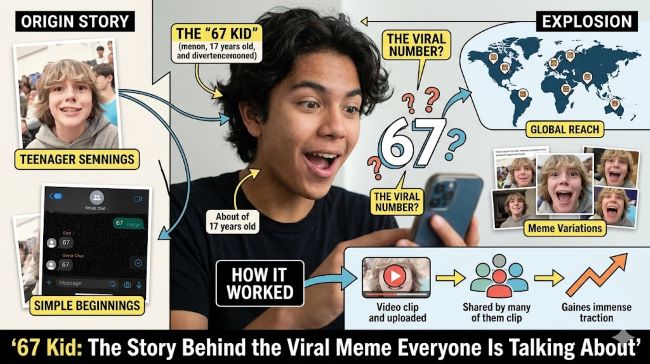
The 67 kid is a young boy with blonde hair who was filmed at a basketball game in March 2025 enthusiastically saying the numbers “six” and “seven.” That short clip, just a few seconds of a kid quoting a meme with his friends, turned him into one of the most recognized faces on the internet over the following year.
According to his TikTok bio, his real name is Maverick Trevillian. He previously posted under the account handle @gmpt08, though that account was later banned. For the most part, the boy himself stayed quiet through the wave of attention, which is part of what makes the story interesting. He did not chase the fame. It found him, and then it kept going long after the original moment.
His blonde hairstyle, which the internet nicknamed “ice cream hair,” and his genuinely enthusiastic delivery of the numbers became defining traits of the meme. To a large slice of the internet, the clip read as “cringe,” and that reaction, rather than killing the meme, became the fuel that powered it.
Where Did the “Six, Seven” Thing Even Come From?
To understand this whole thing, you first have to understand the broader “67 meme” that he was quoting in the first place.
The numbers “six, seven” trace back to lyrics from a rap song called “Doot Doot,” by an artist named Skrilla. The phrase got pulled out of the song and turned into a standalone meme, where people would say “six, seven,” often with a specific hand gesture, as a kind of absurd inside joke. Like a lot of meme phrases, it did not need to mean anything specific. The humor came from the repetition, the delivery, and the shared recognition among people who were in on it.
By early 2025, the “67 meme” was already circulating, particularly among younger audiences. So when the boy was filmed shouting the numbers at a basketball game, he was not inventing anything. He was participating in a joke that was already spreading. What made him stand out was the sheer enthusiasm of his delivery, captured at exactly the right moment.
The Video That Started It All
The original footage came from a YouTube video posted by a creator named Cam Wilder. The now-famous moment happens partway through the video, around the 13-minute mark, when the camera pans over to the boy and his friends, all of them quoting the meme together.
On its own, that clip might have stayed buried inside a longer YouTube video that most people would never watch all the way through. What changed everything was TikTok.
A handful of TikTok accounts clipped that specific moment out of the Cam Wilder video and reposted it to a completely different audience. Short-form video platforms are built for exactly this kind of thing: pulling a few seconds of footage out of context and pushing it to millions of people who would never have found the original. Once those clips started circulating, the meme was off and running.
How the Meme Spread
The TikTokers who clipped the video were building on a formula that had already worked before. Cam Wilder’s videos had produced other viral moments, including one earlier clip that captured a different awkward boy, which had its own brief run of internet fame. The boy essentially followed the same path, except his version blew up even bigger.
A lot of the early posts framed the boy as “cringe,” leaning into the secondhand embarrassment angle. One popular clip carried a caption joking about a “67 apocalypse,” playing up the idea that Gen Alpha’s obsession with these random numbers signaled the downfall of civilization, or at least the end of culture as older generations understood it.
That framing matters, because it points to something specific about how this meme worked. It was not really that people thought the kid was cool. It was that the whole thing tapped into an ongoing, half-joking generational conversation about Gen Alpha kids and their seemingly incomprehensible humor. The boy became a symbol for that entire phenomenon.
The Birth of “Mason 67”
As the meme grew, the figure stopped being just one specific boy and started becoming a stereotype. The internet coined the name “Mason 67” to describe a whole archetype of Gen Alpha boys: the kind of kid who shouts meme phrases, has a very specific haircut, and embodies a certain brand of online-influenced middle school energy.
This is a common pattern in meme culture. A single person goes viral, and then their image gets generalized into a broader character that represents something bigger than the individual. “Mason 67” became shorthand for a type, the way other viral figures have come to represent entire categories of people rather than just themselves.
For the actual boy at the center of it, this meant his specific moment had spun off into something with a life of its own, increasingly disconnected from him as a real person.
When the Meme Got Weird: The “Blue 67 Kid”
Here is where the story takes a genuinely strange turn. The meme had started to fade, the way most memes eventually do, when it came roaring back in a completely different and much creepier form.
Someone created an edited image of the boy with a glowing blue mouth and glowing eyes, transforming the cheerful, cringey clip into something uncanny and unsettling. The style borrowed from older internet edits, the kind that add pulsing lights and lightning effects to characters, often set to a genre of music called phonk.
This “blue” image first surfaced on TikTok and Twitter around the middle of 2025, and it reignited the entire meme. The creator of the original blue edit is unknown, but it did not take long for countless variations to appear across the web, each one distorting the boy’s face in new ways. The meme had mutated from a “look at this funny kid” joke into something closer to a digital horror aesthetic.
The “SCP-067” Phase
The unsettling edits kept escalating until they reached a point where the internet gave the phenomenon a new name entirely: “SCP-067.”
That name is a reference to the SCP Foundation, a collaborative online fiction project where writers create detailed, official-sounding documents about fictional anomalous objects and creatures that have to be contained because they pose some kind of threat. The format is a cornerstone of internet horror writing, often called creepypasta, and it has a large, dedicated community.
By labeling the distorted edits as “SCP-067,” the internet was effectively turning the boy into a fictional cryptid, an internet monster to be cataloged and feared in a tongue-in-cheek way. One of the early eerie edits was made to look like a mock anti-piracy warning screen, the kind that used to appear before movies, which added to the unsettling, liminal quality of the whole thing.
It is a remarkable transformation when you lay it out: a real kid said two numbers at a basketball game, and roughly a year and a half later, his face had been reworked into a fictional horror entity with its own creepypasta-style identity.
Should We Feel Bad for the 67 Kid?
As the meme kept evolving, a question started bubbling up across the internet: is any of this okay? He is a real child, after all, and his face has been endlessly remixed, mocked, labeled “cringe,” and turned into horror content, mostly without his direct involvement.
This is genuinely worth sitting with. There is a meaningful difference between an adult public figure who chooses fame and a kid who got filmed for a few seconds and then watched his image take on a life he never asked for. The casual cruelty of “cringe” culture, especially when aimed at children, is something plenty of people online have started to push back on.
Interestingly, the one glimpse the public got of the boy’s own perspective suggests he was not especially bothered. A podcast called The Bobo Podcast appears to be the only outlet that actually spoke with Trevillian about his viral fame. In the short clip, he comes across as unbothered by the whole thing, even laughing it off when asked when the last time he said “six, seven” was.
That does not fully resolve the ethical questions, but it does add useful context. The kid at the center of the storm seemed to be taking it in stride, treating it as the absurd, fleeting thing it largely is, even as the internet built an entire mythology around him.
What the 67 Kid Says About Internet Fame
Stepping back, this saga is a near-perfect case study in how modern internet fame works, and how little control anyone has over it once it starts.
A few lessons stand out. First, virality is often accidental. The boy did nothing extraordinary. He quoted a meme that thousands of other kids were already quoting. He just happened to be caught on camera at the right moment by a creator with an audience. Second, context collapses instantly. A clip buried in a long YouTube video can be extracted, stripped of context, and shown to millions within days, with none of those viewers knowing or caring about the original setting.
Third, memes mutate in unpredictable directions. Nobody could have planned the path from “cringey basketball kid” to “Mason 67 stereotype” to “glowing blue cryptid” to “SCP-067 horror entity.” Each stage was driven by anonymous creators riffing on what came before, with no central direction. And finally, the human cost is real even when the intent is playful. Behind every viral face is an actual person, and in this case, a child, whose life intersected with a cultural moment they never signed up for.
How Long Will the 67 Kid Stay Relevant?
Memes have a natural lifespan, and most fade as quickly as they appear. This one has already outlasted typical expectations, partly because it kept reinventing itself. Each time the original joke started to die, a new variation, the blue edits, the SCP framing, revived it with fresh energy.
Eventually, like all memes, it will likely fade into internet history, remembered mostly by the people who were online during its peak and referenced occasionally as a marker of a specific moment in Gen Alpha culture. Whether it has another mutation left in it is anyone’s guess, since the entire history of this meme has been impossible to predict from one stage to the next.
What is clear is that the 67 kid captured something about its moment: the speed of viral spread, the strange humor of the youngest internet generation, and the increasingly blurry line between a real person and the digital character the internet turns them into.
Key Takeaways
- The 67 kid is a young boy, reportedly named Maverick Trevillian, who went viral in March 2025 for enthusiastically saying “six, seven” at a basketball game.
- The “six, seven” phrase originally comes from lyrics in the rap song “Doot Doot” by Skrilla, and was already a circulating meme before the boy quoted it.
- The original footage came from a YouTube video by creator Cam Wilder, but it was TikTok accounts clipping the moment that made the 67 kid go viral.
- Much of the meme’s early spread framed the boy as “cringe,” tying into a broader generational conversation about Gen Alpha humor and the “Mason 67” stereotype.
- The meme took an uncanny turn with the “blue 67 kid” edits in mid-2025, which gave the boy a glowing, horror-style appearance and revived the trend.
- It escalated further into “SCP-067,” reframing the boy as a fictional internet cryptid using the format of the SCP Foundation creepypasta community.
- In his only known interview, on The Bobo Podcast, the boy seemed unbothered by the fame, though the meme raises real questions about how internet culture treats children who go viral.
- The 67 kid is a clear example of how accidental, uncontrollable, and unpredictable modern internet fame can be, and how easily a real person becomes a digital character.