Tung Tung Tung Sahur: What the Viral Meme Character Actually Means
If you have spent any time on TikTok, YouTube Shorts, or Instagram Reels recently, there is a decent chance you have come across a strange wooden figure with a smiling face, holding a baseball bat, while a robotic voice repeats a chant that sounds something like “tung tung tung tung sahur.” That character is Tung Tung Tung Sahur, often shortened to “Tung Tung” or “Triple T,” and it has become one of the most recognizable faces of the wider internet meme trend often called Italian Brainrot, even though its actual roots are Indonesian.
This guide breaks down where the character came from, what the chant actually means, how the character fits into the broader brainrot meme world, and why something this strange managed to spread so widely.
Where the Character Came From
The character first appeared in late February 2025, posted by an Indonesian TikTok creator known as @noxaasht. The timing was not random. The post went up the day before Ramadan began in Indonesia, which matters a lot for understanding what the character represents.
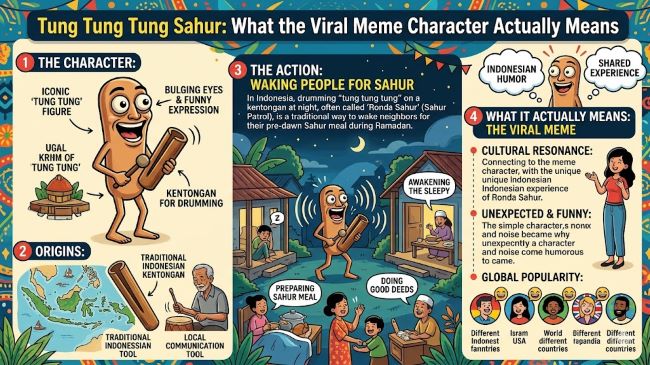
The video showed an AI-generated wooden figure, shaped roughly like a tall block of wood with a face, two thin legs, and a baseball bat in hand, set against a nighttime village backdrop. A robotic Indonesian-language voice repeated a chant built around the sound “tung tung tung,” followed by the word “sahur.”
The post was part of a larger trend on Indonesian TikTok sometimes called “Anomali AI,” where creators used AI image and voice generation tools to make absurd, unsettling characters with strange names and made-up backstories. The character quickly became the most recognizable of these characters and crossed over into the global meme audience within weeks.
What the Name Actually Means
This is the part that gets lost for anyone outside Indonesia or Malaysia, and it is the key to understanding the whole character.
In Indonesian and Malaysian culture, a traditional wooden instrument called a kentongan, sometimes also called a bedug in its larger drum form, is used to make announcements across a village. During Ramadan, this instrument gets used specifically to wake people up for sahur, the meal eaten before dawn that sustains people through the day’s fasting.
The sound this instrument makes is often described with the onomatopoeia “tung tung tung,” which mimics the hollow knocking noise of wood striking wood. So Tung Tung Tung Sahur is literally describing the sound of the wake-up call for the pre-dawn meal during Ramadan.
The character itself is a personification of that sound. The “weapon” the figure carries, often described as a baseball bat, is actually meant to represent a pentungan, the wooden club or drumstick used to strike the kentongan and produce that sound.
The Lore Behind the Character
Like most internet memes that get this big, the character came with its own short, absurdist backstory that spread along with the visuals.
According to the original video’s narration, Tung Tung Tung Sahur is described as a “scary anomaly” that only appears during sahur. The story goes that if someone is called for sahur three times and does not respond or wake up, this creature shows up at their house. The narration plays it for laughs, framing it as something frightening while clearly being tongue-in-cheek, in the style typical of these AI-generated meme characters.
This setup, an exaggerated, slightly creepy consequence tied to a real cultural practice, gave the character a hook that made it easy to share, especially among Indonesian and Malaysian audiences who immediately recognized the reference to the kentongan and sahur traditions, while also being strange and funny enough to travel beyond that audience entirely.
How It Connects to the Italian Brainrot Trend
The character is frequently grouped with what people online call Italian Brainrot, a meme trend built around AI-generated creatures with absurd names, often combining animals or objects with human features, paired with exaggerated Italian-sounding text-to-speech narration.
Despite the name, Tung Tung Tung Sahur has no actual connection to Italy. Its origin is entirely Indonesian, tied to Ramadan traditions and the kentongan instrument. The character ended up grouped with the Italian Brainrot trend mostly because of timing and style. Both trends emerged around the same period in early 2025, both rely on AI-generated visuals and voice-overs, and both feature absurd characters that get “powerscaled” against each other in fan-made content, meaning fans debate and create content about which character would win in a fight.
Triple T has been pitted against other characters from this wider meme universe, including a creature called Brr Brr Patapim and the shark-like Tralalero Tralala. These crossover battles, created by fans rather than the original creators, helped cement the character as one of the central figures in this loosely connected meme universe, even though its cultural roots are completely separate from the Italian-themed characters it gets compared to.
Why It Spread So Fast
A few factors explain why this character went from a single TikTok post to a globally recognized meme within weeks.
Timing with Ramadan. Posting right before Ramadan meant the content was immediately relevant and shareable within Indonesian and Malaysian communities, who recognized both the cultural reference and the playful exaggeration of it. The video explicitly encouraged people to share it with friends who struggle to wake up for sahur, which gave it a built-in reason to spread.
The visual design. The character’s design, simple but distinctive, with an expressive face on an otherwise plain wooden form, made it easy to recognize, easy to recreate, and easy to drop into other contexts as a reaction image or remix. AI tools generate these characters quickly, but the underlying choices still echo familiar illustration types in graphic design, like simplified character forms built for instant recognition.
The audio hook. The repetitive “tung tung tung” chant, paired with a melody that fans nicknamed “Sound of Your Fear,” became instantly recognizable on its own, separate from the visual. Audio hooks like this are a major driver of how memes spread on platforms where sound autoplays.
Crossover potential. Once the character got grouped into the broader brainrot meme ecosystem, it gained access to an existing, highly engaged fan base already creating crossover content, fan art, and “battle” videos between different brainrot characters.
Game integration. The character’s popularity led to appearances in games, most notably the Roblox game Steal a Brainrot, where Tung Tung Tung Sahur appeared as a collectible character. This extended its lifespan well beyond a typical meme cycle, since games introduce the character to audiences who may not have encountered the original video at all.
Translation by fans. Most viewers outside Indonesia and Malaysia could not understand the original narration directly, so fan-made subtitles and translated explainer videos played a real role in helping the cultural reference land for international audiences. Without those translations, the wake-up call backstory would likely have been lost on most viewers, leaving only the visual design and the chant itself, which still proved strong enough to carry the meme on their own for a large share of its audience.
Other Characters in the Same Meme Family
This character did not appear in isolation. It is part of a much larger wave of AI-generated meme creatures that exploded across short-form video platforms in 2025, and understanding that wider family helps explain why this particular character stood out.
The broader trend includes characters like Bombardiro Crocodilo, an anthropomorphic crocodile combined with a military bomber plane, and Tralalero Tralala, a shark depicted wearing sneakers. These characters share a similar formula: an absurd combination of an animal or object with human or mechanical traits, a nonsensical repeated name, and a synthetic voice-over describing a short, often nonsensical backstory.
Within the more specifically Indonesian branch of this trend, sometimes called Anomali AI, other characters followed a similar naming pattern to Tung Tung Tung Sahur, often as direct spin-offs or parodies. Variations with names built around similar repeated syllables, sometimes referencing other foods or sounds associated with Ramadan, appeared in the months after the original went viral, though none reached quite the same level of recognition.
What makes the original character distinct within this crowded field is the specificity of its cultural reference. While many brainrot characters are built purely around absurdity for its own sake, the wake-up call concept gave it a clear, recognizable hook for a specific audience, which likely contributed to it spreading faster within Indonesian and Malaysian communities before crossing over globally.
The Copyright Twist
One detail that sets this meme apart from many other internet characters is that it ran into a copyright dispute. The creator behind the original character made a copyright claim related to its use in games, which led to the character being removed from at least one major Roblox game for a period before later being reinstated.
This is relatively unusual territory for a meme character. Most viral internet characters exist in a legal gray area where the original creator has limited practical ability to control how the character gets used, remixed, and monetized by others. The fact that this situation escalated to an actual copyright claim shows how much commercial value these AI-generated meme characters can accumulate once they cross over into games and merchandise, even when the character started as a single short video.
What Happened After Ramadan
True to the meme’s own internal logic, the trend did not just fade out quietly. As Ramadan ended in late March 2025, Indonesian creators began making follow-up content showing Tung Tung Tung Sahur “going home” after finishing its job of waking people up for sahur. These videos depicted the character walking away, boarding imaginary flights, or dramatically disappearing, treating the end of Ramadan as the character’s natural exit point.
This kind of self-aware, narrative-driven follow-up is common in fast-moving meme cycles, where the joke evolves to acknowledge its own timeline rather than simply repeating the same format indefinitely.
Why This Kind of Meme Matters
It is easy to dismiss something like this as pure nonsense, and on one level, it is. But the speed and scale at which it spread says something about how internet culture works in 2025 and beyond.
AI generation tools made it possible for a single creator to produce a polished, strange, and shareable piece of content very quickly, without needing animation skills, voice actors, or production budgets. The character tapped into a specific cultural reference that resonated deeply with one audience while being absurd enough to entertain people who had no idea what a kentongan was. And once it existed, the open, remixable nature of meme culture took it the rest of the way, through fan art, crossover battles, and game appearances.
Whether or not the trend has staying power, it is a useful example of how quickly something rooted in a specific local tradition can become part of a much broader, global internet vocabulary, often stripped of its original context entirely for most of the people sharing it.
For anyone encountering the character for the first time through a game, a remix video, or a friend’s post with no explanation at all, the gap between the original meaning and the version that travels is often enormous. The chant that started as a respectful, if exaggerated, nod to a Ramadan tradition ended up as a punchline in fan animations, a collectible in a Roblox game, and a subject of mock battles against crocodiles and sharks, with most of that audience never learning what a kentongan is or why the chant sounds the way it does. That gap is not necessarily a problem. It is simply how internet culture tends to work once something crosses from a local context into a global one, and it explains why a meme like this can mean very different things to different parts of its audience at the same time.
Key Takeaways
- Tung Tung Tung Sahur is a viral AI-generated meme character that first appeared on Indonesian TikTok in late February 2025, created by user @noxaasht.
- The name references the kentongan, a traditional wooden instrument used to wake people for sahur, the pre-dawn meal eaten during Ramadan, with “tung tung tung” mimicking the sound of the instrument.
- The character’s lore describes it as a “scary anomaly” that appears if someone is called for sahur three times and does not wake up.
- Tung Tung Tung Sahur is often grouped with the Italian Brainrot trend due to similar timing and AI-generated style, despite having entirely Indonesian origins.
- The character has been featured in fan-made crossover battles against other brainrot characters and appeared in games including Steal a Brainrot.
- A copyright claim from the original creator led to the character being removed from and later reinstated in at least one major game.
- After Ramadan ended, follow-up videos depicted the character “going home,” extending the meme’s narrative beyond its initial trend cycle.
- The meme illustrates how AI generation tools and remix culture can take a reference rooted in a specific cultural tradition and turn it into a globally recognized internet character within weeks.