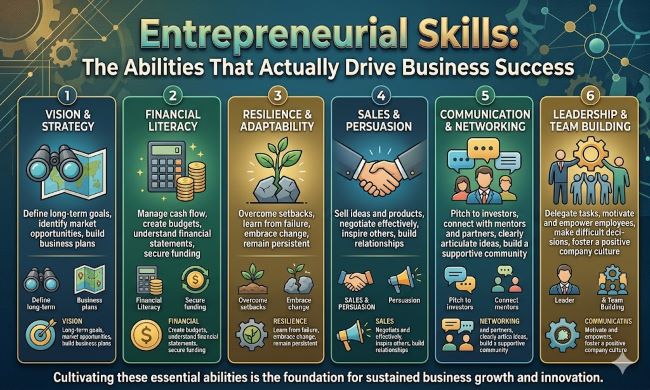
Entrepreneurial Skills: The Abilities That Actually Drive Business Success
Most people picture an entrepreneur as someone with a brilliant idea who takes a leap of faith. The idea matters, but it is rarely what separates a business that survives from one that does not. What actually drives success is a set of entrepreneurial skills, practical abilities that get developed through doing the work, making mistakes, and adjusting.
These skills are not reserved for people who start companies from scratch. They apply just as much to someone running a small side business, managing a team within a larger company, or freelancing. This guide breaks down the entrepreneurial skills that matter most, why each one matters, and how to actually build them.
What These Skills Actually Mean
These are the practical abilities needed to identify opportunities, organize resources, and turn ideas into something that works in the real world. They sit at the intersection of strategic thinking and hands-on execution.
Some people assume these skills are mostly personality traits, things you either have or do not. There is some truth to that for certain traits, like risk tolerance, but most entrepreneurial skills are learnable. Financial literacy, negotiation, and time management are not personality types. They are skills that improve with practice, just like learning a language or a musical instrument.
The list below covers the skills that show up again and again in people who build successful businesses, regardless of industry.
Problem Solving
At its core, a business exists to solve a problem for someone. Entrepreneurial skills start with the ability to identify real problems, not just problems you assume exist, and then design solutions that people will actually pay for.
Strong problem solvers in business tend to share a few habits. They talk to potential customers before building anything, rather than assuming they already know what people want. They break big, vague problems into smaller, testable pieces. And they treat early solutions as drafts to improve, not final products to defend.
This skill also applies internally. Every business runs into operational problems: a process that does not scale, a tool that does not fit the workflow, a bottleneck that slows everything down. The same structured thinking that helps identify a market opportunity also helps fix what is broken inside the business itself.
Financial Literacy
Of all the abilities on this list, financial literacy is one of the most underestimated, and one of the most common reasons businesses struggle even when the underlying idea is solid.
This does not mean becoming an accountant. It means understanding the basics well enough to make informed decisions:
- Cash flow versus profit. A business can be profitable on paper and still run out of cash if money coming in does not line up in time with money going out. Understanding this distinction prevents a common and avoidable failure point.
- Pricing. Setting prices based on costs plus a margin is a starting point, but understanding what the market will actually pay, and what your competitors charge, matters just as much.
- Basic financial statements. Being able to read a profit and loss statement, a balance sheet, and a cash flow statement, even at a basic level, lets you spot problems early instead of discovering them when it is too late to fix.
- Knowing your numbers. Customer acquisition cost, average order value, and monthly recurring costs are the kind of figures that should be familiar, not numbers you have to dig up every time someone asks.
Founders who avoid the financial side of the business because it feels intimidating or boring tend to make decisions based on gut feeling alone, which works fine until it does not.
Adaptability
Plans rarely survive contact with reality. Markets shift, competitors react, supply chains break, and customer preferences change. Adaptability, the ability to adjust plans without losing direction entirely, is one of the entrepreneurial skills that gets tested constantly.
Adaptability does not mean abandoning a plan at the first sign of difficulty. It means distinguishing between a setback that requires a tweak and a signal that something more fundamental needs to change. Businesses that survive major disruptions, whether economic downturns, supply issues, or shifts in how customers behave, tend to share an ability to read those signals early and respond before the situation forces their hand.
This skill also shows up on a smaller scale, every week. A marketing approach that is not working, a product feature nobody uses, a hire that is not the right fit. The willingness to notice these things and adjust, rather than sticking with a decision because changing course feels like admitting a mistake, compounds over time into a more resilient business.
Communication and Persuasion
Communication skills go well beyond writing a good pitch deck, though that matters too. Founders communicate constantly: with customers, employees, investors, suppliers, and partners, and the quality of that communication affects almost everything else.
Selling is the most obvious form of this. Whether it is selling a product to a customer, an idea to an investor, or a vision to a potential hire, the ability to explain why something matters in a way that resonates with the other person is foundational.
Listening matters just as much, and gets less attention. Understanding what a customer actually needs, what an employee is struggling with, or what an investor is genuinely concerned about requires listening past the surface of what is being said.
Clarity under pressure is another piece. When something goes wrong, whether it is a product issue, a difficult conversation with a team member, or a problem with a major client, how that situation gets communicated often matters as much as how it gets resolved.
Leadership and Team Building
Even a one-person business eventually involves other people: contractors, partners, advisors, or eventually employees. Leadership, as one of the core entrepreneurial skills, is about getting the best out of the people around you, not about having all the answers yourself.
Good leadership in a small or growing business looks different from leadership in a large organization. It often means:
- Hiring for the stage you are at. Early on, generalists who can wear multiple hats often matter more than specialists, even if specialists eventually become necessary as the business grows.
- Delegating effectively. Many founders struggle to let go of tasks they are good at, even when their time would be better spent elsewhere. Learning what to delegate, and to whom, frees up capacity for the things only the founder can do.
- Creating clarity. Teams perform better when they understand not just what to do, but why it matters and how their work connects to the bigger picture.
- Giving and receiving feedback. A culture where feedback flows in both directions, calmly and constructively, tends to catch problems earlier and build trust faster than one where feedback only flows downward.
Time Management and Prioritization
Entrepreneurs and small business owners typically have more things they could do than time to do them. Time management as an entrepreneurial skill is less about squeezing more hours out of the day and more about deciding what deserves those hours in the first place.
A few approaches that tend to help:
- Distinguishing urgent from important. Urgent tasks demand attention now. Important tasks move the business forward but rarely scream for attention, which means they get pushed aside unless someone protects time for them deliberately.
- Batching similar tasks. Switching between very different types of work, like deep strategic thinking and quick administrative tasks, carries a hidden cost in lost focus. Grouping similar tasks together reduces that cost.
- Saying no. Every yes to a new opportunity, project, or request is also a no to something else, even if that something else is just focused time. Entrepreneurs who struggle to say no often end up spread too thin across too many directions.
- Building in review time. Regularly stepping back to ask whether current activities still align with priorities prevents a business from drifting into busywork that feels productive but does not actually move things forward.
Risk Management
Starting and running a business inherently involves risk, but successful entrepreneurs are not necessarily the ones who take the biggest risks. They are often the ones who manage risk well, taking calculated risks where the potential upside justifies the downside, and avoiding risks that could be fatal to the business if they go wrong.
This shows up in practical ways:
- Testing before committing. Launching a smaller version of an idea, a pilot, a limited run, or a beta test, before committing significant resources reduces the cost of being wrong.
- Diversifying where it matters. Relying on a single customer for most of your revenue, or a single supplier for a critical input, creates fragility. Spreading that risk, even gradually, protects the business from a single point of failure.
- Keeping a financial cushion. Cash reserves give a business room to weather a bad month, a slow season, or an unexpected expense without making panicked decisions.
- Knowing the difference between a risk worth taking and a gamble. A calculated risk is based on information and has a plan if it does not work out. A gamble is closer to hoping for the best.
Networking and Relationship Building
Few businesses grow in isolation. Networking is often misunderstood as collecting contacts or attending events, but the more useful version is building genuine relationships that create value in both directions over time.
This includes relationships with:
- Customers, who become repeat buyers and referral sources when the relationship goes beyond a single transaction
- Mentors and advisors, who offer perspective from experience that is hard to gain any other way, especially in the early stages
- Other founders, who understand the specific challenges of running a business in ways that friends or family outside that world often do not
- Suppliers and partners, where a strong working relationship can mean better terms, faster problem resolution, and opportunities that would not otherwise come up
The strongest professional relationships tend to develop from genuinely helping other people, not from transactional networking focused only on what someone can do for you.
Resilience
Running a business involves setbacks: deals that fall through, products that flop, employees who leave at bad times, and stretches where nothing seems to work. Resilience, the ability to keep going and keep thinking clearly through these periods, is one of the entrepreneurial skills that is hardest to fake and most necessary over the long run.
Resilience does not mean ignoring setbacks or pretending everything is fine. It means processing what happened, extracting whatever lesson is actually useful, and moving forward without either denying the difficulty or being paralyzed by it. Founders who build resilience over time tend to develop their own routines for this, whether that is talking things through with a mentor, taking time to step back before reacting, or simply having been through enough cycles to know that a bad week does not define the business.
How to Build These Skills
These abilities develop primarily through doing, but a few approaches accelerate the process:
- Start small. A side project, a freelance gig, or a small initiative within a job all provide low-stakes ways to practice these skills before the pressure is higher.
- Seek feedback actively. Asking customers, mentors, or even employees for honest feedback, and actually listening to it, speeds up learning that would otherwise take much longer through trial and error alone.
- Study people doing it well. Books, podcasts, and case studies are useful, but watching how people you have direct access to, whether a boss, a mentor, or another founder, handle real situations often teaches more than any book.
- Reflect regularly. Taking time to review what worked, what did not, and why turns experience into actual skill development. Without reflection, the same mistakes tend to repeat.
- Accept that discomfort is part of the process. Most of these skills get built in situations that feel uncomfortable: a difficult conversation, a financial decision with real consequences, a public failure. Avoiding discomfort also avoids the growth that comes with it. For founders ready to move from planning to action, knowing the next steps after a business plan puts these skills into practice right away.
Key Takeaways
- Entrepreneurial skills are practical, learnable abilities, not just personality traits, and they matter for anyone running or growing a business, not only startup founders.
- Problem solving means identifying real customer problems and treating early solutions as drafts to improve.
- Financial literacy, including understanding cash flow, pricing, and basic financial statements, prevents many of the most common and avoidable business failures.
- Adaptability is about distinguishing between setbacks that need a small adjustment and signals that something bigger needs to change.
- Communication includes selling, listening, and staying clear under pressure, all of which affect relationships with customers, employees, and partners.
- Leadership in a small business focuses on hiring for the right stage, delegating effectively, and building a culture of two-way feedback.
- Time management is about prioritization and saying no, not just working more hours.
- Risk management means taking calculated risks with a plan, keeping a financial cushion, and avoiding fragility from over-reliance on a single customer or supplier.
- Networking works best as genuine relationship building rather than transactional contact collection.
- Resilience, the ability to keep thinking clearly through setbacks, is built over time and is one of the hardest of these to develop quickly.
- These skills develop fastest through small low-stakes practice, active feedback seeking, studying others, regular reflection, and accepting discomfort as part of the process.