Which Statement Best Explains How Elasticity and Incentives Work Together
Economics often feels abstract until you connect it to real decisions. You’re making choices constantly. Every choice involves elasticity and incentives whether you realize it or not.
Which statement best explains how elasticity and incentives work together is a question that appears in economics courses. But understanding the answer matters beyond just getting a test question right. Understanding this relationship helps you grasp why businesses make certain decisions and why consumers respond the way they do.
Let’s talk about elasticity, incentives, and how they work together to shape economic behavior.
Understanding Elasticity
Before discussing how elasticity and incentives work together, understanding elasticity alone is essential.
Elasticity measures how much quantity demanded changes when price changes. It describes the responsiveness of demand to price changes.
If you lower the price of bottled water by 10 percent and people buy 20 percent more, demand is elastic. The quantity change is larger than the price change. Consumers respond significantly to the price reduction.
If you lower the price of insulin by 10 percent and people buy only 1 percent more, demand is inelastic. The quantity change is smaller than the price change. Consumers don’t respond much to the price change because they need insulin regardless of price.
What does high elasticity mean is an important distinction. High elasticity means demand is very responsive to price changes. Small price changes create large quantity changes.
Low elasticity means demand doesn’t respond much to price changes. Quantity demanded stays relatively stable even when price changes.
Perfect elasticity would mean any price increase causes demand to drop to zero. Consumers completely abandon the product for alternatives.
Perfect inelasticity would mean price changes don’t affect quantity demanded at all. Consumers buy the same amount regardless of price.
Real world examples fall somewhere between these extremes.
Understanding Incentives
Incentives are factors that motivate people to take action.
Financial incentives include prices, discounts, rebates, and commissions. Money motivates behavior.
Non-financial incentives include convenience, status, social approval, and personal values. These matter as much as money sometimes.
People respond predictably to incentives. When you make something cheaper, more people buy it. When you reward a behavior, more people do it.
Incentives can be positive (rewards for doing something) or negative (penalties for doing something).
The strength of incentives varies. A 5 percent discount on luxury items might not motivate many people. A 5 percent increase in price might reduce demand slightly.
A 5 percent price increase on essential medications motivates almost nobody to reduce consumption. People need medicine.
Understanding incentives means understanding that people respond to what motivates them.
How Elasticity and Incentives Work Together
The connection between elasticity and incentives is crucial.
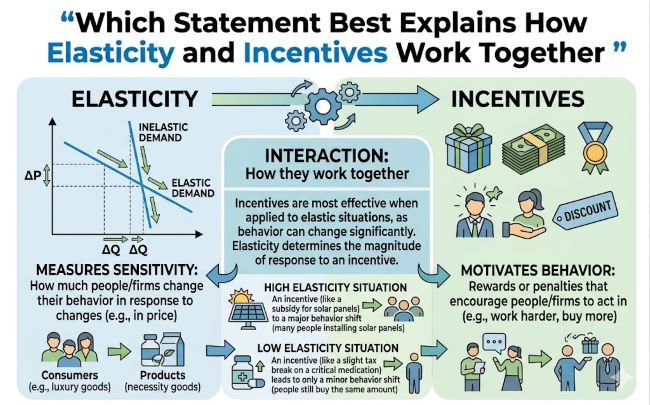
When a good has high elasticity, incentives (like price changes) create large responses. Price is a powerful incentive when demand is elastic.
When a good has low elasticity, the same incentive creates small responses. Price is a weaker incentive when demand is inelastic.
A business considering a price reduction needs to know elasticity. If demand is elastic, reducing price increases revenue by increasing quantity sold significantly. If demand is inelastic, reducing price decreases revenue because the quantity increase is small.
The incentive (price reduction) has different effects depending on elasticity (demand responsiveness).
Understanding both together tells you whether an incentive will achieve the desired outcome.
Real-World Examples of Elasticity and Incentives Working Together
Examples clarify the connection.
Movie theaters and popcorn. Popcorn has high elasticity. If the price drops from $5 to $3, many more people buy popcorn. The lower price incentive works because demand is responsive. Movie theaters know this. They use popcorn pricing strategically. When they want to increase concession sales, they discount popcorn.
Gasoline and demand. Gasoline has low elasticity. Even if prices drop from $3 to $2 per gallon, people don’t drive dramatically more miles. The lower price incentive doesn’t work as strongly because demand isn’t responsive. People drive about the same amount regardless. The incentive doesn’t change behavior much.
Restaurant discount offers. Some restaurants offer “eat one get one free” for slow periods. This strong incentive works because restaurant meals have relatively high elasticity. The deep discount motivates people to visit who otherwise wouldn’t. The incentive achieves the goal.
Movie ticket prices. Movie tickets have moderate elasticity. Lowering prices increases attendance, but not proportionally. A 20 percent price reduction might increase attendance 15 percent. The incentive works but less dramatically than for popcorn.
These examples show elasticity determines how strong an incentive needs to be.
The Statement That Best Explains the Relationship
Several statements could explain how elasticity and incentives work together. The best statement would acknowledge these truths:
Incentives only work if the good has sufficient elasticity to respond to the incentive.
High elasticity means the same incentive produces larger quantity changes.
Low elasticity means the same incentive produces smaller quantity changes.
Businesses strategically use incentives differently depending on elasticity.
A comprehensive statement might be: “Incentives are most effective when applied to goods with high elasticity, where price changes create substantial changes in quantity demanded. Conversely, incentives have limited impact on goods with low elasticity, where quantity demanded remains relatively stable despite price changes or other incentives.”
This statement captures both concepts and their relationship.
Why This Matters in Business
Businesses constantly use elasticity and incentives together.
Retailers know clothing has high elasticity. They use sales and discounts as incentives. The incentives work because demand responds.
Utilities know electricity has low elasticity. They don’t use aggressive price incentives because people will use about the same amount of electricity regardless. Instead, they might use other incentives like rebates for energy-efficient appliances.
Restaurants use different strategies for different items. Appetizers might have high elasticity. They discount appetizers as incentives to get people in the door. Main courses might have lower elasticity. They don’t discount heavily because people will order them anyway.
Airlines use dynamic pricing. When elasticity is high (leisure travel), they price low to fill seats. When elasticity is low (business travel), they price high because people book regardless.
Understanding elasticity and incentives together makes business strategy more effective.
Why This Matters for Consumers
Understanding elasticity and incentives helps you make better decisions.
When you see a sale, understanding elasticity helps you assess whether it’s a genuine deal or marketing.
If something you buy frequently is on sale, it might truly be a good time to stock up. If it’s a one-time purchase, the sale might not matter much.
Understanding incentives helps you recognize when they’re manipulating you. Stores use deep discounts on a few items to get you in the door, knowing you’ll buy full-priced items too.
Understanding that your behavior responds to incentives helps you set better incentives for yourself. If you want to exercise more, paying for a gym membership is an incentive. Whether it works depends on your “elasticity” regarding exercise.
Supply Side: Elasticity of Supply
Elasticity also applies to what businesses supply, not just what consumers demand.
High supply elasticity means sellers can increase production significantly when price rises.
Low supply elasticity means sellers can’t increase production much even when price rises.
Agricultural products often have low supply elasticity. Farmers can’t suddenly grow more crops because prices rise. Crops take time to grow.
Manufacturing goods often have higher supply elasticity. Factories can increase production relatively quickly when demand rises.
The relationship between elasticity and incentives applies to supply too. A price increase incentive only creates increased supply if supply has sufficient elasticity.
Elasticity in Different Markets
Elasticity varies across markets dramatically.
Luxury goods typically have high elasticity. When prices rise, demand drops significantly as people buy substitutes or do without.
Necessity goods have low elasticity. When prices rise, demand drops slightly because people need them regardless.
Branded goods sometimes have low elasticity. Loyal customers buy regardless of price increases.
Commodity goods have high elasticity. Consumers switch easily between brands.
Understanding what market you’re in determines whether incentives will work.
Why Students Learn About This
Economics courses teach elasticity and incentives together because understanding both is essential.
Students need to understand that incentives don’t have uniform effects. The same price incentive creates different outcomes depending on elasticity.
Students need to understand business decision-making. Why do some businesses discount heavily? Because elasticity is high. Why do others rarely discount? Because elasticity is low.
Students need to understand policy implications. Government pricing policies only work if there’s sufficient elasticity for behavior to change.
The relationship between elasticity and incentives is fundamental to economic thinking.
Misconceptions to Avoid
Several misconceptions exist about elasticity and incentives.
Misconception 1: All incentives work equally. Reality: Incentives only work as well as elasticity allows.
Misconception 2: Lower prices always increase sales. Reality: Lower prices increase quantity demanded only if elasticity is sufficient.
Misconception 3: Supply always increases with price. Reality: Supply increases with price only if supply elasticity is sufficient.
Misconception 4: Incentives are just financial. Reality: Non-financial incentives matter as much or more sometimes.
Misconception 5: People always respond to incentives. Reality: People respond to incentives if the incentive is strong enough relative to elasticity.
Avoiding these misconceptions helps you think clearly about economics.
Applying This Understanding
You can apply elasticity and incentive understanding in your own life.
When shopping. Recognize that sales work better on high-elasticity items. Stocking up on discounted items makes sense for things you use. For one-time purchases, sales might not be worth waiting for.
When negotiating salary. Understand that your employer faces elasticity constraints. If demand for your skills is low elasticity, salary incentives matter less. If demand is high elasticity, salary incentives matter more.
When starting a business. Research the elasticity of your product. Determine what incentives will work. Don’t waste money on incentives that won’t work given the market’s elasticity.
When making lifestyle changes. Set incentives for yourself proportional to the elasticity of your behavior. Want to exercise more? Create stronger incentives if your demand for exercise is inelastic.
Real-world application makes this knowledge useful.
Key Takeaways
- Which statement best explains how elasticity and incentives work together requires understanding that incentive effectiveness depends on elasticity.
- What does high elasticity mean is that demand is responsive to price changes. A small price change creates a large quantity change.
- Elasticity and incentives work together because elasticity determines how effective an incentive will be.
- High elasticity products respond dramatically to incentives. Low elasticity products respond minimally to the same incentives.
- Businesses use this relationship strategically. They offer strong incentives on high-elasticity products and weaker incentives on low-elasticity products.
- Supply also has elasticity. Incentives to increase supply only work if supply elasticity is sufficient.
- Understanding both concepts helps you make better personal and business decisions.
- Incentive effectiveness depends on elasticity. The same incentive creates different results in different markets.
- Different products have different elasticities. Luxuries are usually more elastic than necessities.
- Students learn this relationship because it’s fundamental to economic thinking and decision-making.
- Real-world examples show how elasticity and incentives work together in retail, restaurants, transportation, and other industries.
- Misconceptions about universal incentive effectiveness ignore elasticity’s crucial role.
- You can apply this understanding to shopping, negotiating, business planning, and personal goal-setting.
- The relationship between elasticity and incentives explains why some businesses succeed with certain strategies while others fail using the same approach.
- If you’re taking an economics course or learning business strategy, understanding how elasticity and incentives work together is essential knowledge.