How to Deal With Jet Lag After Travel: Science-Based Recovery Strategies
You land in a new country. Your watch says 2 PM, but your body thinks it’s midnight. Everything moves in slow motion. Your eyes won’t focus. You’re starving at 3 AM and wide awake at dinner time.
How to deal with jet lag after travel is a question every frequent flyer eventually asks. Jet lag disrupts your sleep, ruins your first days of vacation, and tanks your productivity on business trips. It feels unavoidable. But it’s not. Understanding what jet lag actually is and knowing proven strategies to combat it means you recover much faster.
This guide covers what causes jet lag, when it hits hardest, and concrete steps you can take starting before your flight to minimize the damage. You can’t eliminate jet lag entirely, but you can reduce its grip from days to hours.
What Jet Lag Actually Is
Understanding Your Body’s Clock
Your body runs on a circadian rhythm. This is a 24-hour internal clock that controls sleep, hunger, body temperature, and hormone release. Your brain synchronizes this clock using light exposure and feeding times.
When you fly across time zones, your clock gets out of sync with your environment. Your brain still thinks it’s 3 AM when local time is 3 PM. Your body doesn’t release melatonin for sleep because it’s still bright outside. You feel exhausted at the wrong times and wired when you should sleep.
Jet lag is your body trying to resynchronize. It’s not just tiredness. It’s a real physiological mismatch between your internal clock and external time.
The circadian rhythm shifts about 1 hour per day. If you flew through 8 time zones, your body needs roughly 8 days to fully adjust. This is why jet lag doesn’t disappear instantly.
Why Some Flights Hit Worse Than Others
Flying east is harder than flying west. When you fly east, you lose hours from your day. Your body has to advance its clock, which is harder than delaying it. Flying west feels easier because you gain time and your natural circadian rhythm is easier to delay than advance.
The number of time zones matters. Flying 2 time zones causes mild jet lag. Flying 8 zones causes severe jet lag.
How you sleep on the plane affects recovery. Good sleep on the flight reduces jet lag. Poor sleep on the plane makes it worse.
Your age affects how quickly you adapt. Younger people adjust faster. Older travelers take longer to resynchronize.
Before Your Flight: Preparation Starts Now
Adjusting Your Sleep Schedule Before Travel
Start shifting your sleep schedule 3 to 4 days before your flight if possible.
For eastbound flights, go to bed earlier each night. This advances your clock toward the destination time. Try sleeping 1 hour earlier than normal on day one, 2 hours earlier on day two, and so on.
For westbound flights, go to bed later each night. This delays your clock. Stay up 1 hour later than normal and gradually push it further.
This pre-adjustment gives your circadian rhythm a head start. By the time you land, you’re already partially adjusted.
Managing Light Exposure Before Travel
Light is the strongest circadian rhythm regulator. Get bright light at the right time and you adjust faster.
For eastbound flights, get bright light exposure in the morning. Morning light advances your clock. Avoid evening light.
For westbound flights, get bright light in the evening. Evening light delays your clock. Avoid morning light.
Start doing this 3 days before your flight. Even small adjustments help.
If you can’t get natural sunlight, bright indoor light works too. Go outside or sit near windows during target times.
Adjusting Eating Times
Eating at specific times also influences your circadian rhythm.
For eastbound flights, eat meals on your destination time schedule starting a few days before travel.
For westbound flights, do the same but in the opposite direction.
This tells your digestive system when to expect food. Your body starts preparing for meals at those times, helping your clock shift.
During Your Flight
Sleep Strategy on the Plane
Sleep quality on the plane dramatically affects how you feel after landing.
For flights arriving in the morning at your destination, try to sleep as much as possible on the plane. Darkness and rest help you adjust faster.
For flights arriving in the evening, stay awake as much as possible. Being awake helps you stay alert when you land and get tired at bedtime.
Use earplugs, eye masks, and neck pillows to maximize sleep quality. Discomfort disrupts rest.
Avoid alcohol on the flight. It disrupts sleep quality even though it might make you drowsy initially.
Light Management on the Plane
Many planes have windows and overhead lights. Use them strategically.
Close your window shade if you want to sleep. Open it if you want to stay awake.
Bright light exposure helps shift your clock. Getting light exposure at the right time accelerates adjustment.
Hydration and Caffeine Timing
Airplane cabins are dry. Dehydration worsens jet lag symptoms. Drink plenty of water throughout the flight.
Avoid alcohol and excessive caffeine. Both dehydrate you and disrupt sleep.
If you drink caffeine, do it early in the flight. Caffeine consumed late makes it harder to sleep.
Immediately After Landing
Your First Hours in the New Location
The moment you land, begin acting on destination time. Don’t check the time in your home zone. Focus entirely on local time.
Get bright light exposure immediately. If you landed in the morning, get outside. Sunlight tells your body it’s daytime.
If you landed at night, avoid bright light. Darkness tells your body it’s time to sleep.
Eat on destination time schedule. Have breakfast if locals eat breakfast. Skip meals if locals aren’t eating. This synchronizes your digestive system.
Go outside and move around. Walking and light exercise increase alertness and help shift your circadian rhythm.
The Sleep Decision
The hardest choice after arriving is when to sleep. Should you nap immediately or push through until bedtime?
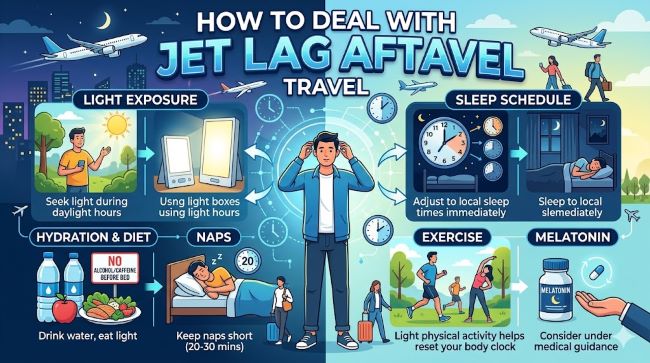
If you landed in the morning and are extremely tired, take a short nap. Sleep 20 to 30 minutes, not more. Longer naps make it harder to sleep at night.
If you landed in the afternoon or evening, push through to local bedtime. Forcing yourself to stay awake accelerates adjustment.
The goal is to sleep when locals sleep. This synchronizes your clock fastest.
Recovery Strategies the First Few Days
Light Exposure Protocol
Continue managing light exposure for several days after arrival.
The first morning, get bright light exposure. Sunlight is ideal. Sit outside or near a window during peak sunlight hours.
Morning light advances your clock and tells your body it’s daytime. This is the most powerful adjustment tool.
Avoid bright light in the evening. Evening light delays your clock and makes adjustment harder.
If you can’t get natural sunlight, bright artificial light works. Sit under bright indoor lights for 30 minutes to an hour.
Exercise and Activity
Physical activity shifts your circadian rhythm and combats fatigue.
Exercise in the morning at your destination. Morning exercise advances your clock and increases alertness during the day.
Avoid intense exercise in the evening. It can disrupt sleep.
Even light activity like walking helps. You don’t need strenuous exercise. Just get moving.
Exercise also improves sleep quality at night, which helps you adjust faster.
Strategic Napping
Napping in the first few days can help or hurt depending on timing.
Nap before 3 PM if you must nap. Evening naps disrupt nighttime sleep.
Keep naps short. 20 to 30 minutes is ideal. Longer naps cause sleep inertia and make you feel worse.
Avoid napping by day 3 or 4. By then, pushing through to nighttime sleep helps you adjust faster.
Using Melatonin Effectively
How Melatonin Works
Melatonin is a hormone your body produces when it gets dark. It makes you sleepy. Taking melatonin supplements tells your body it’s time to sleep.
Taking melatonin at the right time shifts your circadian rhythm.
When to Take Melatonin
For eastbound flights where you need to advance your clock, take melatonin in the evening at your destination. This tells your body to sleep earlier.
For westbound flights where you need to delay your clock, take melatonin at local bedtime but later than usual. This doesn’t advance your clock further.
Take melatonin for 3 to 5 days after arrival. This helps your body resynchronize.
Melatonin Dosage
Low doses work better than high doses. Take 0.5 to 3 mg. Higher doses don’t work better and can cause grogginess.
Take melatonin 30 minutes to 1 hour before you want to sleep.
Avoid melatonin if you’re already sleeping well. It’s most helpful when your circadian rhythm is misaligned.
Nutrition for Faster Recovery
Strategic Eating on Arrival Days
Eating at specific times tells your body what time it actually is. This is powerful.
Have breakfast when locals eat breakfast, even if you’re not hungry. Eating breakfast signals it’s morning to your body.
Skip meals when locals aren’t eating. Skipping a meal tells your body it’s not mealtime.
Protein-rich meals increase alertness. If you need to stay awake, eat protein.
Carbohydrate-rich meals promote sleep. If you need to sleep, eat carbs.
Foods That Help Sleep
Warm milk, turkey, and tuna contain tryptophan, which promotes sleep.
Complex carbs help tryptophan reach your brain. Bread with cheese works better than cheese alone.
Avoid heavy meals close to bedtime. They disrupt sleep.
Avoid spicy or greasy foods. They cause discomfort that prevents sleep.
Managing Common Jet Lag Symptoms
Extreme Fatigue and Brain Fog
These symptoms feel devastating but pass as your circadian rhythm adjusts.
Get bright light exposure in the morning. This fights fatigue and improves focus.
Exercise in the morning. Movement increases alertness and energy.
Avoid caffeine in the afternoon. It disrupts nighttime sleep, which worsens fatigue the next day.
Drink plenty of water. Dehydration worsens cognitive symptoms.
Insomnia at Night
Your first night at the destination might be sleepless. This is normal.
Don’t panic or take sleeping pills immediately. Your body needs one bad night to start resynchronizing.
Try melatonin. It’s gentler than prescription sleeping pills.
Keep your bedroom cool and dark. Temperature and darkness promote sleep.
Avoid screens 30 minutes before bed. Blue light from screens suppresses melatonin.
Digestive Issues
Your digestive system operates on a schedule. Time zone changes disrupt this.
Eat small meals frequently. This is easier on your digestive system than large meals.
Eat when locals eat. This synchronizes your digestive rhythm.
Avoid eating late in the evening. Your digestive system is slower at night.
Stay hydrated. Dehydration worsens digestive symptoms.
Common Mistakes That Worsen Jet Lag
What Not to Do
Don’t check the time in your home zone. This reinforces your old circadian rhythm. Ignore your home time completely.
Don’t nap for long periods. Long naps prevent nighttime sleep and extend jet lag.
Don’t stay in your hotel room. Isolation worsens symptoms. Get outside and engage with your environment.
Don’t drink alcohol to sleep. It disrupts sleep quality and worsens jet lag the next day.
Don’t take prescription sleeping pills unless absolutely necessary. They can create dependency and don’t help your circadian rhythm adjust.
Don’t expect to be fully productive on day one. Accept that you’ll be less efficient and plan accordingly.
Recovery Timeline
What to Expect Each Day
Day one is the worst. Fatigue, brain fog, and disorientation peak. This is normal.
Days two and three improve slightly. Your circadian rhythm begins shifting. You start sleeping better at night.
Days four and five see continued improvement. You adapt more. Daytime alertness increases.
Days six through eight involve final adjustment. Most people feel normal by day 7 or 8.
The exact timeline varies. People recover in 5 to 10 days depending on time zone difference and age.
When to Consult a Doctor
Jet Lag That Doesn’t Improve
Most jet lag resolves on its own within a week or two.
If symptoms persist longer than two weeks, consult a doctor. Persistent issues might indicate something else.
If jet lag severely impacts your health or mental state, seek medical advice.
Talk to your doctor before traveling if you take medications. Time zone changes affect medication schedules.
Preventing Jet Lag on Return Travel
Adjusting on the Way Back
Most people focus on adjustment when arriving at the destination. Adjusting on the return trip is equally important.
Start adjusting your sleep schedule 2 to 3 days before returning home.
Follow the same light exposure and eating protocols as you did arriving.
The return adjustment often feels easier because you’re going back to your natural rhythm. Use that advantage.
Key Takeaways
- How to deal with jet lag after travel starts before your flight with sleep schedule adjustments and light exposure management.
- Jet lag is a real physiological mismatch between your internal circadian rhythm and external time. It’s not just tiredness.
- Eastbound flights cause worse jet lag than westbound flights. Flying east requires advancing your clock, which is harder than delaying it.
- Get bright light exposure in the morning at your destination. This is the most powerful tool for adjusting your circadian rhythm.
- Sleep strategically on the plane. Sleep if you want to be rested when you arrive in the morning. Stay awake if you arrive at night.
- Eat on your destination’s schedule immediately upon arrival. Meals synchronize your digestive system and circadian rhythm.
- Melatonin supplements help shift your circadian rhythm when taken at the right time. Low doses work better than high doses.
- Napping in the first few days should be brief (20 to 30 minutes) and before 3 PM. Longer naps extend jet lag.
- Avoid alcohol and excessive caffeine during travel and recovery. Both disrupt sleep and worsen symptoms.
- Exercise in the morning at your destination. Movement increases alertness and accelerates circadian adjustment.
- Complete recovery takes 5 to 10 days depending on the number of time zones crossed and your age.
- Return trip adjustment is equally important. Start adjusting your sleep schedule before your flight home.
For deeper insights into sleep science and travel wellness, explore resources on travel health tips that explain the connection between rest and well-being. Learning about wellness practices helps you understand how sleep impacts your overall health. Additionally, understanding destination planning provides context on choosing trips that align with your recovery needs.