What Does Digitally Anonymised Mean? A Plain-English Explanation
If you’ve ever watched a true crime documentary or read about a data privacy case and seen the phrase “digitally anonymised,” you’ve probably paused and wondered exactly what that means. What does digitally anonymised mean in practice, who decides when it’s used, and how reliable is it? These are fair questions, and the answers matter more than most people realise.
This post breaks it down clearly: what the term means, where it shows up, and why it’s not always as protective as it sounds.
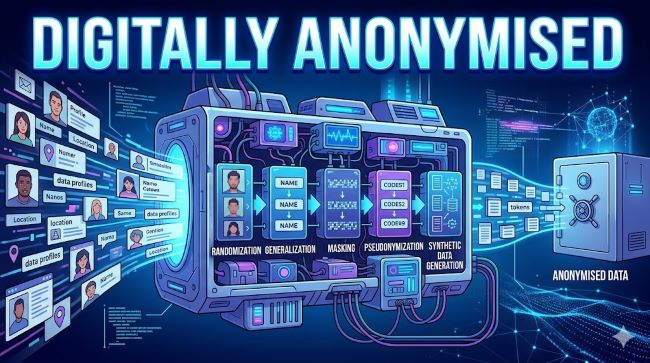
Digitally Anonymised Meaning: The Basic Definition
The digitally anonymised meaning is this: personal or identifying information has been altered or removed using digital tools so that an individual can no longer be identified from the data or content alone.
In the context of video or images, it means faces are blurred, voices are altered, names are removed, or a combination of these techniques is applied. In the context of anonymized data, it means records have been stripped of identifiers like names, addresses, email addresses, and national ID numbers before being stored, shared, or analysed.
The goal is the same in both cases: protect individual identity while still making the underlying content or data usable.
Where You See This Term Used
Digitally anonymised appears in a few distinct contexts:
Documentary film and broadcast media. Witnesses, victims, or individuals who haven’t consented to being identified are often digitally anonymised before footage airs. This includes face blurring, voice modulation, and sometimes full digital alteration of appearance.
Medical and research data. Hospitals and research institutions anonymize patient records before sharing them with third parties or using them for AI training. The anonymized data is supposed to be usable for research without revealing who the patient was. As AI moves deeper into clinical environments, the volume of patient data being processed and shared under the anonymised label is growing fast.
Legal proceedings. Court documents and evidence sometimes involve digitally anonymised material, particularly when minors or vulnerable individuals are involved.
AI training datasets. Large datasets used to train machine learning models are frequently described as anonymized. The assumption is that removing names and obvious identifiers makes the data safe to use at scale. But as one analysis notes, AI systems still need real, detailed data to function well — which creates an inherent tension between data utility and genuine privacy protection.
The Lucy Letby Documentary and AI Anonymisation
A recent example that brought this term into wider public conversation was coverage around the Lucy Letby documentary. In discussions about how media reconstructed events, questions arose about how individuals connected to the case were represented, which faces were altered, and how digital tools were used to protect or obscure identities in visual reconstructions.
The lucy letby documentary ai angle reflected a broader trend: producers and broadcasters are now using AI tools to digitally alter faces and voices in ways that were previously too expensive or time-consuming for standard post-production. This makes anonymisation faster and more consistent, but it also raises questions about accuracy and the ethics of reconstructing events digitally.
When AI handles anonymisation at scale, the process becomes less transparent. Viewers often can’t tell what has been altered, or how much.
Why “Anonymised” Doesn’t Always Mean “Safe”
Here’s where it gets important. The term digitally anonymized carries an implication of permanence and security that isn’t always warranted. The real risk is something called deanonymization.
Deanonymization is the process of re-identifying individuals from data or content that was supposed to be anonymous. It happens more often than most people expect, and it works because:
- Removing a name from a dataset doesn’t remove the patterns that make a person identifiable. Age, location, job role, and behavioural patterns can combine to pinpoint someone even without their name attached.
- Cross-referencing multiple anonymized datasets can reveal identity. A famous 2006 study showed that Netflix’s “anonymous” movie rating dataset could be re-identified by cross-referencing it with public IMDb reviews.
- Face blurring in video can sometimes be reversed with the right tools, especially if the blur is low-quality or inconsistent.
- Voice modulation can be partially reversed or matched against other recordings.
This doesn’t mean anonymisation is pointless. It means the standard of anonymisation matters, and the claim that something is “digitally anonymised” should prompt you to ask: how, and to what standard? Organisations that take enterprise security and data resilience seriously treat anonymisation as one layer in a broader strategy, not a standalone fix.
What Strong Anonymization Actually Looks Like
Good anonymization goes beyond deleting a name field. For anonymized data, strong practice includes:
- Generalisation: replacing specific values with ranges (exact age replaced with an age bracket)
- Suppression: removing records that are too unique to protect even with other methods
- Data masking: replacing real values with realistic but fictitious substitutes
- Differential privacy: adding mathematical noise to datasets so individual records can’t be extracted even with statistical analysis
- k-anonymity: ensuring every record matches at least k-1 other records across key attributes, making individual identification harder
For video and image anonymisation, stronger approaches use AI to replace faces entirely with synthetic alternatives rather than simply blurring them, making reversal significantly harder. Network-level anonymisation sits alongside these data-focused techniques — routing connections through cheap proxy services hides the originating IP before requests ever reach a server, which is often the first layer individuals adopt when they want to limit how easily their activity can be tied back to them.
Key Takeaways
- Digitally anonymised means identifying information has been removed or altered using digital tools to prevent identification.
- It applies to both anonymized data (databases, research records) and visual media (documentaries, CCTV footage, court evidence).
- The lucy letby documentary ai coverage is one example of how AI tools are now used to anonymise individuals in broadcast media at scale.
- Deanonymization is a real and documented risk. Removing obvious identifiers doesn’t always make someone unidentifiable.
- Strong anonymisation uses techniques like differential privacy, generalisation, and full face replacement rather than surface-level edits.
When you see “digitally anonymised,” it’s worth asking what method was used and what the stakes are if it fails. The phrase offers reassurance, but the protection behind it varies considerably.