
What Are the Best Arduino Alternatives?
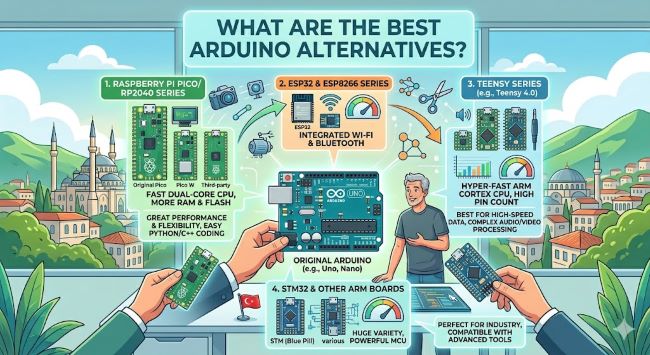
Looking for the best Arduino alternatives? This guide covers Raspberry Pi, ESP32, STM32, and more, with honest comparisons to help you pick the right board for your project.
Arduino is the board that got most hobbyists into electronics, and for good reason. It is approachable, well-documented, and supported by a massive community. But it is not always the right tool for every project. If you need more processing power, built-in Wi-Fi, lower cost, or just want to explore what else is out there, there are plenty of solid Arduino alternatives worth knowing about. This guide covers the best options and helps you figure out which one fits your project.
Raspberry Pi
The Raspberry Pi is the most well-known Arduino alternative, though comparing the two directly is a bit like comparing a microcontroller to a full computer, because that is essentially what it is.
The Raspberry Pi runs a full Linux operating system. It has a proper CPU, RAM, HDMI output, USB ports, and can run Python, Node.js, or almost any language you want. It is a better choice than Arduino when your project needs:
- Network connectivity and web servers
- A display or graphical interface
- Complex data processing
- Camera integration
The trade-off is power consumption and complexity. A Raspberry Pi draws significantly more power than an Arduino and requires an operating system to boot. For simple sensor reading or motor control, that is overkill. For a home automation hub or media server, it is the right call.
Best for: Projects that need a full computer in a small form factor.
ESP32
The ESP32 is arguably the best direct Arduino alternative for most maker projects. It is a microcontroller like the Arduino, but it comes with built-in Wi-Fi and Bluetooth, a dual-core processor running at up to 240MHz, and costs significantly less than most Arduino boards.
It is also compatible with the Arduino IDE, which means you can use the same programming environment you already know. Most Arduino libraries work with it too.
The ESP32 is the go-to choice when your project needs wireless connectivity without adding a separate module. Think IoT sensors, smart home devices, weather stations, or anything that sends data to the cloud.
Best for: Wi-Fi and Bluetooth projects, IoT applications, and anyone who wants more power at a lower price.
STM32
The STM32 family of microcontrollers comes from STMicroelectronics and covers a wide range of boards from simple, low-power options to high-performance chips used in industrial applications. The performance ceiling is well above what Arduino offers, with faster clock speeds, more memory, and more peripheral options.
The learning curve is steeper. STM32 boards are not as beginner-friendly as Arduino, and the toolchain setup takes more effort. But if you are building something that needs real-time performance, precise timing, or you are moving toward professional embedded development, STM32 is the path worth taking.
The STM32 Nucleo boards are a good entry point. They are affordable, well-supported, and compatible with the Arduino IDE through the STM32duino project.
Best for: Performance-critical applications, professional embedded development, and makers ready to go deeper.
Teensy
Teensy boards are made by PJRC and are a favorite in the audio and music electronics community. They run on ARM Cortex processors, support USB audio and MIDI natively, and are fast enough to handle real-time audio processing that would overwhelm an Arduino.
Teensy boards are Arduino IDE compatible and the community around them is active and helpful. They are small, powerful, and reliable. If your project involves sound, music, or anything that benefits from fast USB communication, Teensy is worth a close look.
Best for: Audio projects, USB devices, MIDI controllers, and performance-sensitive applications.
BBC micro:bit
The micro:bit is aimed at beginners and education, but it is a capable board with built-in Bluetooth, an LED matrix, buttons, and accelerometer all on one small board. It is easier to get started with than Arduino and supports both block-based and Python programming.
For teaching kids electronics or building quick interactive prototypes, the micro:bit gets you there faster than almost anything else. It is not the right choice for complex or power-hungry projects, but for its target use case it delivers.
Best for: Education, beginners, and quick interactive prototypes.
Which Arduino Alternative Should You Choose?
Here is a quick summary to help you decide:
| Board | Best For | Wi-Fi Built-in | Arduino IDE Compatible |
|---|---|---|---|
| Raspberry Pi | Complex projects, Linux apps | Yes | No |
| ESP32 | IoT, wireless projects | Yes | Yes |
| STM32 | Performance, professional use | No (some models) | Yes (via STM32duino) |
| Teensy | Audio, USB, real-time tasks | No | Yes |
| micro:bit | Education, beginners | Yes (Bluetooth) | No |
The Short Answer
The best Arduino alternatives depend entirely on what you are building. The ESP32 is the strongest all-around replacement for most maker projects. The Raspberry Pi is the right choice when you need a full computer. STM32 is where you go when performance matters and you are ready for a steeper learning curve. Teensy wins for audio. micro:bit wins for beginners.
Pick based on your project requirements, not brand loyalty, and you will end up with a better result.