
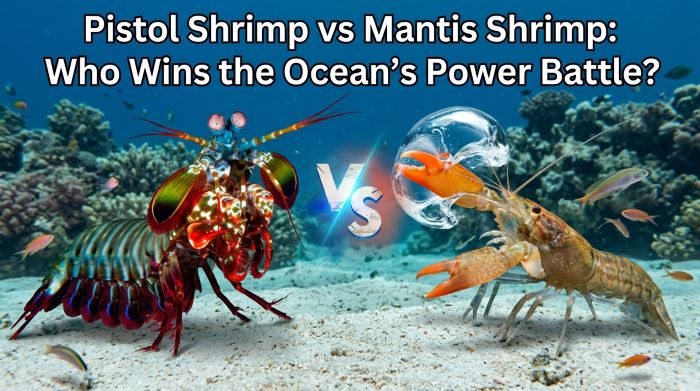
Pistol Shrimp vs Mantis Shrimp
The ocean is home to two tiny creatures with superpowers that sound made up. One can snap its claw so fast that it creates a bubble hotter than the surface of the sun. The other throws a punch so strong it can crack aquarium glass.
Meet the pistol shrimp and the mantis shrimp. This guide compares pistol shrimp vs mantis shrimp, from size and weapons to eyes and behavior, so you can see which one truly rules the reef.
Quick Overview
- Pistol shrimp (also called snapping shrimp) use one oversized claw to fire a high speed jet of water that creates a stunning shock wave.
- Mantis shrimp use powerful front limbs to smash or spear prey with one of the fastest strikes in the animal kingdom.
Despite the names, a mantis shrimp isn’t a true shrimp. It belongs to a separate group of crustaceans called stomatopods.
Pistol Shrimp vs Mantis Shrimp at a Glance
| Feature | Pistol Shrimp | Mantis Shrimp |
|---|---|---|
| Scientific group | Family Alpheidae (true shrimp) | Order Stomatopoda (not true shrimp) |
| Number of species | Hundreds | About 450 or more |
| Typical size | About 1 to 2 inches | About 4 inches; some species over 12 inches |
| Main weapon | Snapping claw | Club or spear shaped front limbs |
| How it attacks | Shock wave from a collapsing bubble | Direct punch or stab |
| Strike speed | Water jet up to about 60 mph | Club moves up to about 50 mph |
| Sound | Up to about 210 decibels | Clicking sounds |
| Eyesight | Poor | Among the most complex eyes known |
| Habitat | Warm coastal waters, reefs, seagrass | Tropical and subtropical reefs and burrows |
| Lifestyle | Often lives with a goby partner | Solitary, territorial |
Meet the Pistol Shrimp
Pistol shrimp are small, usually just 1 to 2 inches long, but one of their claws is huge, sometimes half the size of their body. When the claw snaps shut, it shoots out a jet of water so fast that it forms a cavitation bubble.
When the bubble collapses, it releases:
- A shock wave strong enough to stun or kill small fish and crabs
- A loud crack reaching about 210 decibels, louder than a gunshot
- A flash of light, called sonoluminescence
- A brief burst of heat estimated at around 4,700°C (8,500°F), close to the temperature of the sun’s surface
All of this happens in a tiny fraction of a second. Large colonies of pistol shrimp are so loud they can interfere with submarine sonar.
Best Friends With Gobies
Many pistol shrimp have a famous partnership with goby fish. The shrimp digs and maintains a burrow, while the goby, which has much better eyesight, keeps watch. The shrimp keeps one antenna on the goby, and when danger appears, the goby flicks its tail and both dive into the burrow.
Meet the Mantis Shrimp
The mantis shrimp is a colorful, fierce predator often called the “punching shrimp.” It gets its name from its front limbs, which fold like a praying mantis’s arms.
There are two main types:
- Smashers: Use club shaped limbs to smash crabs, snails, and clams.
- Spearers: Use spiny, barbed limbs to stab soft bodied prey like fish.
The Punching Shrimp’s Super Strike
The peacock mantis shrimp is the most famous punching shrimp. Its club accelerates as fast as a .22 caliber bullet and can reach speeds of about 50 mph (80 km/h). The strike is so fast it creates its own cavitation bubbles, so prey gets hit twice: once by the club and once by the collapsing bubble.
The punch can break snail shells, crab claws, and even aquarium glass. Scientists study the mantis shrimp’s club, which doesn’t shatter despite thousands of hits, to design stronger materials for helmets and aircraft.
Mantis Shrimp Size
Mantis shrimp size varies a lot by species. Most are about 4 inches (10 cm) long. The peacock mantis shrimp usually grows to about 3 to 7 inches.
The largest species, the zebra mantis shrimp, can reach around 15 inches (38 cm), making it one of the biggest stomatopods in the world.
| Species | Typical Mantis Shrimp Size |
|---|---|
| Peacock mantis shrimp | 3 to 7 inches |
| Common mantis shrimp | About 4 to 8 inches |
| Zebra mantis shrimp | Up to about 15 inches |
Compared with the 1 to 2 inch pistol shrimp, the mantis shrimp’s larger body gives it a big advantage.
Mantis Shrimp Eyes
Mantis shrimp eyes are some of the most complex in the animal world. Here’s what makes them special:
- 12 to 16 photoreceptor types. Humans have just three types of color receptors. The mantis shrimp has up to 16.
- Ultraviolet vision. Mantis shrimp eyes can see UV light that’s invisible to us.
- Polarized light. They can detect polarized light, including circular polarization, which very few animals can see.
- Trinocular vision. Each eye is split into three sections, so each eye alone can judge depth.
- Independent movement. Each eye sits on a stalk and moves on its own.
Interestingly, research suggests mantis shrimp aren’t better than humans at telling similar colors apart. Instead, their eyes may help them recognize colors very quickly without much brain processing.
Pistol shrimp, by contrast, have poor eyesight, which is why they rely on goby partners.
Hunting Styles Compared
Pistol shrimp: Wait near their burrow and fire their snapping claw at passing prey. The shock wave stuns the target, then the shrimp drags it home.
Mantis shrimp: Hunt actively or ambush from burrows. Smashers break hard shells, while spearers strike fish and soft prey with lightning speed.
Pistol Shrimp vs Mantis Shrimp: Who Would Win?
So who wins the pistol shrimp vs mantis shrimp battle? Most experts would bet on the mantis shrimp.
| Factor | Advantage |
|---|---|
| Size | Mantis shrimp |
| Armor | Mantis shrimp |
| Strike power | Mantis shrimp |
| Eyesight | Mantis shrimp |
| Long range attack | Pistol shrimp |
| Sound | Pistol shrimp |
The pistol shrimp’s snap works from a short distance and can stun small animals. But a mantis shrimp is bigger, heavily armored, and has excellent vision to spot attacks coming. In the mantis shrimp vs pistol shrimp matchup, one punch from a mantis shrimp would likely end the fight quickly.
In fact, mantis shrimp eat small crustaceans, so a pistol shrimp could easily become a meal.
Mantis Shrimp vs Pistol Shrimp as Pets
Both creatures appear in saltwater aquariums, but they’re very different to keep.
- Pistol shrimp are popular in reef tanks, especially when paired with a goby. They’re usually peaceful toward larger fish.
- Mantis shrimp are often unwanted hitchhikers on live rock. They can eat fish, snails, and crabs, and large smashers can crack glass. Keepers who want one usually give it a tank of its own.
Fun Facts
- Pistol shrimp snaps are among the loudest sounds in the ocean.
- Mantis shrimp have existed in some form for hundreds of millions of years.
- Some mantis shrimp species mate for life and share a burrow.
- The mantis shrimp’s club inspires research into tougher body armor.
- The pistol shrimp’s bubble flash lasts less than a billionth of a second.
Where They Live
Pistol shrimp live in warm, shallow coastal waters around the world. You’ll find them in coral reefs, seagrass beds, oyster reefs, and muddy bottoms. Many dig burrows in sand or hide in crevices.
Mantis shrimp live mainly in tropical and subtropical seas, especially in the Indian and Pacific Oceans. Most live in burrows or rock cracks and spend much of their time hidden, waiting for prey.
The two often share the same reefs, which means real life pistol shrimp vs mantis shrimp encounters do happen in the wild.
What Science Learns From Them
Both animals have taught scientists a lot:
- Pistol shrimp have helped researchers study cavitation, the bubble effect that can damage boat propellers and pumps. Some engineers have even built robotic claws based on the snapping shrimp to study underwater shock waves.
- Mantis shrimp have inspired research into impact resistant materials and new camera sensors that detect polarized light, which could help spot certain cancers.
The mantis shrimp vs pistol shrimp comparison isn’t just about who wins a fight. Both are helping humans design better technology.
Pistol Shrimp vs Mantis Shrimp: By the Numbers
| Stat | Pistol Shrimp | Mantis Shrimp |
|---|---|---|
| Strike time | Under a millisecond | A few milliseconds |
| Bubble temperature | About 4,700°C | Also forms cavitation bubbles |
| Lifespan | A few years | Up to about 20 years in some species |
| Color receptors | Few | 12 to 16 |
Looking at the pistol shrimp vs mantis shrimp numbers side by side, it’s clear both are record breakers in their own way. The pistol shrimp vs mantis shrimp rivalry is really a story of two different solutions to the same problem: catching food fast.
Frequently Asked Questions
Is the mantis shrimp dangerous to humans? It won’t hunt people, but large ones can cause painful cuts or bruises if handled. Fishermen nickname them “thumb splitters.”
Can a pistol shrimp hurt a human? Not seriously. The snap might give a small sting at very close range.
Is a mantis shrimp a real shrimp? No. It’s a stomatopod, a separate group of crustaceans.
Which is louder? The pistol shrimp, by far.
Final Thoughts
The pistol shrimp vs mantis shrimp matchup pits sound and shock waves against raw punching power. The pistol shrimp is a tiny marvel of physics. The mantis shrimp is a bigger, armored fighter with incredible eyes. Both prove that the ocean’s smallest creatures can be its most amazing.
Key Takeaways
- Pistol shrimp vs mantis shrimp: the pistol shrimp stuns prey with a shock wave, while the mantis shrimp punches or spears it.
- Pistol shrimp snaps reach about 210 decibels and create brief heat around 4,700°C.
- The mantis shrimp, or punching shrimp, strikes as fast as a .22 caliber bullet.
- Mantis shrimp size is usually about 4 inches, with the zebra mantis shrimp reaching about 15 inches.
- Mantis shrimp eyes have up to 16 photoreceptor types and can see UV and polarized light.
- In a fight, the bigger, armored mantis shrimp would most likely win.