
Classical Conditioning vs Operant Conditioning
Why does your mouth water when you smell popcorn? Why does your dog sit when it sees a treat? Both are learned behaviors, but they’re learned in different ways. Psychologists call these two kinds of learning classical conditioning and operant conditioning.
This guide breaks down classical conditioning vs operant conditioning in simple terms, with real life examples you’ll recognize right away.
The Short Answer
- Classical conditioning links two things together. You learn that one signal predicts another, and you react automatically.
- Operant conditioning links a behavior to a result. You learn that an action brings a reward or a punishment, and you change what you do.
In short: classical conditioning is about associations. Operant conditioning is about consequences.
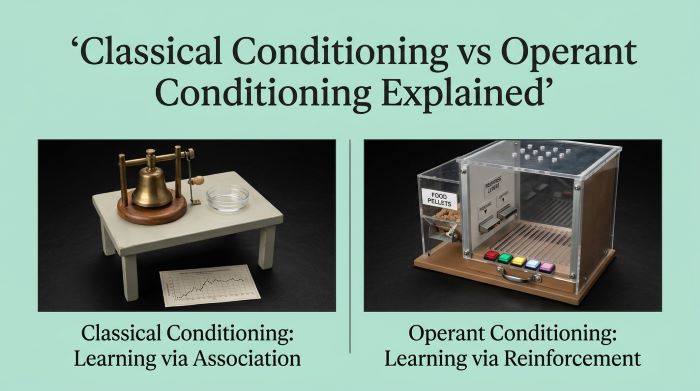
Classical vs Operant Conditioning at a Glance
| Feature | Classical Conditioning | Operant Conditioning |
|---|---|---|
| Key idea | Learning by association | Learning by consequences |
| Main scientist | Ivan Pavlov | B.F. Skinner |
| Type of behavior | Automatic, involuntary | Voluntary, chosen |
| What comes first | The stimulus | The behavior |
| Learner’s role | Passive | Active |
| Key terms | Stimulus, response | Reinforcement, punishment |
| Classic example | Dog drools at a bell | Rat presses lever for food |
What Is Classical Conditioning?
Classical conditioning is a type of learning where a neutral signal becomes linked to something that already causes a natural reaction. After enough pairings, the neutral signal alone triggers the reaction.
Pavlov’s Dogs
Russian scientist Ivan Pavlov discovered classical conditioning in the 1890s while studying digestion in dogs. He noticed his dogs began drooling before food arrived, just from hearing the lab assistants’ footsteps.
Pavlov tested this idea. He rang a bell right before giving the dogs food. After several pairings, the dogs drooled when they heard the bell, even with no food in sight.
Key Terms
| Term | Meaning | Pavlov Example |
|---|---|---|
| Unconditioned stimulus (UCS) | Naturally triggers a response | Food |
| Unconditioned response (UCR) | Natural, unlearned reaction | Drooling at food |
| Neutral stimulus (NS) | Causes no response at first | Bell |
| Conditioned stimulus (CS) | Neutral stimulus after learning | Bell after pairing |
| Conditioned response (CR) | Learned reaction | Drooling at the bell |
Little Albert
In 1920, John B. Watson and Rosalie Rayner ran a now famous experiment with a baby known as “Little Albert.” They paired a white rat with a loud, scary noise. Soon, Albert cried at the sight of the rat alone. The study showed that emotions like fear can be learned, though it’s now seen as deeply unethical.
Classical Conditioning Examples
Here are everyday classical conditioning examples you’ve probably experienced:
- Phone notifications. Your heart jumps when you hear your phone buzz, because the sound has been paired with exciting messages.
- Food smells. The smell of popcorn makes you hungry because you link it to movies and snacks.
- Dentist anxiety. The sound of a dental drill makes some people tense up after past discomfort.
- Pets and the treat bag. A cat runs to the kitchen when it hears the treat bag crinkle.
- Songs and memories. A song from a happy summer instantly lifts your mood.
- Food aversion. If you get sick after eating a certain food, you may feel nauseous just smelling it later.
- Advertising. Brands pair products with happy music, attractive people, or exciting scenes so you feel good about the product.
These examples of classical conditioning show how often our automatic reactions are shaped by past pairings.
What Is Operant Conditioning?
Operant conditioning is learning based on what happens after a behavior. If a behavior leads to something good, you’re more likely to repeat it. If it leads to something bad, you’re less likely to repeat it.
Thorndike and Skinner
Psychologist Edward Thorndike laid the groundwork with his “law of effect” around 1898. He found that cats in puzzle boxes escaped faster over time as they learned which actions worked.
B.F. Skinner built on this idea in the 1930s. He created the “Skinner box,” where rats learned to press a lever to get food. Skinner named this process operant conditioning, because the animal “operates” on its environment.
Reinforcement and Punishment
Operant conditioning uses four main tools:
| Type | What Happens | Effect on Behavior | Example |
|---|---|---|---|
| Positive reinforcement | Add something good | Increases behavior | Getting a bonus for hard work |
| Negative reinforcement | Remove something bad | Increases behavior | Buckling up to stop the car’s beeping |
| Positive punishment | Add something bad | Decreases behavior | Getting a speeding ticket |
| Negative punishment | Remove something good | Decreases behavior | Losing phone time for breaking curfew |
“Positive” means adding, and “negative” means taking away. They don’t mean good or bad.
Schedules of Reinforcement
How often a reward comes also matters:
- Fixed ratio: Reward after a set number of actions (a coffee card that gives a free drink after 10 purchases).
- Variable ratio: Reward after an unpredictable number of actions (slot machines). This creates the strongest habits.
- Fixed interval: Reward after a set time (a weekly paycheck).
- Variable interval: Reward after unpredictable time (checking for email).
Operant vs Classical Conditioning: Key Differences
When comparing operant vs classical conditioning, focus on these points:
- Voluntary vs automatic. Classical conditioning shapes automatic reactions like drooling or fear. Operant conditioning shapes chosen actions like studying or working.
- Order of events. In classical conditioning, the signal comes before the response. In operant conditioning, the consequence comes after the behavior.
- Active vs passive. In classical conditioning, the learner doesn’t have to do anything. In operant conditioning, the learner must act.
- Main focus. Classical conditioning connects two stimuli. Operant conditioning connects a behavior to its consequence.
Shared Concepts
Classical vs operant conditioning also have a lot in common:
- Acquisition: The learning phase.
- Extinction: The learned behavior fades when the pairing or reward stops.
- Spontaneous recovery: A faded behavior suddenly returns after a break.
- Generalization: Reacting to similar signals (fearing all small dogs, not just one).
- Discrimination: Learning to tell similar signals apart.
When Both Work Together
In real life, the two types often mix. Think about dog training. A trainer says “sit” and gives a treat when the dog sits. That’s operant conditioning. Over time, the dog gets excited just hearing the trainer’s voice. That’s classical conditioning.
The same happens with kids, students, and even adults at work.
Real World Uses
| Field | Classical Conditioning Use | Operant Conditioning Use |
|---|---|---|
| Therapy | Exposure therapy for phobias | Token systems and behavior plans |
| Parenting | Bedtime routines that signal sleep | Praise, rewards, and time outs |
| Education | Calm classroom cues | Grades, gold stars, and privileges |
| Marketing | Pairing products with good feelings | Loyalty points and rewards |
| Animal training | Clicker as a reward signal | Treats for correct behavior |
More Examples of Classical Conditioning
Here are more examples of classical conditioning you might notice this week:
- School bells. Students start packing up the moment they hear the bell, even before the teacher finishes.
- Alarm tones. Hearing your morning alarm sound on someone else’s phone can make you feel tired or stressed.
- Hospital smells. The scent of hand sanitizer may bring back memories of being sick.
- Holiday scents. Cinnamon and pine can instantly make you feel festive.
These examples of classical conditioning show how strongly our bodies react to cues we’ve learned without trying.
Easy Ways to Remember Classical vs Operant Conditioning
Students often mix these up on tests. Try these memory tricks for classical vs operant conditioning:
- Classical = Cue. Both start with C. A cue triggers an automatic reaction.
- Operant = Operate. The learner operates on the world and gets a consequence.
- Pavlov rings, Skinner rewards. Pavlov rang a bell; Skinner gave rewards.
- Before vs after. In classical conditioning, the key event happens before the response. In operant conditioning, it happens after.
Operant vs Classical Conditioning in Everyday Habits
Think about your morning coffee. The smell of brewing coffee makes you feel alert before you take a sip. That’s classical conditioning. You also keep buying coffee because it rewards you with energy. That’s operant conditioning. Looking at operant vs classical conditioning this way shows how both shape the same habit.
Understanding classical conditioning vs operant conditioning can help you build good habits too. Pair a new routine with something pleasant, then reward yourself when you stick with it. Teachers, parents, and coaches use classical conditioning vs operant conditioning ideas every day, often without realizing it. Once you learn the classical conditioning vs operant conditioning difference, you’ll start spotting it everywhere.
Classical Conditioning vs Operant Conditioning in Therapy
Psychologists use both types of learning to help people. Exposure therapy, which slowly pairs a feared object with calm and safety, is based on classical conditioning. Behavior plans that reward progress are based on operant conditioning. Knowing the classical conditioning vs operant conditioning difference helps therapists choose the right tool for each problem.
Frequently Asked Questions
Is classical or operant conditioning more powerful? Neither is stronger overall. Classical conditioning shapes emotional reactions, while operant conditioning shapes everyday choices.
Who is the father of operant conditioning? B.F. Skinner, building on Edward Thorndike’s earlier work.
What is a simple classical conditioning example? Feeling hungry when you hear the ice cream truck’s music.
Can classical conditioning be undone? Yes. Through extinction, the link fades when the signal appears again and again without the original stimulus.
Final Thoughts
The classical conditioning vs operant conditioning difference is easy to remember. Classical conditioning teaches us to connect signals and react automatically. Operant conditioning teaches us to change our actions based on rewards and punishments. Together, they explain a huge share of how people and animals learn.
Key Takeaways
- Classical conditioning vs operant conditioning: one is learning by association, the other is learning by consequences.
- Ivan Pavlov discovered classical conditioning; B.F. Skinner developed operant conditioning.
- Classical conditioning examples include drooling at food smells and feeling anxious at a dentist’s drill.
- Operant conditioning uses positive and negative reinforcement and punishment.
- Classical conditioning affects automatic reactions; operant conditioning affects voluntary actions.
- In real life, such as dog training, both often work together.