Sunny Side Up vs Over Easy
Order breakfast at any diner and the server will probably ask, “How do you want your eggs?” If you say “fried,” you’ll often get a follow up question: sunny side up or over easy? Both are classic fried eggs with runny yolks, but they’re cooked a little differently and taste a little different too.
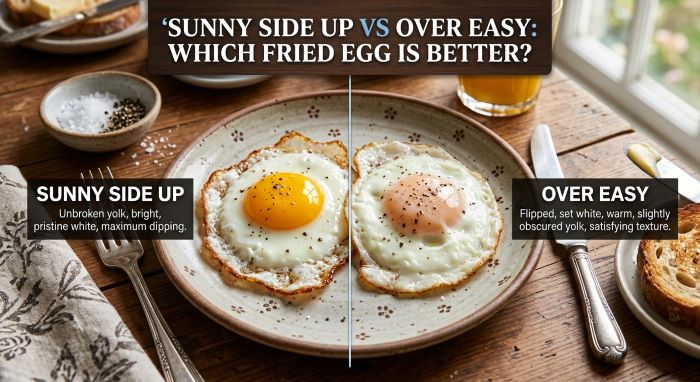
The main difference in sunny side up vs over easy is simple. A sunny side up egg is never flipped, so the yolk stays bright yellow on top. An over easy egg is flipped once and cooked briefly on the second side, which sets a thin layer of white over the yolk while keeping it runny inside.
This guide explains how each egg is made, how they compare in taste and texture, which is safer, and how to cook both perfectly at home.
Quick Comparison
| Sunny Side Up | Over Easy | |
|---|---|---|
| Flipped? | No | Yes, briefly |
| Yolk | Fully runny, bright and exposed | Runny, with a thin film of cooked white on top |
| White | Set on the bottom, can be soft on top near the yolk | Fully set on both sides |
| Cook time | About 2 to 4 minutes | About 3 to 4 minutes total |
| Look | Bright yellow “sun” on white | Golden on both sides, yolk hidden |
| Difficulty | Easier for beginners | Requires a gentle flip |
| Best for | Toast, hash, rice bowls, photos | Sandwiches, burgers, breakfast plates |
What Is a Sunny Side Up Egg?
A sunny side up egg is fried on one side only. You crack the egg into a hot pan and cook it until the white is set, but you never flip it. The yolk stays whole and bright, like a little sun sitting on a white plate. That’s how it got its name.
Because the top never touches the pan, the white right around the yolk can stay a bit soft or slightly translucent. Some cooks cover the pan for a few seconds or baste the egg with hot fat to help the top set.
What Is an Over Easy Egg?
An over easy egg starts the same way as sunny side up. Once the bottom is set, you flip it gently and cook the second side for about 20 to 30 seconds. That short time is just enough to set the white on top while keeping the yolk liquid.
“Over” means the egg is flipped. “Easy” means the second side is cooked only briefly, so the yolk stays runny.
The Over Egg Family
Over easy is part of a family of flipped eggs. The difference is how long you cook the second side:
| Style | Second Side Time | Yolk |
|---|---|---|
| Over easy | About 20 to 30 seconds | Runny |
| Over medium | About 1 minute | Jammy, partly set |
| Over hard | About 1.5 to 2 minutes | Fully cooked and firm |
Sunny Side Up vs Over Easy: Key Differences
1. Cooking Method
The biggest difference in sunny side up vs over easy is the flip. Sunny side up is never turned. Over easy is turned once and cooked briefly.
2. Texture
Sunny side up eggs have the softest, silkiest whites near the yolk. Over easy eggs have fully set whites, with a slightly firmer, more even texture.
3. Yolk
Both have runny yolks. With sunny side up, the yolk is exposed and very liquid. With over easy, a thin layer of white covers the yolk, which makes it a little less messy when you cut into it.
4. Appearance
Sunny side up eggs look bright and cheerful, which is why food photographers love them. Over easy eggs look more golden and uniform.
5. Difficulty
Sunny side up is easier because there’s no flip. Over easy takes a bit of practice, since a rough flip can break the yolk.
How to Cook a Perfect Sunny Side Up Egg
- Heat the pan. Use a nonstick or well seasoned cast iron skillet over medium low heat.
- Add fat. Melt about 1 teaspoon of butter or oil.
- Crack the egg. Crack it into a small bowl first, then slide it gently into the pan.
- Cook gently. Let it cook for 2 to 3 minutes until the white is set on the bottom.
- Set the top. If the white near the yolk is still runny, cover the pan with a lid for 30 to 60 seconds, or spoon hot butter over the white.
- Season and serve. Add salt and pepper and slide it onto your plate.
Tip: Low heat is the secret. High heat makes the edges crispy and brown before the top sets.
How to Cook a Perfect Over Easy Egg
- Heat the pan. Use a nonstick pan over medium heat.
- Add fat. Melt about 1 teaspoon of butter or oil.
- Crack the egg. Slide it gently into the pan.
- Cook the first side. Cook for about 2 to 3 minutes until the white is mostly set.
- Flip gently. Slide a thin spatula under the egg and turn it over in one smooth motion. Keep it close to the pan.
- Cook the second side. Cook for 20 to 30 seconds.
- Serve. Flip it back over or serve as is.
Tip: A thin, flexible fish spatula makes flipping much easier.
Taste Differences
In a taste test of sunny side up vs over easy, both eggs taste rich and buttery, but there are small differences:
- Sunny side up tastes a bit more delicate and creamy, especially if the edges stay soft.
- Over easy has a slightly more cooked, savory flavor from the second side touching the hot pan.
If you cook either in butter or bacon fat, you’ll get extra flavor.
Which Is Safer?
When it comes to food safety, sunny side up vs over easy is close. Both have runny yolks, which means the yolk isn’t fully cooked. Raw or undercooked eggs carry a small risk of salmonella.
The USDA recommends cooking eggs until both the white and yolk are firm. People at higher risk, such as young children, older adults, pregnant people, and anyone with a weakened immune system, should choose fully cooked eggs or use pasteurized eggs.
Over easy may be very slightly safer because the white is fully set on both sides, but the yolk is still runny. To lower risk:
- Buy fresh eggs from a trusted source.
- Keep eggs refrigerated.
- Use pasteurized eggs if you love runny yolks.
Not sure if your eggs are fresh? Learn How to Tell if Eggs Are Still Good before you start cooking.
Nutrition
There’s no real winner in sunny side up vs over easy when it comes to nutrition. Cooking style doesn’t change an egg’s nutrition much. One large egg has about 70 to 80 calories, about 6 grams of protein, and about 5 grams of fat before any added butter or oil. The main difference comes from how much fat you use in the pan.
Best Ways to Serve Each Egg
Your meal often decides the sunny side up vs over easy choice for you.
| Dish | Best Style | Why |
|---|---|---|
| Avocado toast | Sunny side up | Looks great and the yolk soaks into the toast |
| Breakfast sandwich | Over easy | Less messy, holds together better |
| Burger | Over easy | Fits neatly under the bun |
| Rice bowl or bibimbap | Sunny side up | Yolk becomes a sauce |
| Corned beef hash | Either | Runny yolk mixes into the hash |
| Huevos rancheros | Sunny side up | Classic presentation |
| Steak and eggs | Over easy | Hearty and easy to eat |
Common Mistakes to Avoid
- Using high heat. It burns the bottom before the top sets.
- Cracking eggs on the pan edge. This can push shell into the egg. Crack on a flat surface instead.
- Flipping too soon. Let the white set first, or it will tear.
- Using a sticky pan. A nonstick or well seasoned pan prevents broken yolks.
- Overcooking the second side. Over easy can quickly turn into over medium.
Other Ways to Cook Eggs
Fried eggs are just one option. If you prefer a fully cooked yolk without flipping, boiling is easy and consistent. See our guide on How Long to Boil Eggs for soft, jammy, and hard boiled timing.
Frequently Asked Questions
What’s the difference between sunny side up and over easy? Sunny side up isn’t flipped, so the yolk is exposed. Over easy is flipped briefly, so a thin layer of white covers the runny yolk.
Which is easier to make? Sunny side up, because you don’t need to flip the egg.
Is over easy the same as over medium? No. Over medium cooks longer on the second side, so the yolk is partly set.
Are runny yolks safe? They carry a small risk of salmonella. Use fresh or pasteurized eggs, and choose fully cooked eggs if you’re in a higher risk group.
Final Thoughts
The sunny side up vs over easy debate comes down to personal taste. If you love a bright, fully runny yolk and soft whites, go sunny side up. If you want fully set whites and a slightly neater egg for sandwiches and burgers, choose over easy. Either way, a little low heat, good butter, and a gentle hand will give you a perfect fried egg.
Key Takeaways
- Sunny side up vs over easy comes down to the flip: sunny side up is never flipped, while over easy is flipped and cooked briefly.
- Both styles have runny yolks, but over easy has a thin layer of cooked white over the yolk.
- Sunny side up is easier for beginners and looks great on toast and rice bowls.
- Over easy is neater for sandwiches and burgers.
- Cook both on low to medium heat with butter or oil for the best texture.
- Runny yolks carry a small salmonella risk, so use fresh or pasteurized eggs, especially for higher risk groups.