Automotive Diagnostic Trouble Code
The check engine light comes on. Your stomach drops. Is it a loose gas cap or a failing engine? You cannot tell by looking at the dashboard. But your car already knows. When its computer spots a problem, it stores an automotive diagnostic trouble code, a short string of letters and numbers that points to what went wrong.
This guide explains what these codes are, how to read them, what each part of the code means, the most common codes and their likely causes, and when you can fix the problem yourself versus when to call a mechanic.
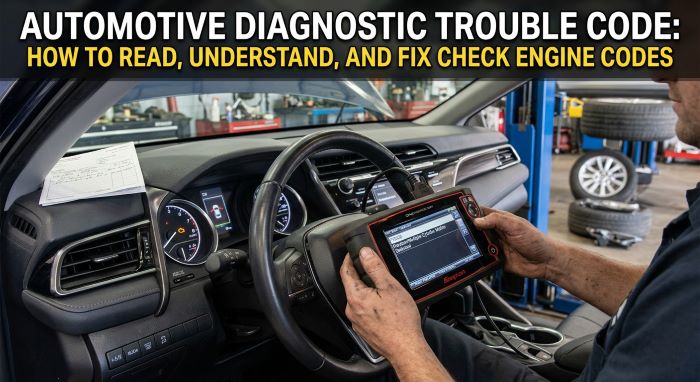
What Is an Automotive Diagnostic Trouble Code?
A diagnostic trouble code, or DTC, is a code your vehicle’s computer stores when a sensor reading falls outside its normal range. Modern cars have several computers, called modules. The main one is the engine control module, often called the ECM or PCM (powertrain control module). These modules watch hundreds of sensors many times each second.
When a module detects a fault, it may:
- Store a code in memory
- Turn on the check engine light, also called the malfunction indicator lamp (MIL)
- Save a “freeze frame,” a snapshot of conditions such as speed, engine temperature, and load at the moment the fault occurred
- Change how the engine runs to protect it, sometimes called limp mode
The code does not always name the broken part. It tells you which system or circuit failed a test. A mechanic or a careful owner then confirms the real cause.
A Short History: OBD-I to OBD-II
OBD stands for on-board diagnostics.
| System | Years | What It Offered |
|---|---|---|
| OBD-I | 1980s to mid-1990s | Basic codes that varied by maker. Each brand used its own connector and code list |
| OBD-II | Required on cars and light trucks sold in the U.S. from the 1996 model year | A standard connector, a standard code format, and standard emissions tests |
| EOBD | Europe, from 2001 for petrol cars and 2004 for diesels | The European version of OBD-II |
OBD-II changed everything for drivers. Any compatible scanner now works on any 1996 or newer car sold in the U.S., whatever the brand.
Where Is the OBD-II Port?
The OBD-II port, also called the data link connector, is a 16-pin socket. On most vehicles, it sits under the dashboard on the driver’s side, near the steering column or above the pedals. Some cars hide it behind a small cover. Your owner’s manual shows the exact spot.
How to Read an Automotive Diagnostic Trouble Code
Every OBD-II code has five characters, such as P0301. Each character tells you something.
Character 1: The System
| Letter | System | Examples |
|---|---|---|
| P | Powertrain | Engine, transmission, fuel, ignition, emissions |
| B | Body | Airbags, seats, power windows, climate control |
| C | Chassis | ABS brakes, steering, suspension |
| U | Network | Communication between the car’s modules |
P codes are by far the most common, since they cover the engine and emissions systems that trigger the check engine light.
Character 2: Generic or Manufacturer-Specific
| Digit | Meaning |
|---|---|
| 0 | Generic. The same meaning on every brand |
| 1 | Manufacturer-specific. The meaning depends on the brand |
| 2 | Mostly generic for P codes |
| 3 | Mixed. Some generic, some maker-specific |
A P0 code means the same thing on a Ford as on a Toyota. A P1 code needs the brand’s own code list or a scanner that supports that maker.
Character 3: The Subsystem
For powertrain codes, the third character points to the area of the problem.
| Digit | Subsystem |
|---|---|
| 1 | Fuel and air metering |
| 2 | Fuel and air metering (injector circuits) |
| 3 | Ignition system or misfire |
| 4 | Auxiliary emissions controls |
| 5 | Vehicle speed, idle control, and auxiliary inputs |
| 6 | Computer and output circuits |
| 7, 8, 9 | Transmission |
| A, B, C | Hybrid propulsion systems |
Characters 4 and 5: The Specific Fault
The last two digits identify the exact fault. In P0301, “01” means cylinder 1. In P0302, it means cylinder 2, and so on.
So P0301 reads as: powertrain (P), generic (0), ignition or misfire (3), cylinder 1 (01). In plain words, the computer detected a misfire in cylinder 1.
Steady Light vs. Flashing Light
How the check engine light behaves matters as much as the code.
| Light | What It Means | What to Do |
|---|---|---|
| Off | No active fault the computer is tracking | Nothing |
| Steady | A fault has been detected. Usually not an emergency | Read the code soon, within days |
| Flashing | A serious misfire is happening now, which can overheat and damage the catalytic converter | Reduce speed, avoid hard acceleration, and get the car checked as soon as possible |
Other warning lights, such as oil pressure or engine temperature, are more urgent than the check engine light. If one of those comes on, stop safely and turn off the engine.
The 15 Most Common Codes and Their Usual Causes
These codes appear often across many makes. The causes listed are the most common, not the only ones.
| Code | Meaning | Common Causes | Urgency |
|---|---|---|---|
| P0300 | Random or multiple cylinder misfire | Worn spark plugs, bad coils, vacuum leak, low fuel pressure | Medium to high |
| P0301 to P0308 | Misfire in a specific cylinder | Spark plug, ignition coil, or fuel injector on that cylinder | Medium to high |
| P0420 | Catalyst efficiency below threshold, bank 1 | Aging catalytic converter, faulty oxygen sensor, exhaust leak | Medium |
| P0171 | System too lean, bank 1 | Vacuum leak, dirty mass airflow sensor, weak fuel pump | Medium |
| P0172 | System too rich, bank 1 | Leaking injector, faulty sensor, high fuel pressure | Medium |
| P0442 | Small evaporative emissions leak | Worn gas cap seal, cracked hose | Low |
| P0455 | Large evaporative emissions leak | Loose or missing gas cap, disconnected hose | Low |
| P0456 | Very small evaporative emissions leak | Gas cap, small hose leak | Low |
| P0128 | Coolant below thermostat regulating temperature | Thermostat stuck open | Low to medium |
| P0401 | EGR flow insufficient | Clogged EGR valve or passages | Medium |
| P0135 | Oxygen sensor heater circuit, bank 1 sensor 1 | Failed oxygen sensor or wiring | Low to medium |
| P0101 | Mass airflow sensor range or performance | Dirty or failing MAF sensor, air leak | Medium |
| P0335 | Crankshaft position sensor circuit | Failed sensor or wiring | High, may cause stalling |
| P0505 | Idle air control system | Dirty throttle body or faulty idle valve | Low to medium |
| P0700 | Transmission control system malfunction | Points to a separate transmission code | Medium to high |
“Bank 1” means the side of the engine with cylinder 1. Four-cylinder engines in a row have only one bank. V6 and V8 engines have two.
Types of Codes: Pending, Confirmed, and Permanent
Not every automotive diagnostic trouble code turns on the light right away.
| Type | What It Means |
|---|---|
| Pending | The fault was seen once. The computer is waiting to see if it repeats. The light may stay off |
| Confirmed (stored) | The fault repeated, often over two drive cycles. The light turns on |
| Permanent | Added to newer vehicles. It cannot be erased with a scan tool and clears only after the car’s own tests pass |
| History | A past fault stored for reference after the problem stopped |
A good scanner shows all of these. Pending codes give early warning before a problem gets worse.
How to Read Codes Yourself
You do not need to be a mechanic to pull a code.
Tools You Can Use
| Tool | Typical Cost | What It Does |
|---|---|---|
| Basic code reader | Low cost | Reads and clears generic engine codes |
| Bluetooth OBD-II adapter with phone app | Low to moderate | Reads codes, live data, and freeze frames on your phone |
| Mid-range scanner | Moderate | Adds ABS, airbag, and transmission codes on many brands |
| Professional scan tool | High | Full access to all modules, tests, and programming |
| Free scan at an auto parts store | Free | Many U.S. parts chains read engine codes at no charge |
Step by Step
- Park the car and turn off the engine.
- Find the OBD-II port under the dashboard.
- Plug in the scanner or adapter.
- Turn the key to “on” without starting the engine, or press the start button without your foot on the brake. Some tools work with the engine running.
- Follow the scanner’s prompts to read codes.
- Write down every code, including pending ones.
- Save or note the freeze frame data.
- Look up each code’s meaning for your make and model.
What to Do After You Read the Code
A code is a starting point, not a final answer. Follow these steps:
- Check the simple things first. For EVAP codes, tighten or replace the gas cap.
- Research your exact vehicle. Many models have known problems that cause certain codes. Check for technical service bulletins and recalls.
- Look at the freeze frame. It shows when the fault happened, such as cold start or highway speed.
- Inspect the area. Look for cracked hoses, loose connectors, or damaged wires.
- Test before you replace. A P0420 code often leads people to replace a costly catalytic converter when a $40 oxygen sensor or an exhaust leak was the real cause.
- Fix the cause, then clear the code. Drive normally and watch for the code to return.
Should You Clear the Code?
You can clear most codes with a scanner. But clearing a code does not fix anything. If the fault is still there, the light will return.
There is another catch. Clearing codes also resets the car’s readiness monitors, the self-tests the computer runs on emissions systems. Many state emissions and inspection programs check these monitors. If you clear codes just before a test, the car may be rejected as “not ready.” It usually takes several days of normal driving for the monitors to complete.
DIY Fix or Mechanic?
| Usually DIY-Friendly | Usually Best Left to a Mechanic |
|---|---|
| Tightening or replacing a gas cap | Internal engine problems |
| Replacing spark plugs on many four-cylinder engines | Transmission codes |
| Swapping an ignition coil | Timing chain or belt faults |
| Cleaning a mass airflow sensor with MAF cleaner | Catalytic converter replacement |
| Replacing an easy-to-reach oxygen sensor | Network (U) codes and module programming |
| Replacing an air filter | Airbag (B) codes |
Airbag systems can be dangerous to work on. Leave B-code airbag repairs to trained technicians.
How Much Does a Diagnosis Cost?
Reading a code is cheap or free. Finding the real cause takes time. Many repair shops charge a diagnostic fee, often about an hour of labor, to test the system the code points to. Some shops credit that fee toward the repair. Ask about the fee before you agree to the diagnosis.
Common Myths
- “The code tells you exactly which part to replace.” It points to a circuit or system. Testing finds the part.
- “If the car drives fine, the code does not matter.” Small faults can grow, waste fuel, and damage costly parts such as the catalytic converter.
- “Disconnecting the battery fixes it.” It may clear the light, but the fault remains, and readiness monitors reset.
- “Only dealers can read codes.” Any OBD-II scanner reads generic codes on 1996 and newer U.S. vehicles.
Frequently Asked Questions
What is an automotive diagnostic trouble code? It is a code your car’s computer stores when it detects a fault, such as P0301 for a misfire in cylinder 1.
Can I drive with the check engine light on? If it is steady and the car drives normally, you can usually drive to get it checked soon. If it flashes, reduce speed and get help quickly.
How do I read the code for free? Many auto parts stores read codes for free, or you can buy an inexpensive scanner.
What does the “P” in a code mean? Powertrain, which covers the engine, transmission, and emissions systems.
Why did my code come back after I cleared it? The fault was not fixed. Clearing a code only resets the light.
Is a loose gas cap really enough to turn on the light? Yes. It can trigger EVAP codes such as P0455 or P0457.
Do electric cars have trouble codes? Yes. They use codes for their battery, motors, and other systems, though many details are maker-specific.
Final Thoughts
An automotive diagnostic trouble code turns a vague warning light into a useful clue. Learn the five-character format, read the code with a scanner or at a parts store, and pay attention to whether the light is steady or flashing.
Treat the code as the start of a diagnosis, not the end. Check simple causes first, test before you buy parts, and know when a job is better left to a professional. With that approach, the next automotive diagnostic trouble code your car throws will be far less stressful.
Key Takeaways
- An automotive diagnostic trouble code is a five-character code stored by your car’s computer when a system fails a self-test.
- The first letter shows the system: P for powertrain, B for body, C for chassis, and U for network.
- A second digit of 0 means a generic code. A 1 means a manufacturer-specific code.
- A steady check engine light needs attention soon, while a flashing light signals a serious misfire that needs prompt action.
- Common codes include P0300 misfires, P0420 catalyst efficiency, P0171 lean conditions, and P0455 EVAP leaks.
- Codes point to a system or circuit, so test before you replace parts.
- Clearing codes resets readiness monitors, which can cause a failed emissions inspection.