AA1937 Emergency Landing
Editor’s note: This is past news. The event covered here took place on July 27, 2026. This article looks back at what happened and what has been reported since, as of October 2026. If new official information appears, it may change parts of the picture below.
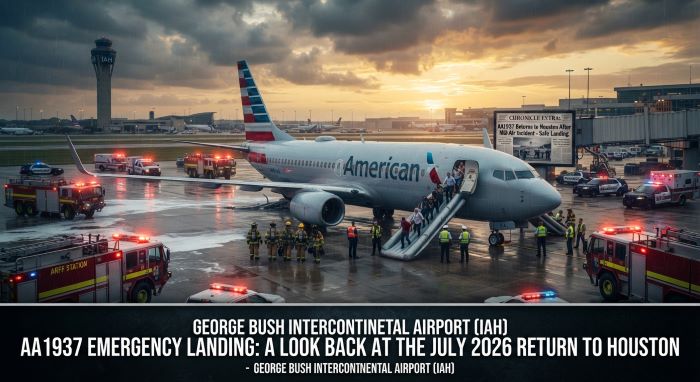
On a Monday in late July, an American Airlines jet climbing out of Houston suddenly stopped its climb, sent out an emergency code, and turned back. Twenty-five minutes after it left the runway, it was on the ground again, taxiing to the gate under its own power. No injuries were reported. The AA1937 emergency landing drew attention online within minutes, thanks to flight-tracking sites and aviation news accounts, and it remains a common search more than two months later.
This guide sets out what is known about the flight, what was only reported second-hand, and what is still unknown. It also explains the terms that appeared in the coverage, such as squawk 7700, and what passengers can expect when a flight returns to its departure airport.
Quick Facts
| Detail | Information |
|---|---|
| Date | Monday, July 27, 2026 |
| Airline | American Airlines |
| Flight | AA1937 |
| Route | Houston George Bush Intercontinental (IAH) to Phoenix |
| Aircraft | Boeing 737-800 (737-823), registration N983AN |
| Departure runway | Runway 15 at IAH |
| Point where the climb stopped | About 4,000 feet |
| Emergency code | Squawk 7700 (general emergency) |
| Outcome | Returned and landed on runway 15 about 25 minutes after takeoff |
| After landing | Left the runway and taxied to the gate under its own power |
| Injuries | None reported |
| Reported issue | Smoke seen from one engine during the climb, according to other aircraft and flight-tracking observers. Not confirmed by the airline or the FAA |
| Official cause | Not publicly confirmed |
What Happened: A Timeline
The details below come from flight-tracking data and aviation news reports published on July 27 and 28, 2026.
- Departure. AA1937 took off from runway 15 at George Bush Intercontinental Airport in Houston, bound for Phoenix.
- The climb stops. Shortly after takeoff, the crew leveled off at about 4,000 feet. A normal departure would keep climbing toward cruise altitude.
- Emergency declared. The aircraft’s transponder began showing code 7700, the signal for a general emergency.
- The return. The jet turned back toward Houston.
- Landing. About 25 minutes after takeoff, it landed on runway 15, the same runway it had used to depart.
- Taxi to the gate. The aircraft cleared the runway and taxied to the gate on its own. It did not need to be towed or stopped on the runway for an evacuation.
A later update from AirLive reported an engine issue during the climb. Posts from the Flight Emergency account on X said other aircraft had reported smoke coming from one of the engines on the climb-out. These reports were widely shared, but neither American Airlines nor the Federal Aviation Administration confirmed them in the coverage reviewed for this article.
What We Know and What We Do Not
It is easy for a story like this to grow as it spreads. Here is a clear split between confirmed details and open questions.
| Confirmed by Flight Data and Multiple Reports | Reported but Not Officially Confirmed | Not Known |
|---|---|---|
| The flight number, route, and aircraft | Smoke seen from one engine | The exact cause |
| The climb stopped at about 4,000 feet | An engine problem during the climb | The number of passengers and crew |
| Squawk 7700 was set | Whether the engine was shut down in flight | |
| Landing about 25 minutes after takeoff | How passengers were rebooked | |
| Taxi to the gate under its own power | Any formal statement from the airline or the FAA | |
| No injuries reported | Whether any investigation followed |
When reading about the AA1937 emergency landing, keep that middle column in mind. Reports from other pilots and observers are often accurate, but they are not the same as a finding from the airline, the manufacturer, or a safety agency.
What Does Squawk 7700 Mean?
Every airliner carries a transponder, a radio that replies to air traffic control radar with a four-digit code. Controllers assign a code to each flight. Three codes are reserved for special situations.
| Code | Meaning | What Happens Next |
|---|---|---|
| 7500 | Unlawful interference, such as a hijacking | Security response |
| 7600 | Radio communication failure | Controllers follow lost-communication procedures |
| 7700 | General emergency | The flight gets priority handling and help from air traffic control |
Setting 7700 is a standard step. It alerts every radar screen that can see the aircraft that the crew needs priority. It does not by itself mean that the aircraft is in grave danger. Crews often declare an emergency early, as a precaution, so they get the fastest and simplest path back to the ground.
When a crew declares an emergency, controllers clear the way. They move other traffic, give direct routing, and choose a suitable runway. The airport alerts its fire and rescue teams, who wait near the runway as a precaution. In the coverage of the AA1937 emergency landing, these standard steps are described as likely, though the exact actions on the ground were not detailed.
Why the Flight Returned to Houston
Pilots facing a problem soon after takeoff often return to the departure airport. Several reasons make that the natural choice.
- It is close. The aircraft is only a few minutes away.
- The crew knows the conditions. They just took off there, so they know the weather and the runway in use.
- Maintenance is on hand. A hub such as IAH has engineers, spare parts, and replacement aircraft.
- Passengers can be rebooked. A large airport has more onward flights.
There is one more factor. The Boeing 737-800 has no system for dumping fuel in flight. A jet that has just taken off for a long trip is heavy with fuel. Crews can either fly for a time to burn fuel, or land above the normal maximum landing weight when the situation calls for it. Manufacturers and airlines have procedures for an overweight landing, followed by an inspection. Reports did not say which approach the AA1937 crew used, but the 25-minute flight time suggests a fairly quick return.
About the Aircraft
| Detail | Information |
|---|---|
| Type | Boeing 737-800 |
| Model designation | 737-823 (the “23” is Boeing’s customer code for American Airlines) |
| Registration | N983AN |
| Engines | Two CFM56-7B turbofans, standard on the 737-800 |
| Typical role at American | Domestic routes such as Houston to Phoenix |
The 737-800 belongs to the 737 Next Generation family. It is a different model from the 737 MAX. It is one of the most widely flown jets in the world and has a long service record. American Airlines operates a large fleet of them.
Every twin-engine airliner is designed and certified to climb, fly, and land safely on one engine. Pilots train for engine problems after takeoff on a regular schedule in flight simulators. Losing or shutting down one engine is serious, but it is a scenario crews practice often and handle well.
Possible Causes of Engine Smoke
No official cause for the AA1937 emergency landing has been made public. In general, smoke seen from an engine can have several sources. The list below is background, not a finding about this flight.
| Possible Cause | What It Is |
|---|---|
| Oil leak | Oil reaching hot engine parts can burn and produce visible smoke |
| Bird strike | A bird hitting the engine can damage blades and cause smoke or flames |
| Compressor stall | A disruption in airflow through the engine, sometimes with bangs and flames from the exhaust |
| Fuel or hydraulic leak | Fluid contacting hot surfaces |
| Component failure | A bearing, seal, or other part wearing out or failing |
| Foreign object damage | Debris drawn in from the runway |
Each of these has its own checklist. Crews may reduce power on the affected engine or shut it down, then return for landing. Engineers then inspect the engine to find the cause.
What Passengers Experienced
Reports did not include first-hand accounts from people on board. In a typical precautionary return, passengers may notice the following.
- The climb stops, and the engine sound changes.
- The aircraft turns, often more than once.
- The captain makes an announcement about a technical issue and a return to the airport.
- Cabin crew prepare the cabin for landing and may review the brace position as a precaution.
- Fire trucks are visible near the runway after landing.
- The aircraft taxis to a gate, where passengers leave normally.
In the case of AA1937, the aircraft reached the gate under its own power. That points to a controlled return without an evacuation on the runway.
What Happens After an Emergency Return
For the Aircraft
The jet comes out of service until engineers inspect it. If the crew landed above the normal maximum landing weight, an overweight landing inspection is also required. Any faulty part is repaired or replaced before the aircraft flies again.
For the Passengers
Airlines usually do one of the following:
- Swap in another aircraft and depart again after a delay
- Rebook passengers onto later flights
- Provide meal vouchers during a long wait
- Provide hotel rooms if the next flight is the following day
How American Airlines handled the passengers on AA1937 was not reported in the coverage reviewed for this article.
For the Authorities
Airlines report significant events to the FAA. The National Transportation Safety Board investigates accidents and certain serious incidents. Many precautionary returns with no injuries and no serious damage do not lead to a public NTSB investigation. As of this writing, no public report on the AA1937 emergency landing has come to light. Readers who want to check can search the NTSB’s online investigation database.
Your Rights When a Flight Returns or Is Delayed
If you are ever on a flight that turns back, it helps to know the basics. The details below are general and apply to flights in the United States. Airline policies and federal rules change, so check the current versions.
| Situation | What to Expect |
|---|---|
| Your flight is cancelled and you choose not to travel | Under U.S. Department of Transportation rules, you are entitled to a refund to your original form of payment |
| Your flight is significantly delayed or changed and you choose not to travel | The DOT’s refund rules also apply in many of these cases |
| You still want to travel | The airline rebooks you, usually at no extra cost |
| The delay is within the airline’s control | Many U.S. airlines have committed to meals and, for overnight delays, hotels. See the DOT’s airline customer service dashboard |
| The cause is weather or air traffic control | Airlines often offer less, beyond rebooking |
Mechanical problems are generally treated as within the airline’s control. The DOT’s online dashboard lists each major airline’s commitments.
Tips:
- Use the airline’s app to rebook. It is often faster than the gate line.
- Keep receipts for meals and other costs.
- Ask the gate agent which vouchers are available.
- Check your travel insurance or credit card benefits for delay coverage.
How Common Are Emergency Returns?
Emergency returns happen often across the world’s airlines. Most are precautionary and end like AA1937: a normal landing and a taxi to the gate. They make the news far more than they used to, because flight-tracking sites and social media show a squawk 7700 to the public within seconds.
That visibility can make flying feel riskier than it is. In fact, a quick return is usually a sign that the safety system is working. The crew noticed a problem early, followed procedures, and chose the most cautious option.
How to Follow Flight Events Like This One
If you want to keep track of incidents such as the AA1937 emergency landing, these resources are widely used.
| Resource | What It Shows |
|---|---|
| FlightAware | Live and past flight tracks, delays, and diversions |
| Flightradar24 | Live tracking with altitude and speed data |
| AirLive | Aviation news, often within minutes of an event |
| The Aviation Herald | Summaries of incidents, often updated with official findings |
| NTSB investigation search | Official investigations and reports |
| FAA preliminary reports | Brief daily notes on some incidents |
Early reports often change as more facts emerge. Look for updates from the airline and safety agencies before drawing conclusions.
Lessons From This Event
- Crews act early. Declaring an emergency at the first sign of trouble gives the crew every option.
- Training works. Engine problems after takeoff are among the most practiced scenarios in pilot training.
- Twin-engine jets are built for this. They can fly and land safely on one engine.
- Second-hand reports need care. Smoke reports from other aircraft were useful clues, but they are not an official cause.
- Outcomes like this are the norm. Most emergency returns end with a routine landing.
Frequently Asked Questions
When did the AA1937 emergency landing happen? On Monday, July 27, 2026. This is past news.
Where was the flight going? From Houston George Bush Intercontinental to Phoenix.
What aircraft was involved? A Boeing 737-800, registration N983AN.
Why did it return? The official cause has not been made public. Other aircraft and observers reported smoke from one engine during the climb.
Was anyone hurt? No injuries were reported.
How long was the flight in the air? About 25 minutes from takeoff to landing.
What is squawk 7700? The transponder code for a general emergency. It gives the flight priority handling.
Was the aircraft a 737 MAX? No. It was a 737-800, part of the earlier Next Generation family.
Did the plane land safely? Yes. It landed on the runway it departed from and taxied to the gate under its own power.
Was there an official investigation? No public investigation report has appeared as of October 2026.
Final Thoughts
The AA1937 emergency landing was a short, tense flight that ended well. On July 27, 2026, an American Airlines 737-800 bound for Phoenix stopped its climb at about 4,000 feet, declared an emergency, and returned to Houston about 25 minutes after takeoff. It landed on the same runway and reached the gate under its own power, with no injuries reported.
Reports of smoke from one engine circulated quickly, but the cause has not been confirmed in public. As a look back more than two months later, the event shows how much of an emergency return is routine: early decisions, practiced procedures, and a safe landing. If official findings appear, they will add the final piece of the story.
Key Takeaways
- The AA1937 emergency landing took place on July 27, 2026, and this article is a look back at past news.
- American Airlines flight 1937 was a Boeing 737-800, registration N983AN, flying from Houston to Phoenix.
- The crew leveled off at about 4,000 feet, set squawk 7700, and returned to Houston.
- The jet landed on runway 15 about 25 minutes after takeoff and taxied to the gate under its own power.
- No injuries were reported.
- Other aircraft and observers reported smoke from one engine, but no official cause has been made public.
- Emergency returns like this one are usually precautionary and show safety procedures working as designed.