Atardecer de Hoy
Millions of people type “atardecer de hoy” into a search box every day. The phrase is Spanish for “today’s sunset.” Some want to know what time the sun goes down so they can plan a walk, a photo, or a dinner on the terrace. Others want to catch the sky at its most colorful. A few need the time for prayer, fasting, or travel.
This guide answers the question behind the search. It explains what the phrase means, how to find the exact sunset time for your location, why that time shifts from day to day, and how to get the most from the evening light. It also includes a table of sunset times through the year for major cities.
What Does the Phrase Mean?
“Atardecer” means sunset, dusk, or early evening. “De hoy” means “of today.” Together, the phrase asks for the time and look of the sunset on the current day.
Spanish has a few words for the end of the day, and they carry slightly different meanings.
| Spanish Term | English Meaning | Notes |
|---|---|---|
| Atardecer | Sunset, dusk, late afternoon | The most common everyday word |
| Puesta de sol | Sunset, the setting of the sun | The exact moment the sun goes down |
| Ocaso | Sunset | More formal or poetic |
| Crepúsculo | Twilight | The light before sunrise or after sunset |
| Anochecer | Nightfall | When darkness arrives |
| Amanecer | Sunrise, dawn | The start of the day |
| Hora dorada | Golden hour | The warm light near sunrise and sunset |
| Hora azul | Blue hour | The deep blue light after sunset |
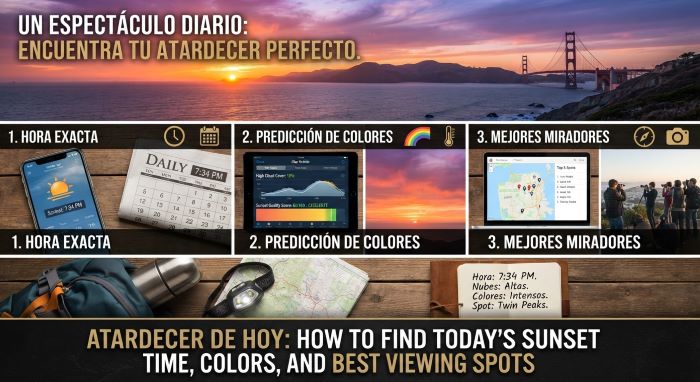
How to Find Today’s Sunset Time
The time depends on where you are. A person in Madrid and a person in Mexico City will see very different results. Use one of these quick methods.
- Search engine. Type “sunset” or “atardecer de hoy” plus your city name. Most search engines show the time at the top of the page.
- Phone weather app. The built-in weather apps on iPhone and Android list sunrise and sunset for your current location.
- Voice assistant. Ask “What time is sunset today?” in English or “¿A qué hora es el atardecer de hoy?” in Spanish.
- Sun tracking sites. Timeanddate.com and similar sites give sunset, twilight, and day length for any city and date.
- Government sources. In the United States, the NOAA Solar Calculator gives precise times for any coordinates. In Spain, the Instituto Geográfico Nacional publishes sunrise and sunset tables.
- Smartwatch. Many watch faces show the sunset time at a glance.
- Photography apps. PhotoPills, Sun Seeker, and The Photographer’s Ephemeris show the time and the exact direction of the sun.
Make sure the tool uses your current location and time zone. If you are traveling, check that your phone has updated to local time.
Why the Sunset Time Changes Every Day
The time of sunset moves a little each day. Several things cause this.
- Earth’s tilt. The planet leans about 23.4 degrees. As it travels around the sun, each half of the globe gets more light for part of the year and less for the rest. This creates long summer days and short winter days.
- Latitude. The farther you are from the equator, the bigger the swing. In Bogotá, near the equator, sunset stays close to 6 p.m. all year. In Madrid, it ranges from before 6 p.m. in December to almost 10 p.m. in June.
- Position in your time zone. Clock time is the same across a time zone, but the sun is not. Places on the western edge of a zone see later sunsets. Spain is a strong example. It sits far west in its time zone, which is one reason its evenings are so late.
- Daylight saving time. Where clocks move forward in spring, sunset jumps an hour later overnight.
- Earth’s orbit. The orbit is slightly oval, so the sun runs a bit ahead or behind clock time through the year. That is why the earliest sunset comes a week or two before the winter solstice, not on it.
- Altitude and horizon. From a mountain or a tall building, you see the sun a little longer. Hills to the west hide it sooner.
Near the equinoxes in March and September, the sunset time changes fastest. Near the solstices in June and December, it barely moves from one day to the next.
Sunset Times Through the Year in Major Cities
The table shows approximate local sunset times in 2026 on four key dates. Times are rounded to the minute and can vary by a minute or two with your exact spot.
| City | March 20 | June 21 | September 22 | December 21 |
|---|---|---|---|---|
| Madrid, Spain | 7:26 PM | 9:48 PM | 8:11 PM | 5:51 PM |
| Barcelona, Spain | 7:03 PM | 9:28 PM | 7:48 PM | 5:24 PM |
| Mexico City, Mexico | 6:47 PM | 7:17 PM | 6:32 PM | 6:03 PM |
| Bogotá, Colombia | 6:06 PM | 6:09 PM | 5:52 PM | 5:49 PM |
| Lima, Peru | 6:18 PM | 5:52 PM | 6:03 PM | 6:31 PM |
| Santiago, Chile | 7:53 PM | 5:42 PM | 7:38 PM | 8:51 PM |
| Buenos Aires, Argentina | 7:04 PM | 5:50 PM | 6:49 PM | 8:05 PM |
| San Juan, Puerto Rico | 6:35 PM | 7:03 PM | 6:20 PM | 5:53 PM |
| Miami, United States | 7:31 PM | 8:14 PM | 7:16 PM | 5:34 PM |
| Los Angeles, United States | 7:04 PM | 8:07 PM | 6:49 PM | 4:47 PM |
| New York, United States | 7:07 PM | 8:30 PM | 6:52 PM | 4:31 PM |
Notice the pattern. Cities near the equator, such as Bogotá, barely change. Cities in the Southern Hemisphere, such as Santiago and Buenos Aires, have their latest sunsets in December. For the exact atardecer de hoy where you live, use one of the tools above.
Sunset, Twilight, Golden Hour, and Blue Hour
Sunset is a single moment: the instant the top edge of the sun slips below the horizon. The light show lasts much longer.
| Phase | When It Happens | What You See |
|---|---|---|
| Golden hour | About the last hour before sunset | Warm, soft, low light and long shadows |
| Sunset | The sun’s upper edge meets the horizon | The sun disappears |
| Civil twilight | Sun 0 to 6 degrees below the horizon | Bright sky, vivid colors, enough light to see outdoors |
| Blue hour | Roughly the later part of civil twilight | Deep blue sky, city lights glow |
| Nautical twilight | Sun 6 to 12 degrees below | Horizon still visible, bright stars appear |
| Astronomical twilight | Sun 12 to 18 degrees below | Sky nearly dark |
| Night | Sun more than 18 degrees below | Full darkness |
The length of each phase depends on latitude and season. Near the equator, twilight is short, and night falls fast. Farther north or south, it lingers, most of all in summer.
Why Sunsets Are Red, Orange, and Pink
Sunlight is a mix of all colors. As it passes through the air, tiny gas molecules scatter blue light far more than red light. This effect is called Rayleigh scattering. At midday, the scattered blue fills the sky.
At sunset, the light travels through much more air to reach your eyes. Most of the blue is scattered away along the path. What remains is yellow, orange, and red.
Clouds make the show better. High and middle clouds act like a screen that catches the red light from below. Clean air after rain often gives the most vivid colors. Heavy smoke or dust can turn the sun itself deep red, though thick haze near the ground usually dulls the sky.
How to Predict a Good Sunset
No forecast is perfect, but these signs help.
- Cloud cover of about 30 to 70 percent. Some clouds are better than none, and better than a full gray lid.
- High or middle clouds. Wispy cirrus and puffy altocumulus catch color well.
- A clear western horizon. The sun needs a gap to shine through from below.
- Clean air. The hours after a rain shower or a cold front are often best.
- Lower humidity. Dry air gives sharper, purer colors.
Some apps and sites offer sunset quality forecasts, which rate the odds of a colorful sky.
Where to Watch
- Beaches facing west. The sun sinks straight into the water.
- Hills, lookouts, and rooftops. Height gives a wide view.
- Lakes and rivers. Calm water doubles the color.
- Open fields and deserts. Nothing blocks the horizon.
- City bridges and waterfronts. Skylines add strong shapes.
Arrive 30 to 45 minutes early. Stay 20 to 30 minutes after the sun goes down, since the richest color often comes late. Also turn around. The eastern sky can glow pink in a band called the Belt of Venus.
Photography Tips
- Check the time and direction of the sun before you go.
- Arrive early and choose a foreground, such as a tree, a pier, or a person.
- Keep the horizon straight, and place it in the upper or lower third of the frame.
- On a phone, tap the bright sky and slide the exposure down a little to keep the color.
- Turn off the flash.
- Try silhouettes by placing a subject in front of the brightest area.
- Use HDR mode for scenes with dark land and a bright sky.
- Clean your lens.
- Use a tripod or rest the camera on a wall as the light fades.
- Keep shooting through blue hour.
Never look at the sun through a camera’s optical viewfinder, a telescope, or binoculars. It can cause eye damage.
Using Sunset Time to Plan Your Day
- Exercise. Finish runs and rides before dark, or carry lights.
- Hiking. Know the sunset time and turn back with a wide margin. Pack a headlamp.
- Driving. Glare is worst when the sun is low. Clean the windshield and wear sunglasses.
- Events. Outdoor weddings and dinners often start about an hour before sunset for the best light.
- Gardening. Water in the evening to cut loss from evaporation.
- Sleep. Dimming lights after sunset can help your body wind down.
- Faith. Several traditions tie prayers, fasts, and holy days to sunset. Use your community’s official timetable for those.
Sunset Safety
A few simple habits keep the evening pleasant.
- Do not stare at the sun, even when it is low and dim. Glance at it briefly and look at the sky around it.
- Bring a light layer. Temperatures drop fast once the sun is gone.
- Carry a small flashlight if your walk back is unlit.
- On cliffs, piers, and rocks, watch your footing while you look at the sky.
- Near the coast, check the tide before you settle on a beach or a sandbar.
- Use insect repellent in warm, humid places, since mosquitoes are most active at dusk.
Sunset in Culture
Evening light holds a special place in Spanish-speaking countries. In Spain, late sunsets shape daily life. People take a paseo, an evening stroll, and eat dinner late. In Ibiza, crowds gather on the west coast to applaud as the sun goes down. In Latin America, coastal towns from Cartagena to Puerto Vallarta treat the hour as a daily event, with music and food along the waterfront.
That may be why “atardecer de hoy” is searched so often. For many people, sunset is a time to stop, meet friends, and look up.
Common Myths
- “Sunset and darkness happen together.” Twilight gives 20 to 30 minutes or more of usable light after sunset.
- “Pollution makes sunsets prettier.” Clean air usually gives brighter color. Heavy haze mutes it.
- “The sun sets due west.” That is true only near the equinoxes. In summer, it sets north of west. In winter, it sets south of west.
- “The earliest sunset is on the shortest day.” It comes a week or two earlier in most places.
- “The green flash is a myth.” It is real. A brief green spot can appear on the sun’s top edge over a sharp, clear horizon.
Frequently Asked Questions
What does atardecer de hoy mean in English? It means “today’s sunset.”
What time is sunset today? It depends on your location and the date. Check your phone’s weather app or search for sunset plus your city.
How long does a sunset last? The sun takes about two to three minutes to cross the horizon at middle latitudes. The color can last 20 to 40 minutes.
What is the difference between atardecer and puesta de sol? “Puesta de sol” is the moment the sun sets. “Atardecer” is broader and covers the whole early evening.
Why is sunset later in Spain than in other countries at the same latitude? Spain uses Central European Time though it lies far to the west, so its clocks run ahead of the sun.
When is the best light for photos? The hour before sunset and the 20 to 30 minutes after.
Does sunset time change with altitude? Slightly. From higher ground, you see the sun a little longer.
Where does the sun set? In the west, shifted north in summer and south in winter.
Final Thoughts
The atardecer de hoy is easy to find and worth the minute it takes. Check a weather app or a search engine for the exact time in your city. Then head out 30 minutes early, face west, and stay through the blue hour.
Sunset times shift with the seasons, your latitude, and your place in a time zone, so tomorrow’s will differ a little from today’s. That steady change is part of the appeal. Whether you want a great photo, a calm walk, or a reason to pause, the atardecer de hoy offers a free show every evening. All you need to do is look up the time and step outside.
Key Takeaways
- “Atardecer de hoy” is Spanish for “today’s sunset.”
- Find the exact time with a weather app, a search engine, a voice assistant, or a sun tracking site set to your location.
- Sunset times change daily due to Earth’s tilt, your latitude, your place in the time zone, and daylight saving time.
- Cities near the equator see little change through the year, while places such as Madrid swing by almost four hours.
- Golden hour comes before sunset, and blue hour follows it. Both give beautiful light.
- Red and orange colors come from the scattering of blue light, and high clouds with clean air give the best displays.
- Arrive early, stay late, and never look at the sun through optical devices.