
Best Places for Whale Watching California
California has more than 800 miles of coastline, and whales pass along almost all of it. Gray whales swim by in winter and spring on one of the longest migrations of any mammal. Blue whales, the largest animals that have ever lived, feed offshore in summer. Humpbacks leap out of the water from spring through fall. With the right place and season, you have a strong chance of seeing a whale on any given day. This guide to the best places for whale watching california has to offer will help you pick both.
Below you will find 14 specific spots, a comparison table, a seasonal calendar, and practical tips for boat tours and shore viewing.
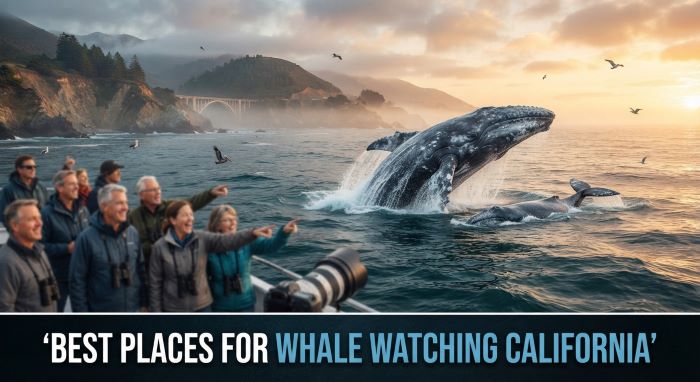
Why California Is So Good for Whale Watching
Three things make this coast special.
- The gray whale migration. Each year, gray whales travel between feeding grounds in the Arctic and breeding lagoons in Baja California, Mexico. The round trip covers roughly 10,000 to 12,000 miles, and much of it hugs the California shore.
- Rich feeding water. Cold, nutrient-rich water rises along the coast in spring and summer. It feeds krill and small fish, which draw blue whales, humpbacks, and fin whales.
- Deep water near land. In places such as Monterey Bay, a deep submarine canyon comes close to shore. Deep-water species can be seen a short boat ride from the harbor.
When to Go: California Whale Watching Calendar
| Season | Months | Main Species | Where Viewing Is Strongest |
|---|---|---|---|
| Winter | December to February | Gray whales heading south | Entire coast, strong in Southern California |
| Spring | March to May | Gray whales heading north with calves, humpbacks arriving, orcas | Entire coast, Monterey Bay for orcas |
| Summer | June to August | Blue whales, humpbacks, fin whales | Channel Islands, Monterey Bay, Southern California |
| Fall | September to November | Humpbacks, blue whales early in the season | Monterey Bay, Central Coast, Farallon Islands |
The best places for whale watching california has in January are not always the same as the top spots in August, so use this calendar first. Dolphins, sea lions, and seals appear year round. Exact timing shifts each year with water temperature and food supply, so check recent sighting reports before you book.
Comparison Table: 14 Whale Watching Spots
| Place | Region | Best Months | Main Species | Shore Viewing | Boat Tours |
|---|---|---|---|---|---|
| Monterey Bay | Central Coast | Year round | Humpback, blue, gray, orca | Fair | Excellent |
| Dana Point | Orange County | Year round | Gray, blue, fin, dolphins | Good | Excellent |
| San Diego | South | December to April, June to September | Gray, blue | Excellent | Excellent |
| Channel Islands and Santa Barbara | South Central | Year round | Blue, humpback, gray | Fair | Excellent |
| Newport Beach | Orange County | Year round | Gray, blue, fin, dolphins | Fair | Excellent |
| Palos Verdes Peninsula | Los Angeles County | December to May | Gray | Excellent | Nearby |
| Long Beach and San Pedro | Los Angeles County | Year round | Gray, blue, fin | Limited | Very good |
| Big Sur | Central Coast | December to May | Gray, humpback | Excellent | None |
| San Simeon and Morro Bay | Central Coast | December to May, summer | Gray, humpback | Good | Good |
| Half Moon Bay | Bay Area | January to April, summer and fall | Gray, humpback | Good | Good |
| San Francisco and the Farallon Islands | Bay Area | May to November | Humpback, blue, gray | Fair | Very good |
| Point Reyes National Seashore | North Bay | January to April | Gray | Excellent | None |
| Bodega Head | Sonoma Coast | January to May | Gray | Excellent | Limited |
| Mendocino and Fort Bragg | North Coast | December to April | Gray, humpback | Excellent | Good |
1. Monterey Bay
Many experts rank Monterey Bay first, and for good reason. The Monterey Submarine Canyon plunges to great depth just offshore. That deep, cold water supports huge amounts of krill and fish, and whales come to feed.
Humpbacks are common from about April through November. Blue whales visit in summer and early fall. Gray whales pass in winter and spring. In April and May, orcas hunt gray whale calves in the bay, a dramatic sight that draws researchers and photographers. Tours leave from Fisherman’s Wharf in Monterey and from Moss Landing, which sits right at the head of the canyon.
2. Dana Point
Dana Point calls itself the Dolphin and Whale Watching Capital of the World, and it became the first Whale Heritage Site in the Americas. The harbor is close to deep water, so boats reach whales fast.
Gray whales pass close to the headland in winter. Blue whales feed offshore in summer. Fin whales, minke whales, and huge pods of common dolphins appear all year. The city holds a Festival of Whales each March. The trails at Dana Point Headlands give good views from land.
3. San Diego
San Diego is the last major stop for gray whales before they reach Mexico. From mid-December through April, thousands pass by. Blue whales show up offshore from about June through September.
For shore viewing, go to Cabrillo National Monument on Point Loma. A sheltered overlook near the old lighthouse sits high above the ocean. Other good spots include the cliffs at Torrey Pines State Natural Reserve and the coast at La Jolla. Boat tours leave from San Diego Bay and Mission Bay.
4. Channel Islands and Santa Barbara
The Santa Barbara Channel is one of the best places on earth to see blue whales. In summer, they gather to feed on krill between the mainland and the islands. Humpbacks join them. Gray whales cross the channel in winter and spring.
Tours leave from Santa Barbara, Ventura, and Oxnard. Some trips to Channel Islands National Park double as whale watches. On shore, try Shoreline Park in Santa Barbara or the bluffs at Carpinteria.
5. Newport Beach
Newport Beach offers year-round tours a few miles up the coast from Dana Point. A deep canyon lies just off the harbor mouth. Gray whales, blue whales, fin whales, humpbacks, and minke whales are all seen here, along with several kinds of dolphins. Trips are short, often about two hours, which suits families and first-timers.
6. Palos Verdes Peninsula
The Point Vicente Interpretive Center in Rancho Palos Verdes is one of the top shore viewing sites in the state. It sits on a high bluff where gray whales swing close to land. Volunteers have counted passing gray whales from this spot for decades as part of a long-running census. The center has exhibits, a lawn, and a paved path. Entry is free.
7. Long Beach and San Pedro
Boats from Long Beach and San Pedro serve the Los Angeles area. Many tours work with the Aquarium of the Pacific and carry trained naturalists. Gray whales pass in winter. Blue and fin whales feed offshore in summer. The trip also passes the busy port, sea lions on buoys, and the Palos Verdes cliffs.
8. Big Sur
Big Sur has no whale watching boats, but it does not need them. Highway 1 runs along high cliffs with wide ocean views. Gray whales pass close to shore from December through May. Humpbacks and blue whales sometimes appear in summer and fall.
Stop at the pullouts near Garrapata State Park, at Point Sur, and at Julia Pfeiffer Burns State Park, where an overlook faces a sheltered cove. Bring binoculars and take your time.
9. San Simeon and Morro Bay
The stretch from San Simeon to Avila Beach is less crowded than the big hubs. Gray whales pass in winter and spring, and humpbacks feed here in summer and fall, sometimes lunging at the surface within sight of the pier at Avila Beach.
Good shore points include the bluffs near the Piedras Blancas Light Station and Montaña de Oro State Park. Boat tours leave from Morro Bay and Avila Beach. The elephant seal rookery at Piedras Blancas is a fine bonus stop.
10. Half Moon Bay
About 30 miles south of San Francisco, Half Moon Bay has tours from Pillar Point Harbor. Gray whales pass from January through April. Humpbacks feed in the area from late spring through fall. The coastal trail and the bluffs give good shore views on a clear day. The sea can be rough, so plan for motion sickness.
11. San Francisco and the Farallon Islands
Full-day trips from San Francisco head about 27 miles offshore to the Farallon Islands, a wildlife refuge in rich feeding water. From roughly May through November, humpbacks and blue whales feed here. You may also see seabirds by the thousands, sea lions, and, in fall, signs of great white sharks.
In recent years, humpbacks have also fed near the Golden Gate and even inside the bay. For shore viewing, try Lands End, Fort Funston, or the Marin Headlands.
12. Point Reyes National Seashore
The Point Reyes peninsula juts about 10 miles into the Pacific, which puts you close to the gray whale route. The lighthouse and the Chimney Rock area are the main viewing points. Peak viewing runs from January through April.
On busy winter weekends, the park often closes the road to private cars and runs a shuttle. Check the park’s website before you go. Expect wind and fog, and dress for cold.
13. Bodega Head
Bodega Head is a rocky headland in Sonoma Coast State Park. Gray whales pass close by from January through May. Volunteer docents from a local whale watch program are often on the bluff on weekends in season to help visitors spot whales. Parking is close to the viewing area, so it works well for people who cannot walk far.
14. Mendocino and Fort Bragg
The Mendocino coast is known for gray whales and for its whale festivals, held in March in Mendocino, Fort Bragg, and Little River. Good shore points include Mendocino Headlands State Park, Point Cabrillo Light Station, and MacKerricher State Park. Charter boats leave from Noyo Harbor in Fort Bragg.
Farther north, Sue-meg State Park near Trinidad and the bluffs near Crescent City also give good views during the migration.
Whales You Can See in California
| Species | Length | When | What to Look For |
|---|---|---|---|
| Gray whale | Up to about 45 to 50 feet | December to May | Heart-shaped blow, mottled gray back, no dorsal fin |
| Humpback whale | Up to about 50 feet or more | April to November | Breaching, long white flippers, tail flukes |
| Blue whale | Up to about 90 feet or more | June to October | Tall, straight blow, long blue-gray back |
| Fin whale | Up to about 70 to 80 feet | Year round, more in summer | Fast, sleek, tall blow |
| Minke whale | Up to about 30 feet | Year round | Small, quick, hard to spot |
| Orca | Up to about 30 feet | Any time, more in spring | Tall black dorsal fin |
You are also likely to see common dolphins, bottlenose dolphins, Risso’s dolphins, Pacific white-sided dolphins, sea lions, harbor seals, and sea otters on the Central Coast.
Boat Tour or Shore Viewing?
| Factor | Boat Tour | Shore Viewing |
|---|---|---|
| Cost | Roughly $40 to $100 or more per adult | Free or a parking fee |
| Closeness | Much closer | Distant, binoculars needed |
| Species | All, including offshore species | Mostly gray whales |
| Comfort | Motion sickness is possible | Stable ground |
| Best for | Blue whales, humpbacks, photos | Families, tight budgets, gray whale season |
The best places for whale watching california visitors can reach on foot are high headlands that stick out into the sea, such as Point Reyes, Point Vicente, and Point Loma. For blue whales and humpbacks, a boat is almost always needed.
How to Choose a Tour
- Look for a naturalist on board. A trained guide makes the trip far richer.
- Check recent sighting logs. Most operators post daily reports.
- Ask about the boat. Large boats are steadier. Small, fast boats get closer to the water and cover more ground.
- Ask about trip length. Two to three hours is common. Monterey and Farallon trips run longer.
- Ask about a sighting guarantee. Many companies give a free return trip if no whales appear.
- Choose responsible operators. Good captains keep a safe distance and never chase whales.
How to Spot Whales From Shore
- Pick a high point with a wide view.
- Go on a calm, clear morning. Wind and whitecaps hide blows.
- Scan slowly with your bare eyes first.
- Look for the blow, a puff of mist that hangs for a few seconds.
- Once you see a blow, raise your binoculars to that spot.
- Watch the same line. Gray whales often blow three to five times, then dive for a few minutes.
- Be patient. Give it at least an hour.
What to Bring
- Layers and a windproof jacket, even in summer
- A hat and sunscreen
- Sunglasses, polarized if you have them
- Binoculars
- A camera with a zoom lens
- Closed-toe shoes with grip
- Water and snacks
- Motion sickness medicine, if you are prone to it
How to Avoid Seasickness
- Take medicine as the label directs, well before you board.
- Eat a light meal. Do not go out hungry or overly full.
- Stay outside in fresh air, near the middle of the boat.
- Watch the horizon, not your phone.
- Pick a morning trip, when seas are often calmer.
- Choose a larger boat or a calmer area if you are worried.
Watch Responsibly
Whales are protected by federal law under the Marine Mammal Protection Act. Federal guidelines advise staying at least 100 yards away. That applies to private boats, kayaks, paddleboards, and drones.
- Never chase, circle, or cut off a whale.
- Slow down in areas where whales are present.
- Do not feed or try to touch marine mammals.
- Follow drone rules, which are strict near wildlife and inside parks.
- Report stranded or entangled animals to the authorities. Do not try to help on your own.
Tips for Families
Many of the best places for whale watching california offers work well for children, with a little planning.
- Choose a short trip of two hours or less for young children.
- Southern California harbors usually have calmer water.
- Bring snacks, warm layers, and a change of clothes.
- Shore sites with visitor centers, such as Point Vicente and Cabrillo National Monument, let kids learn and move around.
- Set fair expectations. Wild animals do not perform on cue.
Photography Tips
- Use a fast shutter speed, about 1/1000 of a second or faster.
- Use burst mode.
- A zoom lens in the 70 to 300 mm range works well from a boat.
- Keep both eyes open and watch for the blow.
- Protect your gear from spray.
- Put the camera down now and then and just watch.
Common Mistakes to Avoid
- Going in the wrong season for the species you want.
- Dressing for the beach. It is much colder on the water.
- Skipping motion sickness prevention.
- Giving up after 15 minutes on shore.
- Booking a single trip with no backup day.
- Expecting whales to be as close as they look in photos.
A Note on Gray Whale Numbers
Scientists have recorded a sharp drop in the eastern North Pacific gray whale population in recent years, linked to changes in their Arctic feeding grounds. You can still see gray whales along the coast in season, but counts have been lower than in the past. Check current reports from NOAA Fisheries and local census groups for the latest picture.
Frequently Asked Questions
What is the best month for whale watching in California? It depends on the species. January through March is best for gray whales. July through September is best for blue whales. Monterey Bay is good in almost any month.
Where are the best places for whale watching california has in winter? San Diego, Dana Point, Palos Verdes, Point Reyes, and Mendocino all offer strong gray whale viewing.
Can you see whales from shore? Yes, mostly gray whales during the migration, from high headlands.
Where can I see blue whales? The Santa Barbara Channel, Monterey Bay, and the waters off Orange County and San Diego in summer.
Where can I see orcas? Monterey Bay offers the best odds, most of all in April and May. Sightings are never certain.
How much does a tour cost? Many trips cost roughly $40 to $100 per adult. Longer and small-boat trips cost more.
How long are the tours? Most last two to four hours. Farallon Islands trips can take a full day.
Is morning or afternoon better? Mornings often have calmer seas and less wind.
Are sightings guaranteed? No. Many operators offer a free return trip if you see no whales.
Final Thoughts
The best places for whale watching california offers stretch from the cliffs of Point Loma to the headlands of Mendocino. Monterey Bay leads for variety and year-round action. Dana Point, Newport Beach, and San Diego are easy picks in the south. The Santa Barbara Channel is the place for blue whales. Point Reyes, Bodega Head, and Palos Verdes shine for free shore viewing.
Match your trip to the season, dress warm, and bring patience. Whether you board a boat or stand on a bluff with binoculars, a whale’s blow on the horizon is a sight you will not forget. Use this list of the best places for whale watching california travelers love, check the latest sighting reports, and plan your day by the sea.
Key Takeaways
- California has whale watching all year: gray whales in winter and spring, blue whales in summer, and humpbacks from spring through fall.
- The best places for whale watching california offers include Monterey Bay, Dana Point, San Diego, and the Santa Barbara Channel.
- Monterey Bay is the top pick for variety, with humpbacks, blue whales, gray whales, and orcas.
- For free shore viewing, go to Point Reyes, Bodega Head, Point Vicente, Cabrillo National Monument, or Big Sur.
- Boat tours get you closer and are needed for blue whales and humpbacks.
- Dress in layers, bring binoculars, and prepare for motion sickness.
- Stay at least 100 yards from whales and choose responsible tour operators.