Best Fixed Blade Knife for Camping: 10 Reliable Picks for Every Budget
A good knife is one of the most useful tools you can bring to camp. It slices food, cuts rope, shaves tinder, carves tent stakes, opens packages, and handles dozens of small jobs every day. Folding knives are handy in a pocket, but a fixed blade is stronger, easier to clean, and safer for hard tasks because it has no hinge or lock to fail.
The choices can be overwhelming. Blades range from tiny neck knives to heavy survival tools, and prices run from $20 to more than $300. This guide lists 10 specific knives, compares them in a table, and explains steel, blade shape, and handle design so you can choose the best fixed blade knife for camping trips of any kind.
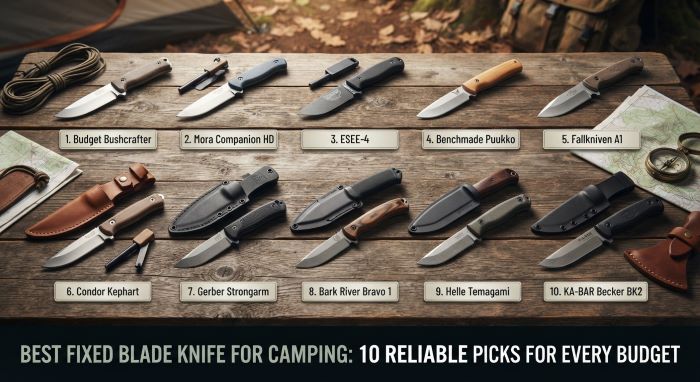
Why Choose a Fixed Blade for Camping?
Strength: A fixed blade is a single piece of steel. With no pivot or lock, it handles prying, carving, and splitting small wood better than a folder.
Reliability: There are no moving parts to jam with dirt, sand, or food.
Easy cleaning: You can wash and dry the whole knife quickly, which matters for food prep.
Safety: The blade cannot fold onto your fingers under pressure.
Speed: It comes out of the sheath ready to use.
The trade-off is size. A fixed blade needs a sheath and takes up more space than a pocket knife. For most car campers and many backpackers, the benefits outweigh the bulk.
What to Look For
Blade length: Three and a half to five inches is the sweet spot for camp tasks. Shorter blades offer control for carving and food prep. Longer blades are better for chopping and splitting.
Tang: A full tang means the steel runs the full length and width of the handle. It is the strongest design. Partial or rat-tail tangs are lighter but less robust.
Steel: Carbon steel is tough and easy to sharpen but can rust. Stainless steel resists corrosion and suits wet environments and food prep.
Grind: A Scandinavian (Scandi) grind excels at wood carving and is easy to sharpen. A flat grind slices food well. A saber grind balances strength and slicing.
Handle: Look for a comfortable, grippy handle that works when wet or cold. Rubber, polymer, Micarta, and G10 are common.
Sheath: A secure sheath protects you and the blade. Polymer and Kydex are durable and weatherproof. Leather is classic but needs care.
Comparison Table: Best Fixed Blade Knife for Camping
| Knife | Blade Length | Steel | Tang | Approx. Price | Best For |
|---|---|---|---|---|---|
| Morakniv Garberg | 4.25 in | Carbon or stainless | Full | around $100 | Best overall bushcraft and camp knife |
| Morakniv Companion | 4.1 in | Stainless (Sandvik 12C27) | Partial | around $20 | Best budget knife |
| ESEE-4 | 4.5 in | 1095 carbon | Full | $120 to $150 | Hard use with a lifetime warranty |
| KA-BAR Becker BK2 Campanion | 5.25 in | 1095 Cro-Van | Full | $100 to $130 | Heavy-duty chopping and batoning |
| Gerber StrongArm | 4.8 in | 420HC stainless | Full | $80 to $100 | Tough all-around use |
| Victorinox Venture | 4.13 in | Sandvik 14C28N stainless | Full | around $66 | Budget-friendly bushcraft |
| White River Ursus 45 | 4.5 in | CPM S35VN or MagnaCut | Full | $250 to $270 | Premium food prep and fire making |
| Benchmade Anonimus | 5 in | CPM CruWear | Full | around $310 | Premium hard use |
| CRKT S.P.I.T. | 2.29 in | 8Cr13MoV stainless | Full | around $44 | Ultralight backpacking |
| Buck 119 Special | 6 in | 420HC stainless | Full | $70 to $90 | Classic camp and hunting knife |
Prices and steel options vary by version and retailer, so check current listings before you buy.
1. Morakniv Garberg
The Morakniv Garberg is the Swedish brand’s first full-tang knife, and it has become a favorite among bushcrafters and campers. The 4.25-inch blade uses a Scandi grind that bites into wood for feather sticks, notches, and carving. The polyamide handle is tough and comfortable, and the spine is ground sharp to strike a ferro rod.
It comes in carbon steel and stainless steel versions. At around $100, many outdoor writers call it the best fixed blade knife for camping for people who want one knife to do everything.
2. Morakniv Companion
The Morakniv Companion may be the best value in outdoor gear. For around $20, you get a sharp stainless steel blade, a comfortable rubberized handle, and a simple plastic sheath. It handles food prep, carving, and general camp chores with ease.
It is not full tang, so it is not ideal for heavy batoning. For most campers, it is all the knife they need, and it makes a great first knife or backup.
3. ESEE-4
The ESEE-4 is a hard-use knife built from 1095 carbon steel with a full tang and Micarta handle scales. It is known for toughness and for ESEE’s no-questions-asked lifetime warranty. The 4.5-inch blade handles carving, batoning, and camp kitchen work.
Carbon steel needs a light coat of oil to prevent rust. In return, it sharpens easily in the field.
4. KA-BAR Becker BK2 Campanion
The Becker BK2 is a tank. Its quarter-inch-thick 1095 Cro-Van blade can split firewood, pry, and chop without complaint. It weighs about a pound, so it is best for car camping rather than backpacking.
If you want a knife that can take abuse, the BK2 is hard to beat.
5. Gerber StrongArm
The Gerber StrongArm has a full-tang 420HC stainless blade, a grippy rubberized handle, and a versatile sheath that mounts several ways. It is made in the USA and widely used by outdoors people and military personnel.
It is a tough, low-maintenance choice for wet environments.
6. Victorinox Venture
Victorinox, the maker of Swiss Army knives, built the Venture as an affordable bushcraft knife. It uses Sandvik 14C28N stainless steel, which holds an edge well and resists rust. At around $66, it is a strong value for campers who want a full-tang knife without spending much.
7. White River Ursus 45
The White River Ursus 45 is a premium American-made knife with a 4.5-inch blade in CPM S35VN or MagnaCut steel. Testers praise it for food prep, fire making, and carving. It weighs about 8.3 ounces.
At $250 to $270, it is an investment, but it offers excellent edge retention and corrosion resistance.
8. Benchmade Anonimus
The Benchmade Anonimus uses CPM CruWear steel, known for toughness and edge retention. The five-inch blade and G10 handle make it suitable for batoning and making kindling. It weighs just 5.9 ounces without the sheath, which is light for its size.
9. CRKT S.P.I.T.
The CRKT S.P.I.T. is a tiny, ultralight fixed blade that weighs under two ounces. Its 2.29-inch blade handles food prep, cord cutting, and small tasks. It is ideal for backpackers who count every ounce but still want a fixed blade.
10. Buck 119 Special
The Buck 119 Special is an American classic with a six-inch clip point blade and a polished handle. It has been a favorite of hunters and campers for decades. It is longer than most camp knives, which makes it useful for larger cutting tasks and processing game.
Carbon Steel vs. Stainless Steel
Carbon steel (such as 1095) is tough, takes a keen edge, and sharpens easily on a simple stone. It throws sparks from flint and develops a gray patina over time. It rusts if left wet, so dry it and oil it lightly.
Stainless steel (such as 12C27, 14C28N, 420HC, and S35VN) resists rust and suits wet climates, coastal trips, and food prep. Modern stainless steels hold an edge very well. Premium steels like MagnaCut combine toughness, edge retention, and corrosion resistance at a higher price.
For beginners, stainless is the easier choice. For bushcraft enthusiasts who enjoy maintaining their gear, carbon steel is rewarding.
Blade Shapes Explained
Drop point: The spine curves down to the tip. Strong and versatile, it is the most common camp knife shape.
Clip point: The spine is clipped near the tip for a finer point. Good for detail work and piercing.
Spear point: Symmetrical with a strong tip.
Scandi profile: Common on Morakniv knives, with a straight edge and a wide single bevel for woodworking.
For general camping, a drop point with a plain, non-serrated edge is the most useful.
Common Camp Tasks for a Fixed Blade
- Food prep: Slicing vegetables, meat, cheese, and bread.
- Fire making: Shaving feather sticks, scraping tinder, and striking a ferro rod with the spine.
- Batoning: Splitting small pieces of wood by tapping the spine with a stick.
- Carving: Making tent stakes, pot hangers, and roasting sticks.
- Cordage: Cutting rope, paracord, and webbing.
- Repairs: Trimming tarps, cutting tape, and fixing gear.
- First aid: Cutting bandages and moleskin.
Knife Safety at Camp
- Cut away from your body and keep your free hand behind the edge.
- Keep a safe distance from others, sometimes called a “blood circle,” an arm’s length plus the blade in every direction.
- Always sheath the knife when you are not using it.
- Never walk around camp with an open blade.
- Keep knives sharp. A dull knife slips and takes more force.
- Hand a knife to someone handle-first, or set it down for them to pick up.
- Supervise children closely and teach them basic rules before they handle a knife.
- Carry a first aid kit and know how to treat cuts.
Knife Laws and Regulations
Knife laws vary by state, country, and even city. Some places restrict blade length or how a fixed blade may be carried. National parks and campgrounds generally allow camp knives, but rules can differ on federal, state, and private land. Check the laws where you live and where you plan to camp. When flying, pack knives in checked luggage only.
Care and Maintenance
- Clean and dry your knife after each use.
- Oil carbon steel blades lightly to prevent rust.
- Sharpen regularly with a whetstone, guided sharpener, or strop.
- Store the knife dry. Do not leave it in a leather sheath long-term, since leather can hold moisture.
- Check the sheath for wear and replace it if retention loosens.
Sharpening Basics
A sharp knife is safer and more useful. Hold a consistent angle, usually 20 to 25 degrees per side for a camp knife. Scandi grinds are easy to sharpen because you lay the wide bevel flat on the stone. Finish with a leather strop to polish the edge. Carry a small pocket stone or ceramic rod on longer trips for touch-ups.
Best Picks by Camping Style
- Car camping: Weight is no concern, so a robust knife like the KA-BAR Becker BK2 or ESEE-4 handles firewood and camp kitchen duty.
- Backpacking: Choose lightweight options like the Morakniv Companion or CRKT S.P.I.T.
- Bushcraft: The Morakniv Garberg and Victorinox Venture have grinds suited to carving and fire prep.
- Canoe and coastal trips: Stainless steel knives like the Gerber StrongArm resist rust around water.
- Family camping: A Morakniv Companion is affordable enough to keep one in the kitchen box and one in the tool kit.
- Hunting camps: The Buck 119 Special handles field dressing and camp chores.
Matching the tool to the trip is the surest way to find the best fixed blade knife for camping. A knife that is perfect at a drive-in campsite may be too heavy for a 30-mile trail.
Sheath and Carry Options
A good sheath makes a knife safer and more useful. Belt carry keeps the knife within easy reach. Dangler sheaths hang lower and move with you when you sit. Scout carry positions the knife horizontally on the back of the belt. Neck carry suits small knives like the CRKT S.P.I.T. Many campers simply keep the knife in a pack pocket until they reach camp.
Check that the sheath holds the knife firmly when you turn it upside down, and that it has a drain hole so water does not collect. A dependable sheath is part of what makes the best fixed blade knife for camping practical day after day.
Teaching Kids Knife Skills
Camping is a great time to teach responsible knife use. Start with clear rules: sit down while carving, cut away from the body, keep others outside your arm’s reach, and close or sheath the knife when finished. Begin with simple tasks like whittling a marshmallow stick from soft, green wood. Use a small knife with a finger guard, such as a rounded-tip Morakniv made for young beginners. Always supervise closely. Kids who learn early build respect for tools, and choosing the best fixed blade knife for camping as a family becomes a chance to pass on outdoor skills.
Building Your Camp Kit
A knife is one part of a complete camping setup. Shelter, sleep system, cooking gear, lighting, and first aid all matter. A camping gear checklist helps make sure you do not forget essentials like a sharpener, fire starter, or first aid kit.
If you camp with family, your shelter matters as much as your tools. This guide to the best tents for family camping covers roomy, weather-ready options. A reliable knife helps with tent setup too, from cutting guylines to carving replacement stakes.
Fixed Blade vs. Folding Knife vs. Multi-Tool
Fixed blades are the strongest and most reliable for hard use.
Folding knives are compact and easy to carry every day, but the lock and pivot are weak points.
Multi-tools add pliers, screwdrivers, and scissors, which are great for repairs, but their blades are small.
Many campers carry a fixed blade on the belt or in the pack and a small multi-tool or pocket knife for light tasks.
Budget Guide
- Under $50: Morakniv Companion and CRKT S.P.I.T.
- $50 to $150: Victorinox Venture, Gerber StrongArm, Buck 119, Morakniv Garberg, KA-BAR Becker BK2, and ESEE-4.
- Over $200: White River Ursus 45 and Benchmade Anonimus.
You do not need to spend a lot. A $20 Morakniv will outperform many pricier knives in everyday camp tasks. Higher prices buy tougher construction, premium steel, and better sheaths.
Choosing the Right Knife
For an all-around camp and bushcraft knife, the Morakniv Garberg is a top choice. For tight budgets, the Morakniv Companion is unbeatable. For hard use, the ESEE-4 and KA-BAR Becker BK2 are built to last. For ultralight trips, the CRKT S.P.I.T. saves weight. For premium performance, the White River Ursus 45 stands out.
The best fixed blade knife for camping fits your hand, suits your tasks, and is one you will keep sharp and carry every trip. Choosing the best fixed blade knife for camping is about matching the tool to your style, whether you are a weekend car camper or a backcountry bushcrafter. With the best fixed blade knife for camping on your belt, everyday camp chores get easier and safer.
Key Takeaways
- Fixed blades are stronger, more reliable, and easier to clean than folding knives.
- A blade of three and a half to five inches with a full tang suits most camp tasks.
- The Morakniv Garberg is a top all-around pick, and the Morakniv Companion is the best budget option at around $20.
- The ESEE-4 and KA-BAR Becker BK2 are built for hard use like batoning and chopping.
- Stainless steel resists rust, while carbon steel is tough and easy to sharpen but needs oiling.
- Always cut away from your body, sheath the knife when not in use, and keep it sharp.
- Check local knife laws before you travel, and pack knives in checked bags when flying.