Which Best Describes Biogeographic Isolation?
If you searched for which best describes biogeographic isolation, you are probably staring down a multiple choice question or a homework prompt that wants one precise answer. The concept shows up constantly in biology, evolution, and ecology courses because it explains why species that share a common ancestor end up looking and behaving so differently. Understanding this concept means recognizing how a physical barrier, not a change in behavior or timing, splits one population into two separate evolutionary paths.
This article walks through the correct definition, explains why the other common multiple choice options are wrong, and gives you real world examples so the idea sticks long after the test is over.
What Is Biogeographic Isolation?
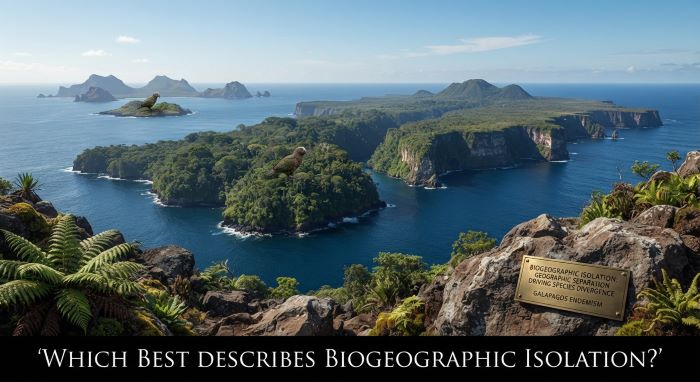
Biogeographic isolation, also called geographic isolation, happens when a physical barrier separates a population of organisms into two or more groups that can no longer interbreed. The barrier can be a mountain range, an ocean, a river, a canyon, a stretch of desert, or even a newly formed island. Once the groups are separated, they stop sharing genes with each other. Over generations, each group adapts to its own environment, accumulates different mutations, and eventually becomes distinct enough that the two populations could no longer produce fertile offspring even if the barrier disappeared.
That last part is the key to answering which best describes biogeographic isolation correctly. The process is defined by physical separation first, with genetic divergence as the outcome. It is not defined by behavior, mating preference, or timing. Those are different mechanisms that produce a similar result through a different path.
The Correct Answer, Explained
When a question asks which best describes biogeographic isolation, the correct choice will almost always describe a physical or geographic barrier that prevents gene flow between two populations of the same species. A typical correct answer reads something like this: a population is divided by a physical barrier such as a mountain range, body of water, or geological event, preventing interbreeding and allowing the separated groups to evolve independently over time.
Every strong answer to which best describes biogeographic isolation will include three elements: a physical or spatial barrier, the interruption of gene flow between groups, and independent evolution as the long term result. If an answer choice leaves out the physical barrier and instead focuses on mating rituals or breeding seasons, it is describing a different type of isolation, not biogeographic isolation.
Why the Other Answer Choices Are Usually Wrong
Multiple choice questions about which best describes biogeographic isolation typically include distractor answers that describe related but distinct concepts. Here is how to rule them out.
- Behavioral isolation distractors. These answers describe populations that stay in the same geographic area but do not interbreed because of differences in courtship rituals, mating calls, or breeding behavior. This is behavioral isolation, not geographic isolation, because there is no physical barrier involved.
- Temporal isolation distractors. These describe two populations that live in the same place but reproduce at different times, such as different flowering seasons in plants or different mating seasons in animals. Timing, not geography, is the barrier here.
- Mechanical isolation distractors. These focus on physical differences in reproductive structures that prevent mating, which is a biological mismatch rather than a geographic separation.
- Gametic isolation distractors. These describe situations where sperm and egg are incompatible at a cellular level, again with no geographic component.
- Habitat isolation distractors. This one is closer to biogeographic isolation and can be a trick answer. Habitat isolation happens when populations live in the same general region but occupy different microhabitats, such as one group living in trees and another on the forest floor. It involves a preference rather than a barrier that physically blocks movement, which is the distinction that separates it from true biogeographic isolation.
Recognizing these distractors is often the fastest way to identify which best describes biogeographic isolation on a timed test, because you can eliminate answers that describe behavior or timing instead of physical separation.
Real World Examples of Biogeographic Isolation
Seeing the concept in action makes it far easier to remember than memorizing a definition alone. These are some of the clearest examples biology teachers use when explaining this concept.
- The Galapagos Islands finches. Charles Darwin’s finches are the textbook example. Ancestral finches arrived on different islands separated by open ocean, and each population adapted its beak shape to the specific food sources available on its island.
- Australian marsupials. Australia separated from other landmasses roughly 50 million years ago, isolating its mammal populations. Marsupials diversified into forms that fill ecological roles similar to placental mammals elsewhere, such as kangaroos filling a niche similar to grazing deer.
- The Grand Canyon squirrels. Kaibab squirrels live on the north rim and Abert squirrels live on the south rim of the Grand Canyon. The canyon itself acts as the barrier, and the two squirrel populations have developed visible differences in coloring over thousands of years.
- Madagascar’s lemurs. Madagascar split from mainland Africa long before most modern primates evolved, leaving lemurs to diversify into more than one hundred species found nowhere else on Earth.
- Hawaiian honeycreepers. A single ancestral bird species colonized the Hawaiian islands and, isolated by ocean between islands and volcanic mountain ranges within islands, diversified into dozens of species with wildly different beak shapes suited to different food sources.
- Panama Isthmus species. When the Isthmus of Panama formed, it separated marine populations in the Atlantic from those in the Pacific, creating pairs of closely related species on either side that are now considered separate.
Every one of these examples fits the same pattern: a physical barrier appears, gene flow stops, and each population evolves along its own path. That pattern is exactly which best describes biogeographic isolation, regardless of which specific species or location the question uses.
Biogeographic Isolation vs Reproductive Isolation
It helps to understand where biogeographic isolation fits into the bigger picture of speciation. Reproductive isolation is the umbrella term for anything that prevents two populations from interbreeding, and it includes prezygotic barriers like behavioral, temporal, mechanical, and habitat isolation, along with postzygotic barriers that occur after mating happens. Biogeographic isolation, sometimes grouped under geographic isolation, is usually treated as the starting mechanism that leads to allopatric speciation, which is the formation of new species due to geographic separation.
In short, biogeographic isolation is often the first domino. Once a physical barrier separates two populations long enough, the other forms of reproductive isolation can develop as a side effect of independent evolution, even if the physical barrier were later removed.
Why This Concept Matters Beyond the Test
Understanding this concept is not just useful for passing a biology exam. It explains real patterns you can observe in the natural world, from why island wildlife looks so different from mainland species to why continents separated by oceans have completely different animal families. It also underlies major conservation concerns today, since climate change and human development can create new artificial barriers, such as highways or urban sprawl, that isolate populations of animals that were once genetically connected. Ecologists use the same principles that explain the Galapagos finches to predict how modern habitat fragmentation will affect biodiversity decades from now.
A Simple Way to Remember the Definition
If you need a quick mental shortcut, remember this: biogeographic isolation is about a place, not a preference. If an answer describes a wall, a gap, an ocean, a mountain, or any barrier you could point to on a map, it is describing biogeographic isolation. If the answer describes a behavior, a schedule, or a biological incompatibility with no map involved, it is describing a different mechanism entirely.
How to Answer This on an Exam
When you encounter this question on a test, read every answer choice carefully and look specifically for the word barrier, separation, or geographic. The correct choice for which best describes biogeographic isolation will always tie the separation of populations to a physical distance or obstacle, not to a mismatch in timing or behavior. If two answers both mention barriers, choose the one that most directly connects the barrier to a stop in gene flow and independent evolution over time, since that is the complete definition rather than a partial one.
Where This Question Shows Up in Coursework
Questions phrased as which best describes biogeographic isolation appear across a wide range of courses, not just introductory biology. High school biology classes usually introduce it alongside natural selection and speciation as part of a broader evolution unit. AP Biology and IB Biology exams test it more rigorously, often pairing it with data interpretation questions that ask you to identify geographic barriers from a map or a phylogenetic tree rather than a plain text description. College level evolutionary biology and ecology courses go further still, asking students to apply the concept to case studies involving real fossil records or genetic sequencing data that shows when two populations actually diverged. Conservation biology programs use the same foundational idea to explain habitat fragmentation, where highways, farmland, or urban development create modern, human made barriers that isolate wildlife populations in much the same way a mountain range or ocean once did naturally.
Because the concept reappears at every level, getting a firm grip on it early pays off well beyond a single exam. A student who understands the core definition in ninth grade biology will recognize the same reasoning years later in a genetics or wildlife management course, just applied to more complex data sets.
Practice Question Walkthrough
Seeing a full multiple choice question worked through step by step often cements the definition better than a written explanation alone. Consider this sample question:
Question: A single population of tree frogs lived along a river valley. Over thousands of years, a mountain range slowly formed through geological uplift, splitting the valley in two. The frogs on either side of the new mountain range could no longer travel across it. After many generations, the two frog populations developed different skin colors, different mating calls, and could no longer produce viable offspring if brought back together. Which of the following best explains this outcome?
A. The frogs developed different mating calls, so they stopped choosing each other as partners. B. The frogs reproduced at different times of year, preventing successful mating. C. A physical barrier separated the population, preventing gene flow and allowing each group to evolve independently over time. D. The frogs on each side developed incompatible reproductive cells at a cellular level.
The correct answer is C. Even though the question mentions different mating calls in the outcome, that detail describes a result of the isolation, not the cause of it. The actual cause described in the question is the formation of the mountain range, which is a physical barrier that stopped the two groups from interbreeding. Answer A describes behavioral isolation as if it were the starting point, which reverses the cause and effect described in the question. Answer B introduces a timing element that never appears in the scenario. Answer D describes gametic isolation, a cellular level barrier that also does not match the physical, geological cause described. Working through the question this way, by identifying the actual cause described in the passage rather than just the eventual outcome, is the most reliable method for answering this style of question correctly on any exam.
Frequently Asked Questions
Is biogeographic isolation the same as geographic isolation? Yes. The two terms are used interchangeably in most biology courses and textbooks. Both describe the same mechanism: a physical barrier that separates a population and stops interbreeding.
Can biogeographic isolation happen without any geological event, like a mountain forming? Yes. It can also happen when a small group of organisms disperses to a new location, such as birds blown off course to a remote island, or when sea levels rise and separate a peninsula into two islands. The mechanism, physical separation preventing gene flow, is the same whether the barrier formed gradually or resulted from a single dispersal event.
Does biogeographic isolation always lead to a new species? Not always, and not immediately. If the barrier disappears before enough genetic divergence has accumulated, the two populations may reunite and interbreed normally, effectively reversing the separation. New species only form when enough time and genetic change have passed that the populations can no longer produce fertile offspring even after reuniting.
How is biogeographic isolation different from the founder effect? The founder effect describes a loss of genetic diversity when a small group starts a new, separate population, which often happens alongside biogeographic isolation but describes a different aspect of the process. Biogeographic isolation explains why the groups stopped exchanging genes in the first place. The founder effect explains why the new, isolated group may have less genetic variation than the original population it came from.
Is this concept the same as allopatric speciation? They are closely related but not identical terms. Biogeographic isolation is the mechanism, the physical separation itself. Allopatric speciation is the outcome, the formation of a new species as a result of that separation combined with enough time and independent evolutionary pressure.
A Note on How Scientists Confirm This in the Field
Textbook definitions make the process sound tidy, but confirming a real case of geographic separation driving divergence takes years of fieldwork. Researchers typically combine several lines of evidence rather than relying on any single observation. Genetic sequencing compares DNA between separated populations to estimate roughly how long ago they diverged, based on the accumulation of mutations over time. Morphological studies measure physical differences, such as beak shape or coloring, across populations to document how far apart they have drifted. Behavioral studies test whether individuals from each population still recognize each other as potential mates when brought into contact, which helps determine whether reproductive isolation has fully set in or whether the populations could still interbreed if the physical barrier were removed. Fossil and geological records help pin down when the barrier itself actually formed, since a mountain range or land bridge does not always finish forming on a clean, easily dated timeline. Combining all of this evidence is what allows scientists to confidently label a case as a clear example rather than a coincidental pattern.
Key Takeaways
- Biogeographic isolation occurs when a physical barrier, such as a mountain range, ocean, or canyon, separates a population and prevents interbreeding.
- The correct answer to which best describes biogeographic isolation will always mention a physical or geographic barrier, not behavior or timing.
- Behavioral, temporal, mechanical, and gametic isolation are distractor concepts that do not involve a physical barrier.
- Habitat isolation is the closest distractor because it involves location, but it describes a preference rather than an actual physical blockage.
- Classic examples include Darwin’s finches, Australian marsupials, Grand Canyon squirrels, Madagascar’s lemurs, and Hawaiian honeycreepers.
- Biogeographic isolation is typically the first step toward allopatric speciation and the formation of entirely new species.
- The fastest way to identify the correct answer is to look for a barrier you could point to on a map rather than a schedule or a preference.