Best Winter Jacket for Extreme Cold: What Actually Matters
Fill power is the number everyone quotes and the number that matters least on its own. An 800-fill jacket with barely any down in it will lose to a 600-fill parka stuffed full, because the metric measures quality per ounce rather than how much insulation is actually present. Understanding what the specifications mean is most of the work in buying properly. Here is the guide.
Safety Comes First
Extreme cold is genuinely dangerous, and no jacket compensates for inadequate planning. The clothing is one part of a picture including route planning, checking forecasts, telling someone where you are going, and carrying emergency supplies.
Hypothermia signs include uncontrollable shivering, confusion, slurred speech, and loss of coordination. Frostbite signs include numbness and skin turning white or greyish-yellow and feeling firm or waxy. Either requires immediate medical attention, and confusion matters particularly since the affected person may not recognize their own condition.
Extremities are most at risk, so hands, feet, ears, and nose need protection regardless of the jacket.
Down Versus Synthetic
This is the first decision in the best winter jacket for extreme cold question. Down offers the best warmth-to-weight ratio available, compresses well, and lasts years with care. Its weakness is moisture, since wet down clumps and loses almost all insulating value.
Synthetic insulation is heavier and bulkier for equivalent warmth with a shorter lifespan, but retains value when damp and dries faster. Hydrophobic down sits between the two.
For dry extreme cold, down generally wins. For wet cold, synthetic is safer.
Fill Power Explained
Fill power is the most quoted and most misunderstood specification in the best winter jacket for extreme cold.
Fill power measures the volume one ounce of down occupies in cubic inches, so higher numbers mean loftier down trapping more air per unit weight. Common ranges:
| Fill power | Quality |
|---|---|
| 400 to 500 | Basic |
| 550 to 650 | Good |
| 700 to 800 | High quality |
| 850 to 900+ | Premium |
Crucially, fill power measures quality, not quantity. It tells you how good the down is per ounce, not how much is in the jacket.
A high fill power garment with minimal down will be lighter and less warm than a lower fill power garment packed full.
Fill Weight Matters More
Fill weight actually determines warmth in the best winter jacket for extreme cold, and manufacturers frequently omit it.
Fill weight is the total amount of down in the garment, usually in grams or ounces.
For extreme cold, you want substantial fill weight. A lightweight jacket with premium down is excellent for its weight and inadequate for genuinely cold conditions.
Both figures together tell you what you need. High fill power with high fill weight gives maximum warmth for minimum bulk, which is why serious expedition parkas are expensive.
If a manufacturer publishes fill power but not fill weight, that omission is itself informative.
Construction Matters
How the insulation is held in place affects the best winter jacket for extreme cold considerably.
Sewn-through construction stitches outer and inner fabric together, which is lighter but leaves each seam a cold spot with no insulation. Box baffle construction uses internal fabric walls so insulation fills the space completely, which is warmer, heavier, and standard on serious garments. Offset baffles stagger layers so cold spots do not align.
For the best winter jacket for extreme cold, box baffle construction is a meaningful indicator that a garment is built for the purpose rather than for mild winter wear.
Temperature Ratings
Treat temperature ratings with caution.
There is no universal standard for jacket temperature ratings, unlike sleeping bags where the EN and ISO standards provide comparable figures.
Manufacturers set their own ratings using their own assumptions, which means a jacket rated to minus 30 from one brand is not directly comparable to another.
Ratings also assume a particular activity level, base layers, and individual metabolism, none of which match everyone.
Use them as rough guidance only, and weight fill power, fill weight, and construction more heavily.
Features That Matter in Extreme Cold
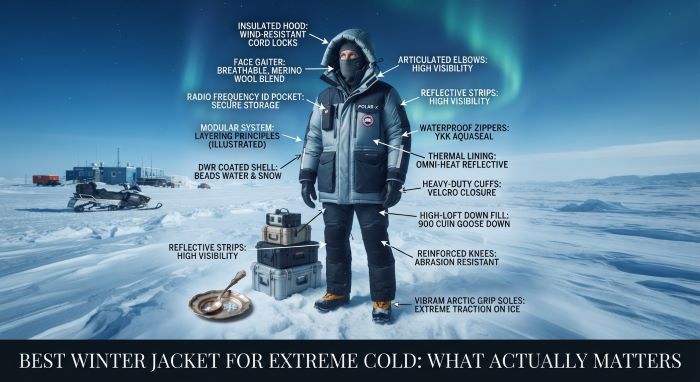
Several details separate the best winter jacket for extreme cold from a fashion parka.
An insulated hood with a ruff, disrupting wind across the face opening, which is functional rather than decorative, and one that adjusts and moves with your head.
Length, since parkas covering the thighs protect substantially more.
A storm flap over the zip, two-way zips, cuff closures, and a hem drawcord.
Pockets above a rucksack hipbelt if carrying a pack, and pit zips for dumping heat, since sweating in extreme cold is dangerous.
The Outer Fabric
A windproof outer is essential, since wind strips heat far faster than still air. Water resistance matters even in dry cold, since snow melts on a warm garment. Fully waterproof shells trap more moisture inside, which is why many expedition parkas use a highly water-resistant breathable fabric rather than a full membrane. Denier indicates fabric thickness, with higher being more durable and heavier.
Layering Still Applies
This point is frequently lost in the search for the best winter jacket for extreme cold. No single garment does the job alone. A base layer wicks moisture from the skin, merino or synthetic, never cotton. A mid layer insulates, and the outer shell is the parka itself.
Cotton is genuinely dangerous in extreme cold, absorbing moisture and holding it against the skin. Ventilating before you sweat matters, since damp clothing in extreme cold is a serious problem.
Fit
Fit is specific to insulated garments and frequently got wrong. The jacket must be loose enough to wear layers beneath without compressing them, since compressed insulation does not insulate, but not so loose that large volumes of air circulate. Try it on wearing what you would actually wear underneath, and check arm movement by raising your arms fully.
Ethical Considerations
Down sourcing has attracted scrutiny regarding live-plucking and force-feeding. Certification schemes covering animal welfare exist, and reputable manufacturers publish which standard they follow. Anyone concerned can look for those or choose synthetic insulation, which avoids the question and performs better when wet regardless.
Care and Longevity
Wash rarely and only when needed, using a detergent formulated for down. Tumble dry with dryer balls to break clumps and restore loft. Store uncompressed, since long-term compression damages fill. Repair small tears promptly, and reproof the outer periodically as the factory finish wears off.
Part of Buying for Conditions
What makes choosing a cold weather jacket difficult is that the marketing metric, fill power, is not the one determining warmth, and the one that does is frequently not published. Buying well means knowing which specification answers your actual question. The same applies at the opposite end of the range, where a garment built for packability and mild conditions has entirely different priorities. A guide like Lightweight Packable Puffer Jacket covers that case, where compressibility and weight matter more than absolute warmth, and comparing the two clarifies what you are actually buying in each.
The bottom line on the best winter jacket for extreme cold is that fill power measures down quality per ounce while fill weight determines how much insulation is actually present, and you need both figures to judge a garment. Box baffle construction outperforms sewn-through, which creates cold spots at every seam. Temperature ratings have no universal standard and should be treated as rough guidance. Look for an insulated adjustable hood with a ruff, storm flap, two-way zip, cuff closures, and adequate length. And remember that no jacket replaces layering, planning, or knowing the signs of hypothermia and frostbite.
Key Takeaways
- Extreme cold is genuinely dangerous, and hypothermia and frostbite require immediate medical attention.
- Confusion is a serious hypothermia sign, since the affected person may not recognize their condition.
- Down offers the best warmth-to-weight ratio but loses almost all value when wet.
- Synthetic insulation retains warmth when damp and dries faster, at more weight and bulk.
- Fill power measures down quality per ounce, not how much down is in the garment.
- Fill weight determines actual warmth and is frequently omitted from product listings.
- Box baffle construction avoids the cold spots created by sewn-through seams.
- Temperature ratings have no universal standard and are not comparable between brands.
- An insulated hood with a ruff disrupts wind across the face and is functional rather than decorative.
- Storm flaps, two-way zips, cuff closures, and hem drawcords all matter in serious cold.
- No jacket works alone, and cotton base layers are genuinely dangerous when damp.
- Buy loose enough to layer beneath without compressing the insulation.