Best Flea Treatments for Cats: A Safety-First Guide
Before anything else about products, one fact deserves to come first, because it kills cats every year and almost always by accident. Dog flea treatments containing permethrin are potentially lethal to cats, even in tiny amounts, and cats can be poisoned simply by rubbing against a recently treated dog. Everything else in this guide matters less than that. Here is what is safe and what is not.
The Critical Warning First
Never use a dog flea product on a cat.
Many dog spot-on treatments contain permethrin, a synthetic pyrethroid that is highly toxic to cats and can be fatal.
The reason is biological. Cats lack a liver enzyme needed to break the compound down, so what a dog metabolizes safely accumulates in a cat.
Dog spot-on products contain permethrin at high concentrations, commonly cited in the region of 45 to 65 percent. Even a very small amount can make a cat seriously ill.
The most common cause of poisoning is an owner applying a dog product to a cat, frequently assuming a smaller dose will be safe. It is not.
Cats can also be poisoned indirectly, by grooming or rubbing against a dog recently treated, or by contacting treated furniture. Products can take up to 24 hours to dry.
If you have both species, International Cat Care advises either choosing a permethrin-free product for the dog or keeping the animals apart for 72 hours after treatment.
Signs of Permethrin Poisoning
If you suspect exposure, contact a vet immediately. This is an emergency.
Signs include:
- Tremors and muscle twitching.
- Seizures.
- Drooling.
- Vomiting.
- Agitation or disorientation.
- Difficulty breathing, less commonly.
- Blindness, in some cases.
Onset is typically minutes to hours after exposure, though it can be delayed up to 72 hours, and symptoms may last two to three days.
Untreated, this can progress to seizures and death within hours.
Take the product and its packaging to the vet. Cases caught and treated early generally have a good outlook, while severely affected cats, particularly those with hard-to-control seizures, have a poorer prognosis.
Pyrethrin Versus Permethrin
The names are similar and the distinction matters.
Pyrethrin is the naturally occurring compound extracted from chrysanthemum flowers. Used correctly and at appropriate concentrations, it can be safe for cats, and it appears in some cat-labelled products.
Permethrin is the synthetic, more potent version. It should never be used on cats.
Because the names are so close, reading labels carefully is essential, and anyone uncertain should ask a vet or pharmacist rather than guessing.
Why Fleas Matter
Fleas are not merely an irritation, which is worth stating when weighing the best flea treatments for cats.
Flea allergy dermatitis is a hypersensitivity to flea saliva causing intense itching, hair loss, and skin damage from a small number of bites.
Anaemia is a genuine risk, particularly in kittens, elderly cats, and small or unwell animals, since fleas feed on blood and heavy infestations can remove a dangerous volume.
Tapeworm transmission occurs when a cat swallows an infected flea while grooming.
Secondary skin infections develop from scratching and broken skin.
Heavy infestations in kittens can be life-threatening, and any kitten with visible fleas should be seen by a vet rather than treated with an over-the-counter product.
The Flea Life Cycle
Understanding this explains why even the best flea treatments for cats fail when used alone.
Only a small proportion of a flea population lives on the animal. The great majority exists in the environment as eggs, larvae, and pupae, in carpets, bedding, floorboard gaps, and furniture.
Eggs fall off the cat and scatter through the home.
Larvae hatch and move away from light, burrowing into carpet and crevices.
Pupae are the resilient stage, protected in a cocoon and capable of remaining dormant for extended periods, resistant to many insecticides.
Adults emerge and jump onto a host.
That structure is why an infestation appears to come back after treatment. Adults on the cat are killed, then a new wave emerges from pupae already in the carpet.
Effective control means treating both the animal and the environment, and continuing for long enough to break the cycle.
Categories of Cat Flea Treatment
The best flea treatments for cats fall into several categories, each with different characteristics:
| Type | How it works | Notes |
|---|---|---|
| Spot-on | Applied to skin at the back of the neck | Most common, monthly typically |
| Oral tablet | Given by mouth | Fast-acting options available |
| Collar | Worn continuously | Long duration, fit matters |
| Shampoo | Bathed in | Immediate kill, no residual |
| Spray | Applied to coat | Whole-body coverage |
| Injection | Administered by vet | Long-acting, vet only |
Spot-ons are the most widely used, applied to skin between the shoulder blades where the cat cannot lick it off.
Oral products avoid residue on the coat, which matters in multi-pet households and homes with young children.
Collars provide extended protection but must fit correctly, with a safety release mechanism, and are not suitable for every cat.
Shampoos kill fleas present at the time but offer little ongoing protection.
Active Ingredients Used in Cat Products
Rather than naming brands, it is more useful to know the actives behind the best flea treatments for cats, since products are reformulated and rebranded regularly.
Ingredients appearing in cat-labelled products include fipronil, imidacloprid, selamectin, fluralaner, spinosad, nitenpyram, dinotefuran, and sarolaner, among others.
Insect growth regulators including (S)-methoprene, pyriproxyfen, and lufenuron work differently, preventing eggs and larvae from developing rather than killing adults. Many products combine an adulticide with an IGR, which addresses both the fleas on the cat and the next generation.
Nitenpyram is notable for very rapid action against adult fleas but has essentially no residual effect, so it is used alongside a longer-acting product rather than instead of one.
Which is appropriate depends on your cat’s age, weight, health, other medications, lifestyle, and what parasites are a concern locally. That decision belongs with a vet.
Why Ask a Vet Rather Than Guessing
This is the honest answer to the best flea treatments for cats question, and it is not a dodge.
Prescription products are frequently more effective and are only available through a vet.
Resistance varies regionally, and a vet knows what is working locally.
Weight and age restrictions apply to every product and getting them wrong is dangerous.
Existing conditions and medications affect what is safe, particularly for cats with kidney or liver disease, epilepsy, or on other treatments.
Kittens, pregnant or nursing cats, elderly cats, and unwell cats all need specific guidance rather than a general recommendation.
Correct diagnosis matters. Itching and hair loss have causes other than fleas, and treating for the wrong thing wastes time while the real problem continues.
Many practices will advise by phone or during a routine appointment, and the cost is generally modest relative to getting it wrong.
What to Avoid
Several things marketed among the best flea treatments for cats cause genuine harm.
Dog products, categorically. Covered above, and the single most important point.
Splitting a dog dose. A smaller amount of permethrin is still dangerous, and this is a common and dangerous mistake.
Essential oils. Tea tree, pennyroyal, and various others are toxic to cats, which are particularly sensitive to many plant compounds. Products marketed as natural are not automatically safe, and several are actively harmful.
Garlic and brewer’s yeast. Both circulate as folk remedies. Garlic in particular is toxic to cats.
Old or expired products, and anything left over from a previous pet without checking suitability.
Multiple products simultaneously without veterinary advice, since actives can interact.
Treating only the cat while ignoring the environment, which reliably produces reinfestation.
Ignoring other pets. Every animal in the household needs treating, with species-appropriate products.
Treating the Environment
Because most of the flea population is off the animal, this is half of what the best flea treatments for cats need to achieve.
Vacuum thoroughly and frequently, including carpets, upholstery, skirting boards, and under furniture. Vibration also encourages pupae to emerge, which makes them vulnerable to treatment.
Empty the vacuum outside immediately after use.
Wash bedding at the hottest temperature the fabric allows, both the cat’s and any human bedding the cat uses.
Treat the home with a product suitable for the purpose, following instructions precisely and keeping pets away as directed. Some household sprays contain permethrin, so check labels with the same care.
Be patient. Because pupae can persist, a full clearance frequently takes weeks, and continuing treatment through that period matters.
Do not neglect the car if your cat travels in it, or outbuildings if they have access.
Kittens Specifically
Worth its own section because the stakes are higher.
Most flea products carry minimum age and weight restrictions, and many are not licensed for very young kittens.
Heavy flea burdens in kittens can cause life-threatening anaemia, so an infestation is a genuine medical concern rather than a nuisance.
Do not use adult products on kittens below the stated threshold.
See a vet for any kitten with fleas. They can advise on age-appropriate treatment and check for anaemia and tapeworm.
Physical removal with a flea comb and warm soapy water is sometimes recommended for very young kittens while awaiting veterinary advice, but this should be confirmed with a vet rather than assumed.
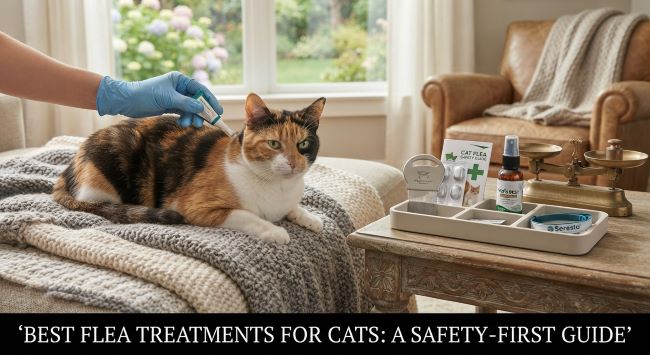
Applying Spot-Ons Correctly
Application errors undermine even the best flea treatments for cats.
Part the fur and apply directly to the skin, not onto the coat.
Apply at the base of the skull or between the shoulder blades, where the cat cannot reach to lick.
Use the whole dose in one spot unless the instructions say otherwise.
Do not bathe the cat immediately before or after, and check the product’s guidance on water exposure.
Separate cats that groom each other until the product has dried.
Wash your hands afterward.
Watch for reactions, including excessive salivation, agitation, or skin irritation at the site, and contact a vet if they occur.
Checking Whether Your Cat Has Fleas
Useful before treating, since itching has other causes.
Flea combing over a white surface reveals adult fleas and flea dirt.
Flea dirt is digested blood and looks like black specks. Placed on damp white tissue, it dissolves into a reddish-brown stain, which distinguishes it from ordinary dirt.
Common sites include the base of the tail, the neck, and the belly.
Absence of visible fleas does not rule them out, particularly in cats that groom heavily and swallow the evidence.
If you find flea dirt but no fleas, treat anyway, since the dirt confirms their presence.
Year-Round Versus Seasonal
A brief practical note on timing.
Fleas were historically seasonal, but centrally heated homes allow them to complete their life cycle year-round in many climates.
Most veterinary guidance now recommends continuous year-round prevention rather than treating only in warmer months, particularly for indoor-outdoor cats.
Indoor-only cats are not immune, since fleas arrive on other pets, on clothing, and from neighbouring properties.
Your vet can advise what is appropriate for your climate and your cat’s lifestyle.
The bottom line on the best flea treatments for cats is that no product recommendation matters more than the warning against dog products, since permethrin in dog spot-ons is highly toxic to cats, potentially fatal in small amounts, and transferable simply by contact with a recently treated dog. Cat-safe options span spot-ons, orals, collars, and sprays using actives including fipronil, imidacloprid, selamectin, fluralaner, and spinosad, frequently combined with an insect growth regulator. Because most of a flea population lives in the home rather than on the cat, treating the environment is half the job. Ask your vet which product suits your cat’s age, weight, health, and lifestyle, and see a vet urgently for any kitten with fleas or any suspected permethrin exposure.
Key Takeaways
- Never use a dog flea product on a cat, since permethrin in dog spot-ons can be fatal.
- Cats lack the liver enzyme needed to break permethrin down, unlike dogs.
- Dog spot-ons contain permethrin at high concentrations and even small amounts are dangerous.
- Cats can be poisoned indirectly by contact with a recently treated dog or treated furniture.
- If treating a dog with permethrin, keep it apart from cats for 72 hours.
- Signs of poisoning include tremors, seizures, drooling, and vomiting, and require emergency care.
- Pyrethrin from chrysanthemums differs from synthetic permethrin, though the names are similar.
- Only a small proportion of a flea population lives on the cat, with the rest in the home.
- Pupae are resistant and can remain dormant, which is why infestations appear to return.
- Cat-safe actives include fipronil, imidacloprid, selamectin, fluralaner, spinosad, and nitenpyram.
- Insect growth regulators such as methoprene and pyriproxyfen prevent eggs and larvae developing.
- Essential oils including tea tree and pennyroyal are toxic to cats despite natural marketing.
- Heavy flea burdens can cause life-threatening anaemia in kittens, so see a vet.
- Ask your vet which product suits your cat’s age, weight, health, and other medications.