What Your Dashcam Footage Does in a Crash Case
Most drivers think of a dashcam as a shield. It’s a record, and a record cuts both ways. The same little box that clears you when someone runs a red light will also catch you rolling a stop sign, muttering something you’d rather no one hear, or drifting three feet over the line before the other car showed up in frame.
Trouble starts in the gap between what drivers believe their footage does and what it does. Here’s what dashcam video is doing for you, and to you, before your camera becomes a witness in the room.
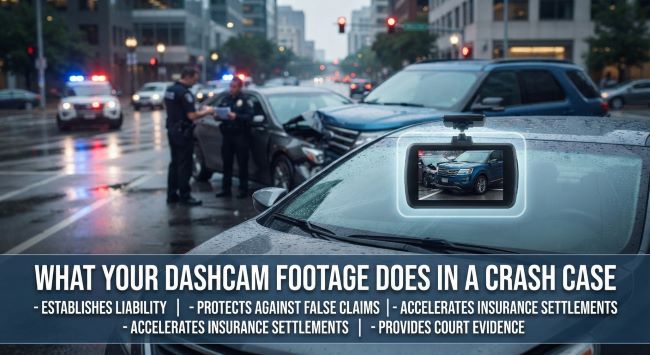
Video Is Not Automatically Better Than a Witness
Trusting video over memory is a reasonable instinct. Human recall is famously unreliable, and the Innocence Project has documented that mistaken eyewitness identification played a role in about 75% of wrongful convictions later overturned by DNA evidence. A camera doesn’t get nervous, doesn’t misremember the color of a jacket, doesn’t fill in gaps to please a prosecutor.
Footage still needs interpretation. A 1080p clip from a fisheye lens compresses distance and warps speed. Low light turns brake lights into halos, and audio without context can make an ordinary exchange sound aggressive.
The camera captures something real. What it captures and what happened are two different things.
Your Own Footage Can Be Used Against You
A dashcam doesn’t only help its owner. Once a file exists, it’s evidence, and evidence follows the case wherever the case goes. Opposing counsel can subpoena it. An insurer can require it as a condition of the claim.
If the file disappears after a crash, the disappearance itself becomes the story, and a jury may be told to assume the missing clip would have hurt you. A short list of what your own camera can hand to the other side:
- Your speed. GPS metadata often logs it to the second, even when you were sure you were doing the limit.
- Your following distance. A wide-angle lens flatters the gap that a frame-by-frame review will happily shrink.
- Your words. A frustrated comment about the other driver, captured on the same file that shows the impact, reads differently in a deposition than it did in the moment.
- Your habits. A camera that records the whole trip also shows the rolling stops, the phone glance, and the unsignaled lane change three blocks earlier.
Audio Recording Is Not Legal Everywhere
Video in public is broadly permissible. Audio is the trap. Some jurisdictions only require one party to a conversation to consent to a recording; others require every party.
A cross-country road trip can move you through both in an afternoon, and the mic on your dashcam doesn’t know the difference. The Reporters Committee maintains a state-by-state primer worth a look before you leave the audio switch on by default.
The practical move: know the rule where you live, know it changes at the state line, and ask whether the audio track is doing enough work to justify the risk. Most claims are made or broken by the video.
Footage Does Not Walk Itself Into Court
Handing a memory card to an adjuster and expecting it to end the argument is optimistic. To be treated as evidence, footage generally has to be authenticated, shown to be unaltered, and tied to a chain of custody with metadata that lines up with the police report. Trim the boring parts and you may have compromised its admissibility.
Preserve the original file. Note the camera model and the timestamps. Don’t send a compressed copy to a group chat before anyone official has seen it. The version that helps you is the untouched one, and it’s easier to lose than people expect.
You Can’t Un-Share What the Camera Already Saw
Once footage leaves your device, it exists in places you no longer control. A clip uploaded to social media before you understood what it showed is now discoverable by anyone who cares to look. A file sent to your insurer becomes part of their file. A video texted to a friend can be forwarded, screenshotted, and pulled into a case you didn’t know was coming.
If the crash was anything more than a scraped bumper, the sequence matters: preserve, then consult, then share. A conversation with an experienced personal injury firm before the footage goes anywhere is usually less expensive than trying to walk it back after it’s public. The camera saw what it saw. But what happens next is still yours to decide.