Best Arroz con Gandules Near Me: Puerto Rico’s National Rice
The best part is scraped off the bottom of the pot. Pegao is the crisp golden layer of rice stuck to the base, and Puerto Rican households genuinely negotiate over who gets it. A dish where the burnt bit is the prize tells you something about how it is cooked, and about how seriously people take getting it right. Here is the guide.
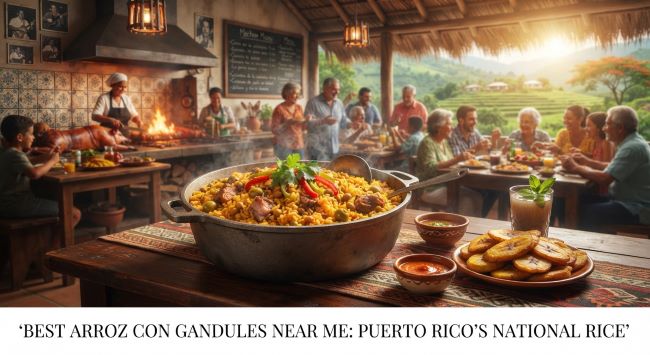
What It Is
Arroz con gandules is Puerto Rico’s national rice dish, combining rice with pigeon peas. The best arroz con gandules near me is built from:
- Rice, medium or short grain.
- Gandules, pigeon peas, fresh, frozen, or tinned.
- Sofrito, the aromatic base that defines Puerto Rican cooking.
- Achiote or annatto, giving the characteristic orange colour.
- Pork, typically salt pork, bacon, or ham.
- Sazón, the seasoning blend.
- Olives and capers, in many versions.
- Culantro and cilantro.
It is cooked in a single pot, traditionally a caldero, a heavy aluminium pot that conducts heat evenly and helps produce the crust.
Sofrito Is the Foundation
Understanding sofrito is essential to the best arroz con gandules near me search, since it flavours the entire dish.
Puerto Rican sofrito is a blended raw aromatic base, typically containing onion, garlic, ají dulce peppers, bell pepper, culantro (recao), and cilantro.
Two elements distinguish it from Spanish or Cuban sofrito. Ají dulce are small sweet peppers with aroma but no heat, and culantro is a long-leafed herb with a stronger, more pungent flavour than cilantro.
Both are genuinely difficult to substitute. A sofrito made without them produces something recognizably different, which is why versions made outside Puerto Rican communities sometimes taste subtly off.
Most households make sofrito in batches and freeze it, and a good restaurant will make its own.
Pegao
The crust on the best arroz con gandules near me deserves its own section, since it is what people care about most.
Pegao, from pegado meaning stuck, is the layer of rice that crisps against the bottom of the caldero during cooking.
It is golden, crunchy, and concentrated in flavour, and it is genuinely prized rather than tolerated. Families argue over it.
Producing it requires the right pot, correct liquid ratio, and heat management at the end of cooking. Too little heat and no crust forms. Too much and it burns rather than crisping.
Asking for pegao is entirely normal at a Puerto Rican restaurant, and establishments that produce good pegao are demonstrating genuine technique.
A version cooked in a rice cooker will not have it, which is one honest limitation of convenience methods.
The Christmas Association
The best arroz con gandules near me is central to Puerto Rican Navidad, appearing alongside pernil and pasteles on the holiday table. The Puerto Rican Christmas season runs from late November into January with Three Kings Day and the octavitas following. Availability increases noticeably then, though it is everyday food as well as holiday food.
Where to Find It
The best arroz con gandules near me search runs through:
Puerto Rican restaurants, the clear first choice.
Puerto Rican cafeterias and food trucks, which serve it as a standard side.
Caribbean and Latin American restaurants with Puerto Rican menus.
Puerto Rican cultural events and festivals.
Around the Christmas season, when it appears most widely.
It is usually served as an accompaniment rather than alone, so it appears on plates alongside a protein rather than as its own menu entry.
How to Judge Quality
Evaluating the best arroz con gandules near me comes down to grain and seasoning:
| Element | Done right | Warning sign |
|---|---|---|
| Rice grains | Separate, tender, distinct | Mushy, clumped, or hard |
| Colour | Even orange from achiote | Pale or artificially bright |
| Sofrito depth | Layered, aromatic | Flat or one-note |
| Gandules | Tender, distributed evenly | Hard or sparse |
| Pegao | Present, golden, crisp | Absent or burnt black |
| Seasoning | Well salted, savoury | Bland |
Grain separation is the primary technical test. Properly cooked, each grain is distinct rather than clumped, which requires correct liquid ratio and not stirring during cooking.
Sofrito depth distinguishes a serious kitchen. Rice flavoured with a proper house-made sofrito tastes noticeably more complex than one relying on packet seasoning.
Pegao presence indicates a caldero and proper heat management.
How It Is Served
The best arroz con gandules near me typically appears:
- As a side alongside a main protein.
- With pernil, roast pork shoulder, the classic pairing.
- With pollo guisado, stewed chicken.
- With tostones or maduros, fried plantain.
- At holiday tables, with pasteles.
- In generous portions, since it is a staple rather than a garnish.
The pernil pairing is the one to seek out, since the two dishes are traditionally served together and complement each other directly.
Making It Well
Use a heavy pot, ideally a caldero, since thin pans burn rather than crisping. Make or buy real sofrito rather than generic aromatics. Do not stir once liquid is absorbed, since stirring breaks grains and prevents pegao. Get the liquid ratio right, the most common source of failure, and finish covered over low heat.
Part of the Puerto Rican Table
What makes arroz con gandules central to Puerto Rican cooking is that it demonstrates the whole seasoning philosophy in one pot, with sofrito, achiote, and cured pork doing work that no single ingredient could. Latin American cooking is full of preparations where a base flavouring defines everything built on it. Something like Best Humintas Near Me shows the Andean version of a staple treated with equal seriousness, where fresh corn wrapped in its own husk needs no seasoning system at all, and the contrast illustrates two entirely different routes to a defining regional dish.
The bottom line on the best arroz con gandules near me search is that Puerto Rico’s national rice dish combines rice and pigeon peas with sofrito, achiote for colour, cured pork, and frequently olives and capers, cooked in a single heavy caldero. Sofrito containing ají dulce and culantro is what makes it taste specifically Puerto Rican, and pegao, the crisp golden crust on the bottom of the pot, is genuinely prized rather than a mistake. Look for Puerto Rican restaurants and cafeterias, ask for pegao, and judge it on separate tender grains and genuine sofrito depth.
Key Takeaways
- Arroz con gandules is Puerto Rico’s national dish, combining rice with pigeon peas.
- Sofrito is the aromatic foundation, containing onion, garlic, ají dulce, culantro, and cilantro.
- Ají dulce are sweet peppers with aroma but no heat, and culantro is more pungent than cilantro.
- Both are difficult to substitute, which is why versions made without them taste subtly different.
- Achiote or annatto provides the characteristic orange colour.
- It is traditionally cooked in a caldero, a heavy aluminium pot that conducts heat evenly.
- Pegao is the crisp golden crust on the pot bottom, genuinely prized rather than tolerated.
- Asking for pegao at a Puerto Rican restaurant is entirely normal.
- Rice cookers do not produce pegao, which is a real limitation of convenience methods.
- The dish is central to Puerto Rican Navidad, served with pernil and pasteles.
- Grain separation requires correct liquid ratio and not stirring once liquid is absorbed.
- Roast pork shoulder, or pernil, is the classic pairing.