Best Medialuna Dulce Near Me: Argentina’s Sweet Crescent
Order a medialuna in Buenos Aires and the person behind the counter asks one question: dulce or salada. It is not a minor preference. The two use different fats, taste different, and belong to different moments of the day. The dulce is the sweet one, glazed sticky with syrup. If you are searching for the best medialuna dulce near me, here is what separates a good one from a disappointment.
What a Medialuna Dulce Is
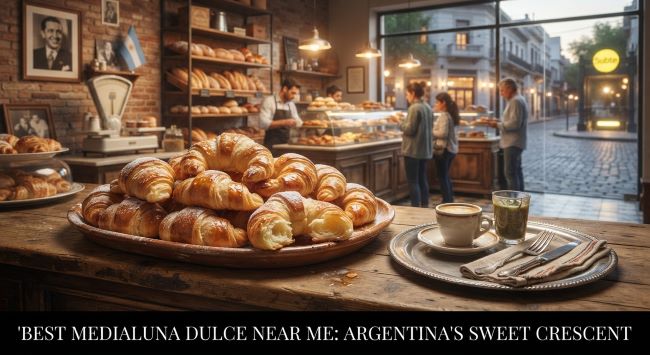
Medialuna means half moon, describing the crescent shape. The best medialuna dulce near me is characterized by being:
- Crescent-shaped, curved and compact rather than long and straight.
- Made with butter, which is the defining feature of the dulce version.
- Sweeter in the dough than its savory counterpart.
- Glazed with almíbar, a sugar syrup brushed on after baking, giving a glossy sticky finish.
- Small, typically eaten two or three at a time.
- Soft and slightly dense rather than airy and shattering.
The best medialuna dulce near me is the most popular factura in Argentina and the default breakfast pastry nationwide.
Dulce Versus Salada
This distinction is the most useful thing to understand in the best medialuna dulce near me search, because ordering the wrong one is a common visitor mistake.
| Feature | Medialuna dulce | Medialuna salada |
|---|---|---|
| Fat used | Butter | Lard or grasa |
| Sweetness | Noticeably sweet | Barely sweet |
| Glaze | Syrup, glossy and sticky | Little or none |
| Texture | Softer, denser | Flakier, more layered |
| Shape | Tightly curved, compact | Often larger, more open |
| Typical use | Breakfast, merienda, with coffee | Often split and filled as a sandwich |
The salada is closer to a French croissant in flavor and is frequently sliced open and filled with ham and cheese, at which point it becomes a common Argentine lunch item.
The dulce is the sweet, glazed, breakfast version, and it is the more popular of the two by a considerable margin.
If you order simply a medialuna, many places will give you dulce by default, but asking is worthwhile.
It Is Not a Croissant
Visitors expecting a French croissant are often disappointed for the wrong reasons. A medialuna dulce is smaller, denser, sweeter, and less flaky, and does not shatter into shards when bitten. That is not a failure of technique but a different pastry, developed in Argentina from Austrian and French influences arriving through European immigration and adapted toward Argentine tastes. The correct question is whether it is a good medialuna: tender, well-glazed, fresh, and sweet without being cloying.
Where to Find Them
The best medialuna dulce near me search runs through:
Argentine bakeries and panaderías, where they are made fresh daily and are usually the best option.
Argentine cafés, where café con medialunas is a standard order.
Uruguayan bakeries, since the tradition is shared.
Latin American bakeries in areas with Southern Cone communities.
Freshness matters enormously, and morning is when they are at their best. Many bakeries produce a second batch for the afternoon.
How to Judge Quality
Evaluating the best medialuna dulce near me comes down to a few clear tests:
| Element | Done right | Warning sign |
|---|---|---|
| Freshness | Soft, made that day | Dry, hard, or stale |
| Glaze | Glossy, lightly sticky | Absent, dull, or crusted sugar |
| Interior | Tender, slightly layered | Dense, bready, or gummy |
| Butter flavor | Present and clear | Flat or greasy |
| Sweetness | Noticeable but balanced | Cloying or barely there |
Freshness is the primary test. Medialunas go from excellent to disappointing within a day, becoming dry and hard. A bakery with high turnover is worth more than a famous name selling yesterday’s stock.
The glaze should give a light shine and slight stickiness without being a thick sugar crust. Missing glaze suggests either a salada served by mistake or a bakery cutting corners.
Butter flavor should be detectable. A dulce made with margarine or insufficient butter tastes noticeably flatter, and this is a common shortcut.
Café con Medialunas
The best medialuna dulce near me is rarely eaten alone. Café con medialunas is a genuine Argentine institution: coffee with two or three medialunas at breakfast or during the afternoon merienda, offered as a set combination in cafés across the country. The pairing works because coffee cuts the syrup glaze, and a medialuna eaten without something bitter can feel one-dimensional. Mate is equally traditional.
How Many to Order
Medialunas are small, and two or three is a normal serving. Bakeries sell them individually or by the dozen, and buying a dozen for a household or office is standard, since they are inexpensive everyday food. They do not keep well, so buying more than you will eat that day is a mistake.
Part of the Argentine Bakery Tradition
The medialuna dulce sits within the broader world of Argentine facturas, the category of syrup-glazed bakery pastries that also includes filled varieties like bolas de fraile and cañoncitos, many carrying names inherited from nineteenth-century labor politics. Understanding that wider category explains why medialunas are sold and eaten the way they are. In a similar vein, a substantial regional dish like Best Fabada Bean Stew Near Me shows the Spanish side of the immigrant heritage that shaped Argentine food, and the two together illustrate how thoroughly European traditions were absorbed and then reshaped into something recognizably Argentine.
The bottom line on the best medialuna dulce near me search is that this is Argentina’s sweet crescent pastry, made with butter, glazed with sugar syrup for a glossy sticky finish, and distinct from the lard-based salada that is barely sweet and often filled as a sandwich. It is smaller, denser, and sweeter than a French croissant by design rather than by failure. Find an Argentine panadería, buy them fresh in the morning, judge them on softness, clear butter flavor, and a light glossy glaze rather than a sugar crust, and order coffee alongside.
Key Takeaways
- Medialuna means half moon, describing the crescent shape of Argentina’s most popular pastry.
- The dulce version is made with butter, sweetened, and glazed with almíbar sugar syrup.
- The salada version uses lard, is barely sweet, flakier, and is often split and filled with ham and cheese.
- Ordering simply a medialuna often defaults to dulce, but asking which you want is worthwhile.
- It is smaller, denser, and sweeter than a French croissant, which is intentional rather than a flaw.
- The style developed in Argentina from Austrian and French influences arriving via European immigration.
- Find them at Argentine and Uruguayan panaderías and cafés, freshest in the morning.
- Freshness is decisive, since medialunas become dry and hard within a day.
- The glaze should be lightly glossy and sticky rather than a thick sugar crust, and butter flavor should be clear.
- Café con medialunas is a national institution, and the coffee’s bitterness balances the syrup glaze.